





























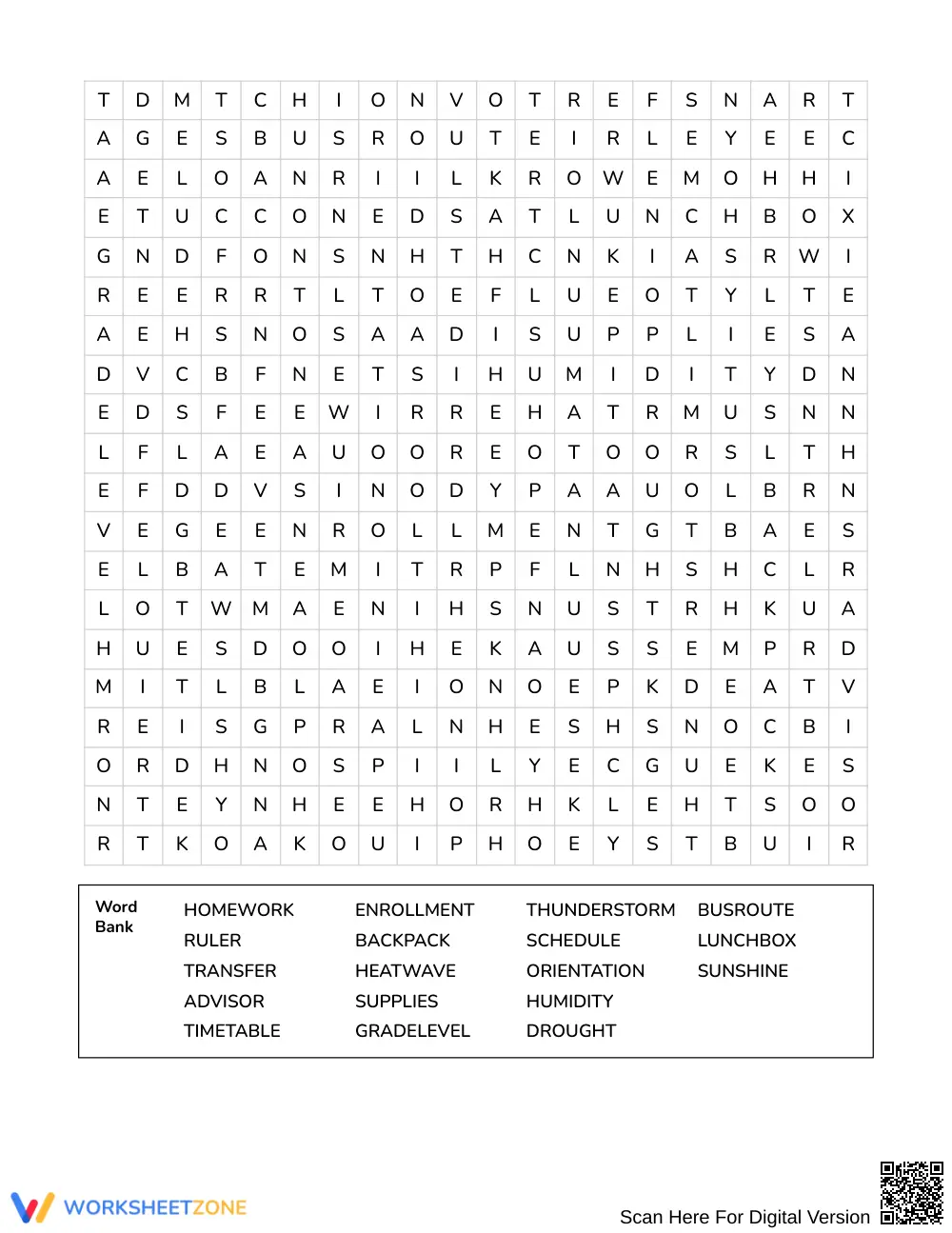


Printable School Transition Word Search | Grades 7–8 ELA

Paste this activity's link or code into your existing LMS (Google Classroom, Canvas, Teams, Schoology, Moodle, etc.).
Students can open and work on the activity right away, with no student login required.
You'll still be able to track student progress and results from your teacher account.
This August school transition word search equips middle school students to master essential back-to-school concepts and academic vocabulary. Featuring 18 foundational terms connected to scheduling, logistics, and late-summer routines, the activity reinforces contextual understanding through clear definitions while welcoming learners into the new academic year with an accessible, low-stress opening routine.
At a Glance
- Grade: Grades 7–8 · Subject: English Language Arts (ELA)
- Standard: Not standards-assessed — contextual vocabulary enrichment
- Skill Focus: Planning the transition to school and seasonal academic routines
- Format: 3 pages · 18 words · Answer key included · PDF
- Best For: First-week homeroom, ELA advisory, or seasonal warm-up
- Time: 20–30 minutes
The 3-page printable set includes a comprehensive puzzle sheet alongside an organized 3-page solution reference. Students encounter an 18-word list paired with full explanatory clues defining terms like orientation, timetable, advisor, and bus route alongside seasonal concepts such as humidity and heatwave. Rather than merely scanning for letter patterns, students engage with functional definitions that unpack school operations and seasonal context, supported by a full answer key displaying exact letter coordinates.
The word search is built around a challenging 20 x 20 letter grid designed to engage middle school learners. Words are hidden across all eight compass directions: north, northeast, east, southeast, south, southwest, west, and northwest, including forward, backward, and diagonal placements. A shuffled word bank pairs each target term with a descriptive clue, requiring students to associate meaning with vocabulary before locating the letter strings.
This activity serves as contextual vocabulary enrichment and is not aligned to a formal standard. It supports foundational literacy and school readiness by introducing and reinforcing terminology vital for student autonomy during secondary school transitions, strengthening familiarity with schedules, campus navigation, and daily planning tools.
This resource functions effectively as an advisory icebreaker on the first day of school before direct instruction begins, or as an independent literacy station during the initial transition week. While students search the grid, teachers can conduct quick formative checks by asking learners to describe how terms like advisor or schedule apply to their personal school week. Expected completion time is 20 to 30 minutes.
Designed specifically for Grades 7–8 students navigating middle school expectations, this activity benefits rising seventh graders acclimating to departmental schedules as well as English learners acquiring practical school-life vocabulary. Pair this word search with a school map orientation lesson or a student planner walk-through to maximize practical impact.
Vocabulary acquisition during academic transitions directly impacts student confidence and classroom engagement. According to Fisher & Frey (2014), intentional exposure to domain-specific and organizational language helps middle grade learners build mental frameworks necessary for navigating complex learning environments. While this activity is not standards-assessed and focuses on vocabulary enrichment, practicing words related to planning the transition to school grounds students in essential logistical and seasonal concepts. By pairing 18 target vocabulary terms with operational definitions—spanning daily school tools like timetables and advisors alongside late-summer environmental terms like heatwaves—the puzzle bridges informal conversation and formal school readiness. Integrating definitional clues alongside spatial puzzle solving reinforces word recognition, semantic memory, and reading stamina. Teachers can deploy this low-stakes vocabulary exercise during the opening days of the term to foster independent task commitment while establishing shared academic vocabulary across Grades 7–8 classrooms.


