




























Views
Downloads
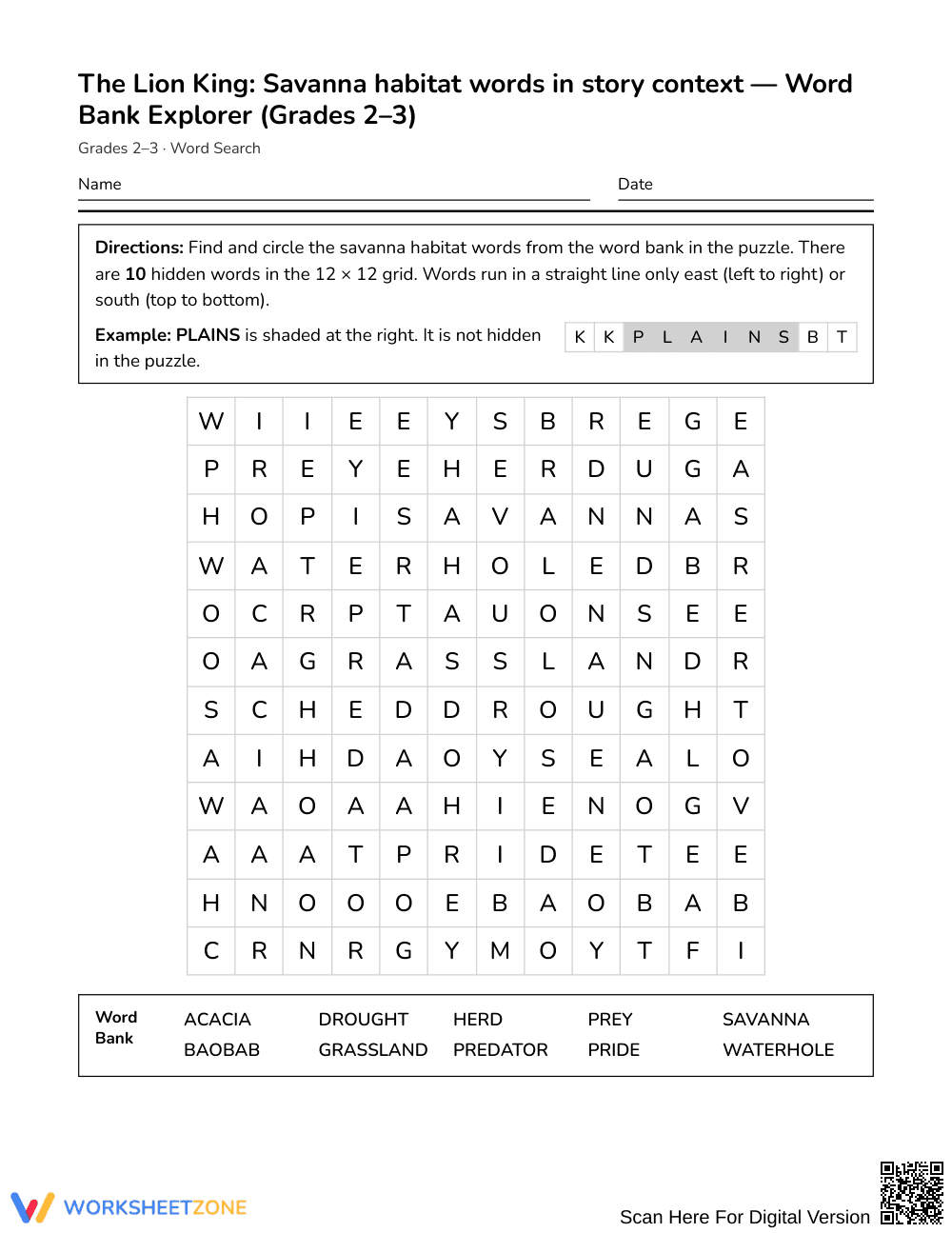

Printable Savanna Habitat Word Search | Grades 2–3 Science

Paste this activity's link or code into your existing LMS (Google Classroom, Canvas, Teams, Schoology, Moodle, etc.).
Students can open and work on the activity right away, with no student login required.
You'll still be able to track student progress and results from your teacher account.
Build foundational life science literacy with this engaging animal habitats word search designed for early elementary classrooms. Students search for key terms related to African grassland biomes while reinforcing domain-specific vocabulary connected to familiar wildlife stories. This activity strengthens spelling, visual tracking, and science reading comprehension through independent word discovery.
At a Glance
- Grade: Grades 2–3 · Subject: Science
- Standard: Not standards-assessed — vocabulary enrichment
- Skill Focus: Savanna habitat words in story context
- Format: 1 page · 10 words · Answer key included · PDF
- Best For: Science centers, bell ringers, sub plans
- Time: 15–20 minutes
What's Inside
This 1-page printable activity features a clean letter grid paired with an alphabetical word bank and student-friendly definitions. Learners search for 10 vocabulary words, including ecosystem terms like acacia, drought, predator, and waterhole. A clear two-page answer key allows for effortless verification during independent work time or fast visual checks by educators and substitutes.
Puzzle Structure and Mechanics
The activity is built specifically for early readers navigating visual search tasks:
- Grid Dimensions: A compact 12-by-12 letter grid accommodates developing visual discrimination skills without overwhelming young learners.
- Search Orientations: Hidden terms run only forward horizontally (East) and downward vertically (South), eliminating backwards diagonal frustration.
- Context Support: An alphabetical bank provides clear reference targets alongside contextual clues that reinforce each word's meaning within the African savanna ecosystem.
Standards Alignment
This resource serves as targeted vocabulary enrichment and is not aligned to a formal state standard. It provides valuable interdisciplinary exposure by connecting informational science vocabulary with narrative contexts that young learners recognize.
How to Use It
Deploy this puzzle as an introductory hook before direct instruction on grassland food chains, or assign it as an independent follow-up task after reading a savanna-themed story. For formative evaluation, observe whether students read the definition clues to confirm meanings or rely solely on letter matching. The activity comfortably fits into a 15- to 20-minute station.
Who It's For
This word search is suited for general education students in Grades 2–3, English language learners developing tier-two environmental vocabulary, and early finishers seeking productive review. Pair this sheet with a non-fiction read-aloud about African herbivores or a visual biome anchor chart to deepen comprehension.
Explicit vocabulary acquisition in early childhood life science establishes the foundational schema necessary for long-term reading comprehension across content areas. As highlighted by Fisher & Frey (2014), purposeful exposure to domain-specific terminology across engaging contexts accelerates lexical retention and strengthens conceptual understanding for elementary learners. By combining manageable visual search paths in a 12-by-12 framework with explicit biome definitions, this 10-word activity reinforces essential concepts such as predators, herds, and drought without inducing cognitive fatigue. Students actively process morphological patterns and spelling arrangements while connecting scientific terms to broader ecological narratives. This structured balance of contextual decoding and low-stakes print practice equips emerging readers in Grades 2–3 with the scientific lexicon required for subsequent inquiry-based units on biomes, food chains, and global animal habitats.


