

































Printable Sampling Methods Worksheet | Grade 12 Statistics

Paste this activity's link or code into your existing LMS (Google Classroom, Canvas, Teams, Schoology, Moodle, etc.).
Students can open and work on the activity right away, with no student login required.
You'll still be able to track student progress and results from your teacher account.
This worksheet teaches Grade 12 Statistics students to tell stratified, cluster, and systematic sampling apart, judge whether a study design fits its target population, and repair flawed plans. Students finish able to justify a sampling choice with numbers and a clear randomization procedure.
At a Glance
- Grade: 12 · Subject: Statistics
- Standard:
HSS-IC.B.3— Explain how randomization in sampling and assignment supports different kinds of conclusions- Skill Focus: Telling stratified, cluster, and systematic designs apart and repairing flawed plans
- Format: 5 pages · 12 problems · Answer key included · PDF
- Best For: Unit review, homework, or assessment prep
- Time: 40–55 minutes
What's Inside
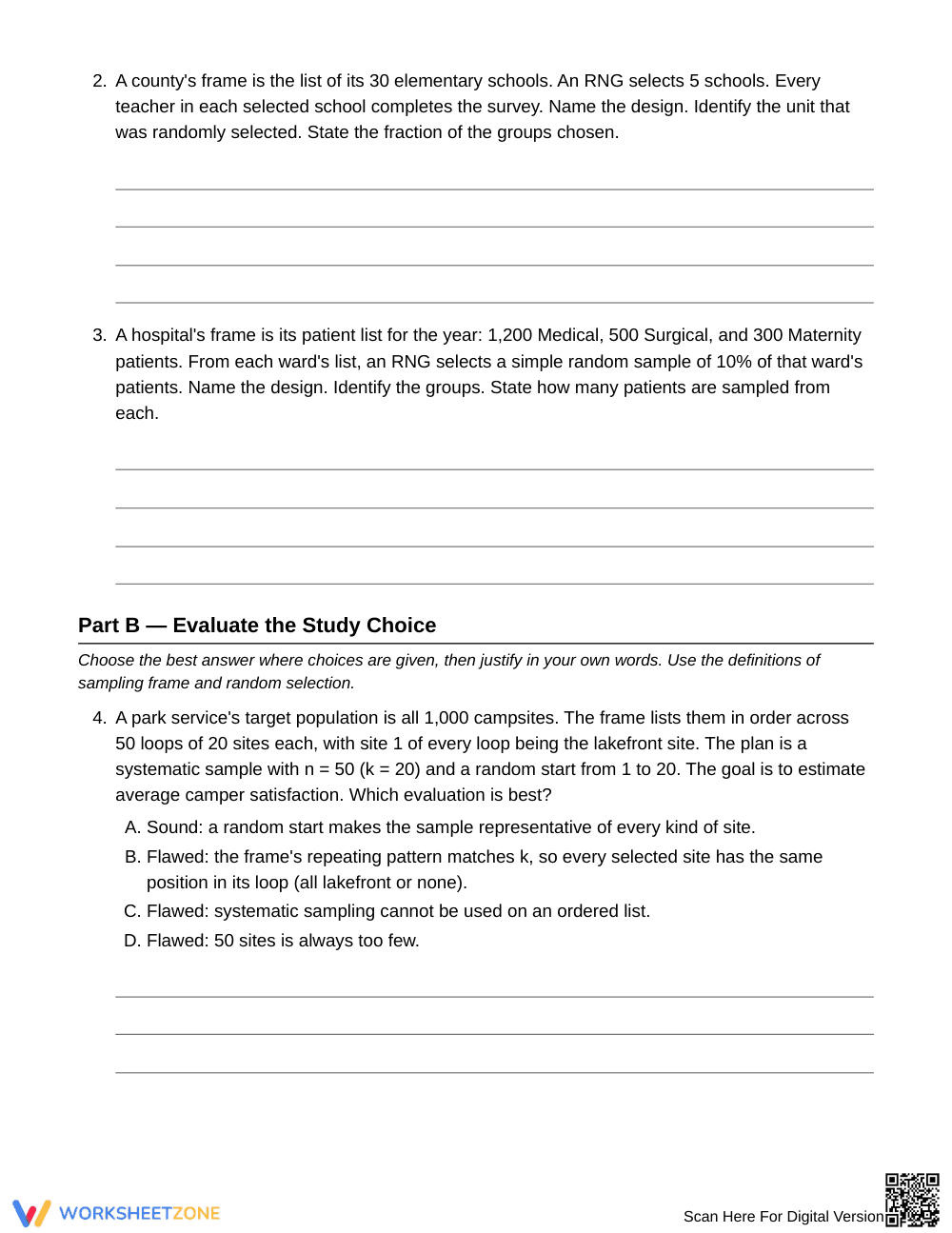
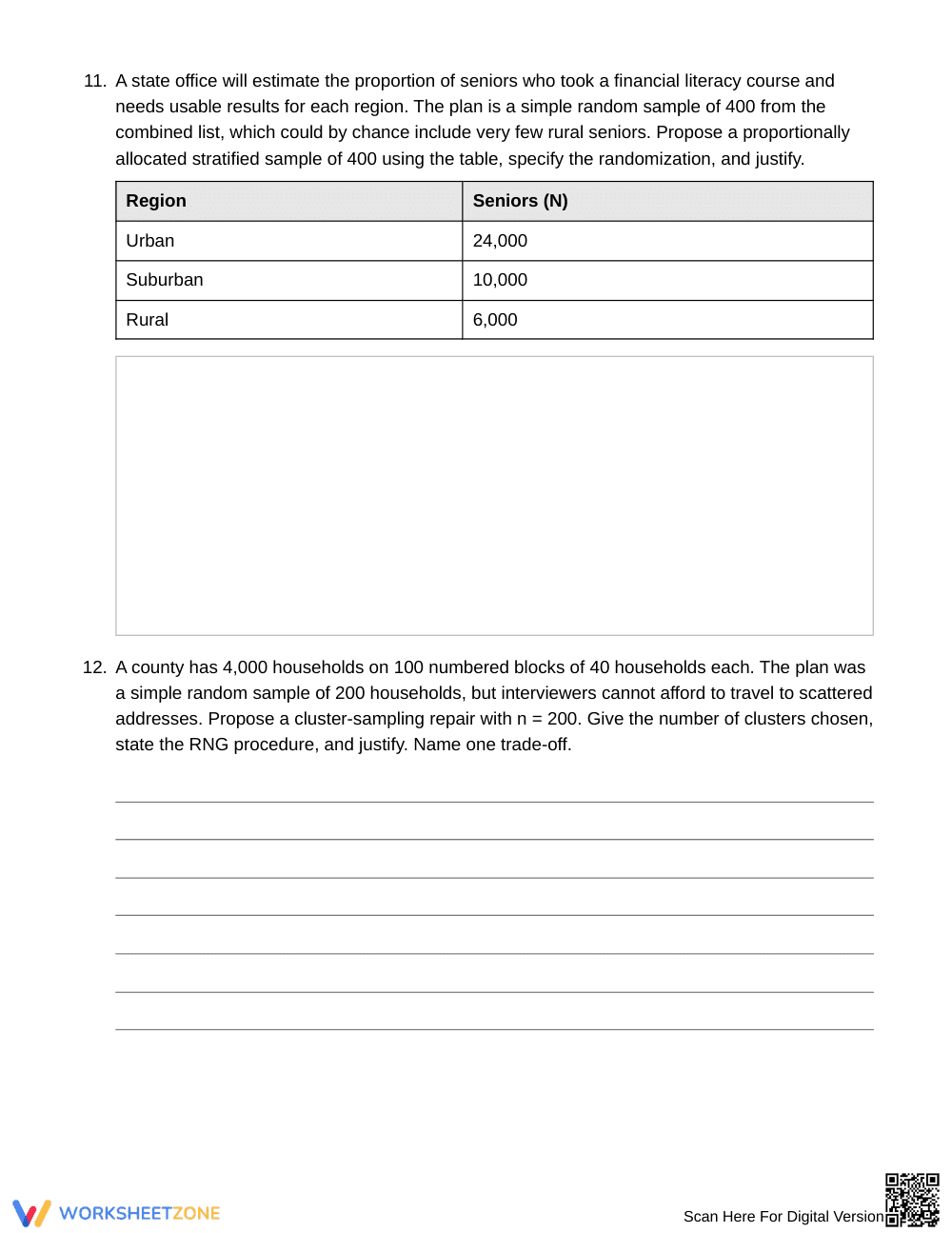
The 5-page packet opens with a reminder box defining target population, sampling frame, each design, and the difference between random sampling and random assignment. Three parts follow: identify the design, evaluate the study choice (multiple choice plus written justification), and propose a justified repair. A 3-page answer key is included.
Skill Progression
- Guided practice (Part A, 3 problems): Name the design and compute k, the first selected positions, group fractions, or sample counts, with the reminder box as support.
- Supported practice (Part B, 6 problems): Judge plans for periodic-frame patterns, undercoverage, unequal allocation, and one-cluster risk.
- Independent practice (Part C, 3 problems): Write a complete repaired plan with design, numbers, randomization, and justification.
The sequence follows gradual release: I do, we do, you do.
Standards Alignment
HSS-IC.B.3 asks students to recognize the purposes of and differences among sample surveys, experiments, and observational studies, and to explain how randomization relates to each. Problems on random sampling versus random assignment address this directly. The standard code can be copied directly into lesson plans, IEP goals, or district curriculum mapping tools.
How to Use It
- After direct instruction: Assign Parts A and B as in-class practice, then use Part C as homework.
- Before a unit test: Have students work Part C alone as a review of design reasoning.
As students work, watch whether they check the frame against the target population before judging a design. Expect 40–55 minutes in total.
Who It's For
Grade 12 Statistics and AP-style students who know the vocabulary but confuse the designs. Students needing support can lean on the reminder box, while stronger students can focus on the written justifications. It pairs well with a direct instruction lesson on bias and sampling frames.
Grade 12 Statistics students meet standard HSS-IC.B.3 when they can explain how randomization supports conclusions from samples and experiments. This worksheet, Sampling Methods & Bias, builds that skill through 12 tasks across 5 pages: students name stratified, cluster, and systematic designs, compute the interval k, proportional allocations, and cluster counts, evaluate flawed plans for undercoverage and periodic-frame problems, and write repaired designs with explicit randomization steps. It also separates random sampling, which supports generalizing to a population, from random assignment, which supports cause-and-effect claims. The three-part sequence of identify, evaluate, and repair follows the gradual-release model described by Fisher & Frey (2014), moving students from structured analysis toward independent justification. A 3-page answer key supports quick checking and error analysis by teachers. Teachers can use it for unit review, homework, or formative assessment of sampling design reasoning.


