































Printable Roman Trade Word Search | Grade 6 Social Studies

Paste this activity's link or code into your existing LMS (Google Classroom, Canvas, Teams, Schoology, Moodle, etc.).
Students can open and work on the activity right away, with no student login required.
You'll still be able to track student progress and results from your teacher account.
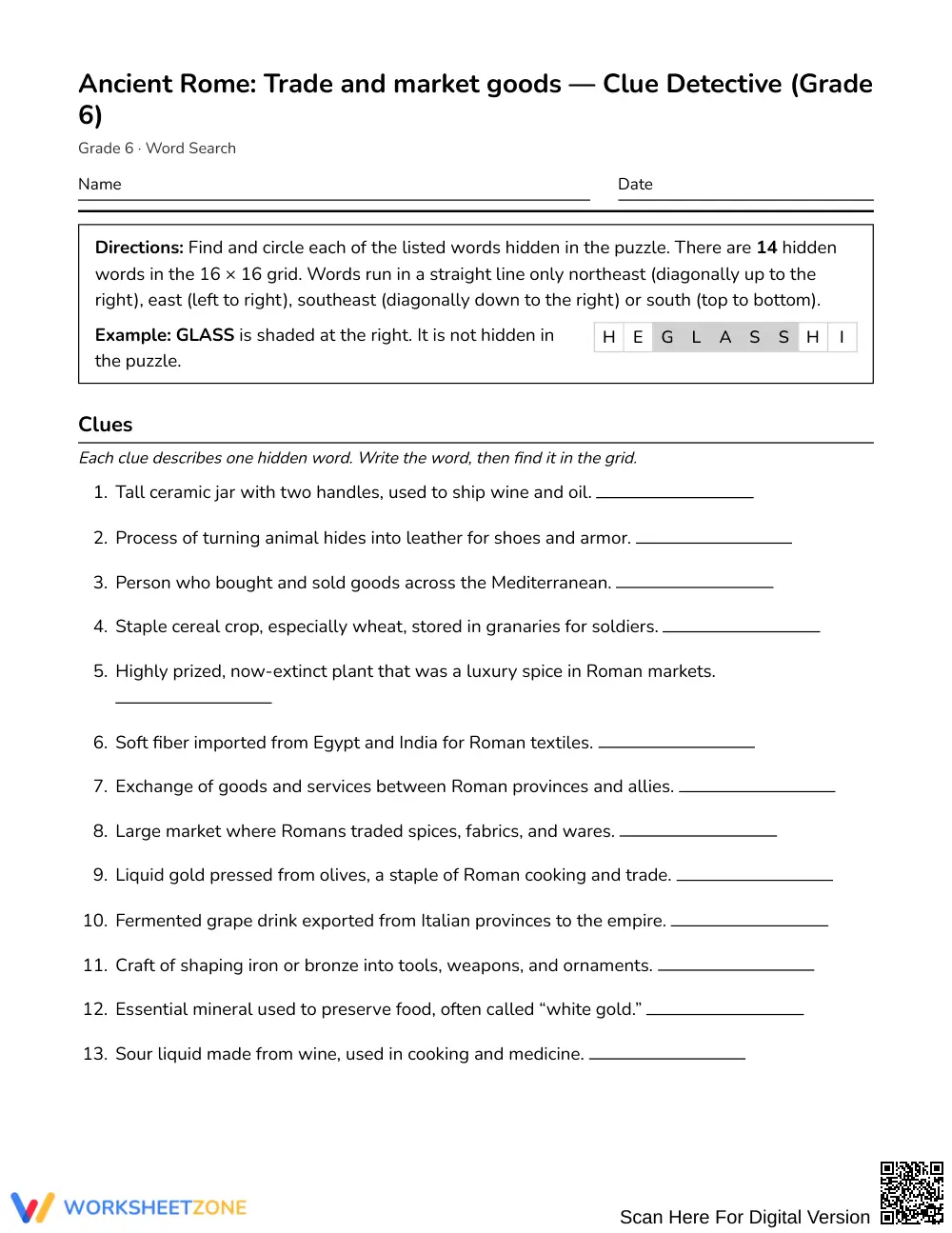
This Grade 6 Ancient Rome word search strengthens content vocabulary by challenging students to identify key goods, resources, and commerce terms from Mediterranean trade networks. Learners examine contextual definitions to discover 14 historical words hidden within the letter grid, building subject-matter familiarity while reinforcing spelling and reading stamina across social studies instruction.
At a Glance
- Grade: Grade 6 · Subject: Social Studies
- Standard:
N/A— Not standards-assessed — vocabulary enrichment- Skill Focus: Ancient Roman trade and market goods
- Format: 2 pages · 14 words · Answer key included · PDF
- Best For: Vocabulary review or sub plans
- Time: 20–30 minutes
What's Inside
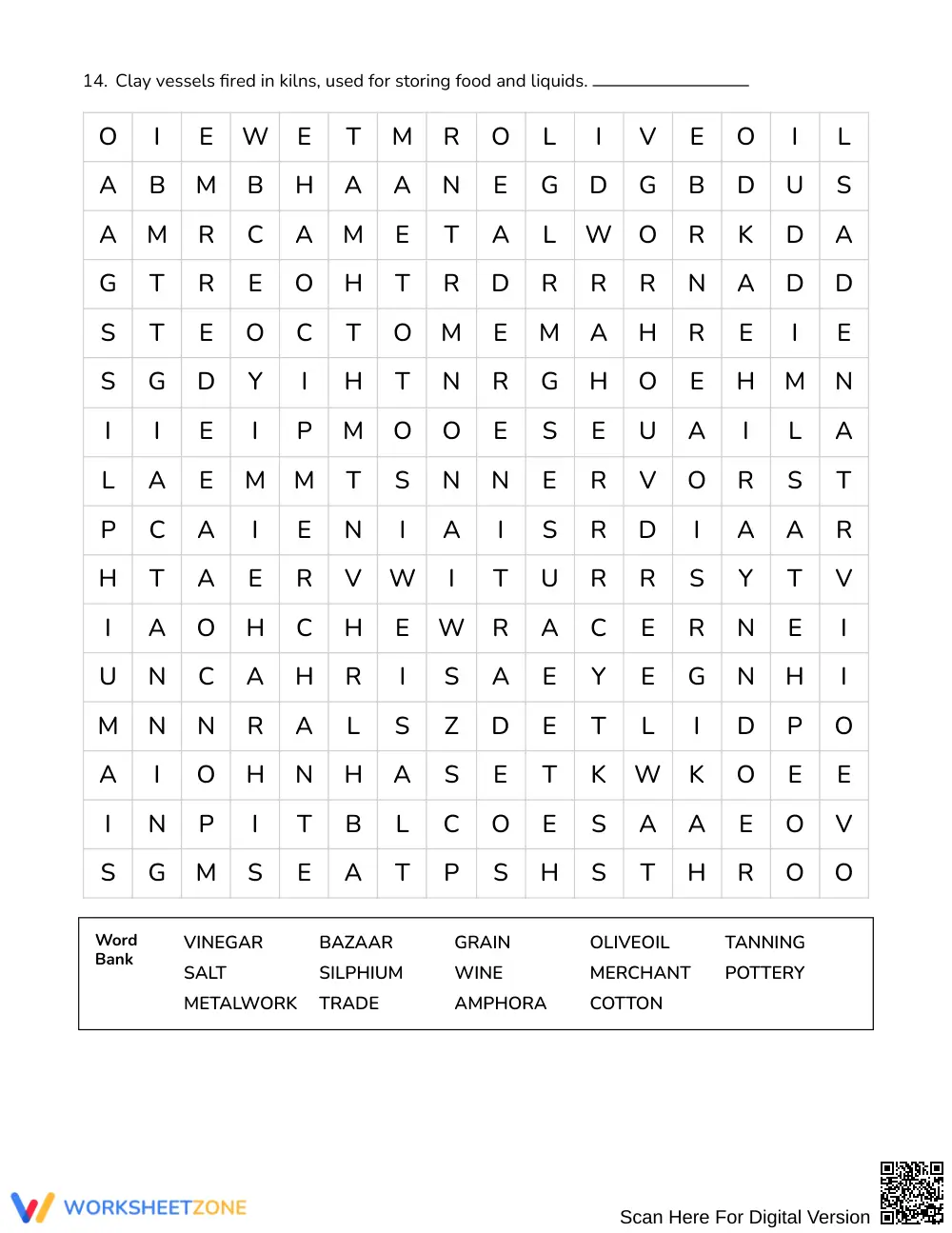
This 2-page print-and-go resource pairs a dense letter grid with historical context clues for all 14 targeted vocabulary terms. Rather than using an alphabetical word list, the activity features a shuffled word bank alongside descriptive clues detailing commodities such as silphium, amphora, grain, and olive oil. A complete 3-page solution key clearly highlights every word location for quick correction.
Puzzle Mechanics and Structure
The activity is built on a 16 × 16 letter grid designed to challenge middle school readers. Hidden terms run across four distinct orientations: northeast, east, southeast, and south. Students can read the descriptive historical clues to determine target terms or scan the shuffled bank directly, locating each hidden word across intersecting diagonal and straight pathways.
Standards Alignment
This activity is designed purely for vocabulary enrichment and is not aligned to a specific state or national content standard. It supports cross-curricular literacy by reinforcing historical terminology and domain-specific concepts encountered in classical civilization units.
How to Use It
Deploy this puzzle as an introductory warm-up before direct instruction on Mediterranean commerce, or use it after lectures as an engaging consolidation task. For formative assessment, observe whether students match terms to clues independently or rely strictly on letter hunting, noting who needs support connecting terms like amphora or bazaar to trade systems. Expected completion takes 20 to 30 minutes.
Who It's For
This resource serves general education Grade 6 social studies classrooms, early finishers, and middle school reading intervention groups needing thematic vocabulary practice. Pair this puzzle with an introductory Mediterranean trade route map or a primary source excerpt describing Roman forum merchants to deepen historical comprehension.
Domain-specific vocabulary acquisition forms the bedrock of historical literacy in middle school social studies. According to research documented in Fisher & Frey (2014), deliberate exposure to content terminology through structured word tasks allows students to consolidate specialized language before engaging in high-level informational reading and historical analysis. By requiring learners to actively connect historical clues with terms like silphium, merchant, and amphora across a 16 × 16 letter puzzle, this activity reinforces morphological familiarity and contextual recall. Integrating playful yet rigorous vocabulary enrichment supports conceptual retention and helps Grade 6 learners establish the background knowledge necessary for complex historical texts.


