

































Printable Real & Imaginary Worksheet | Grade 11 Algebra II

Paste this activity's link or code into your existing LMS (Google Classroom, Canvas, Teams, Schoology, Moodle, etc.).
Students can open and work on the activity right away, with no student login required.
You'll still be able to track student progress and results from your teacher account.
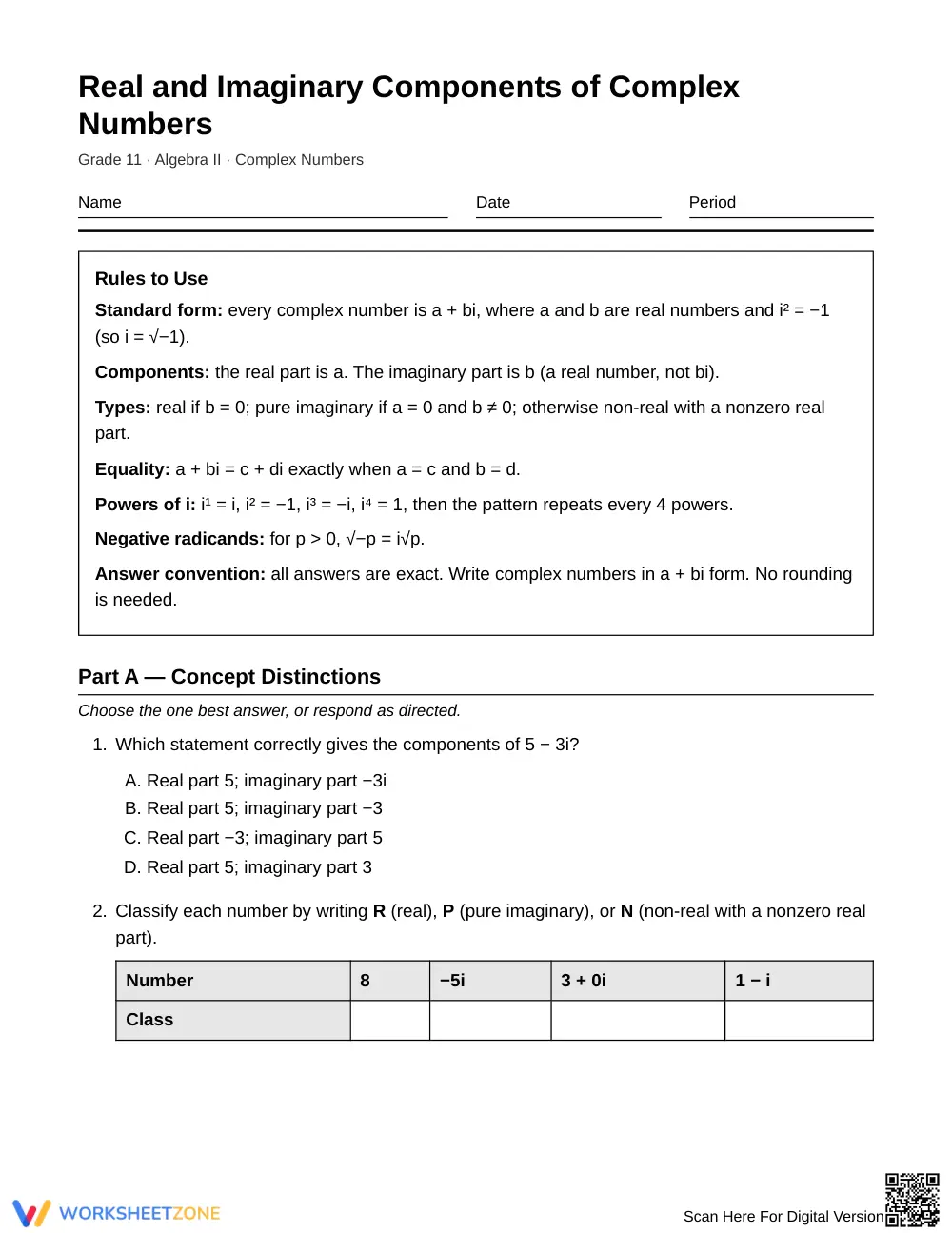
This worksheet helps Grade 11 Algebra II students identify the real and imaginary parts of a complex number written as a + bi. Students separate the two components, classify numbers, and carry the skill through arithmetic and quadratic solutions. Sixteen problems build accuracy with the most common component errors.
At a Glance
- Grade: 11 · Subject: Algebra II
- Standard:
HSN-CN.A.1— Write complex numbers as a + bi and identify real and imaginary parts.- Skill Focus: Identifying real and imaginary components
- Format: 5 pages · 16 problems · Answer key included · PDF
- Best For: Practice after introducing complex numbers
- Time: 30–40 minutes
What's Inside
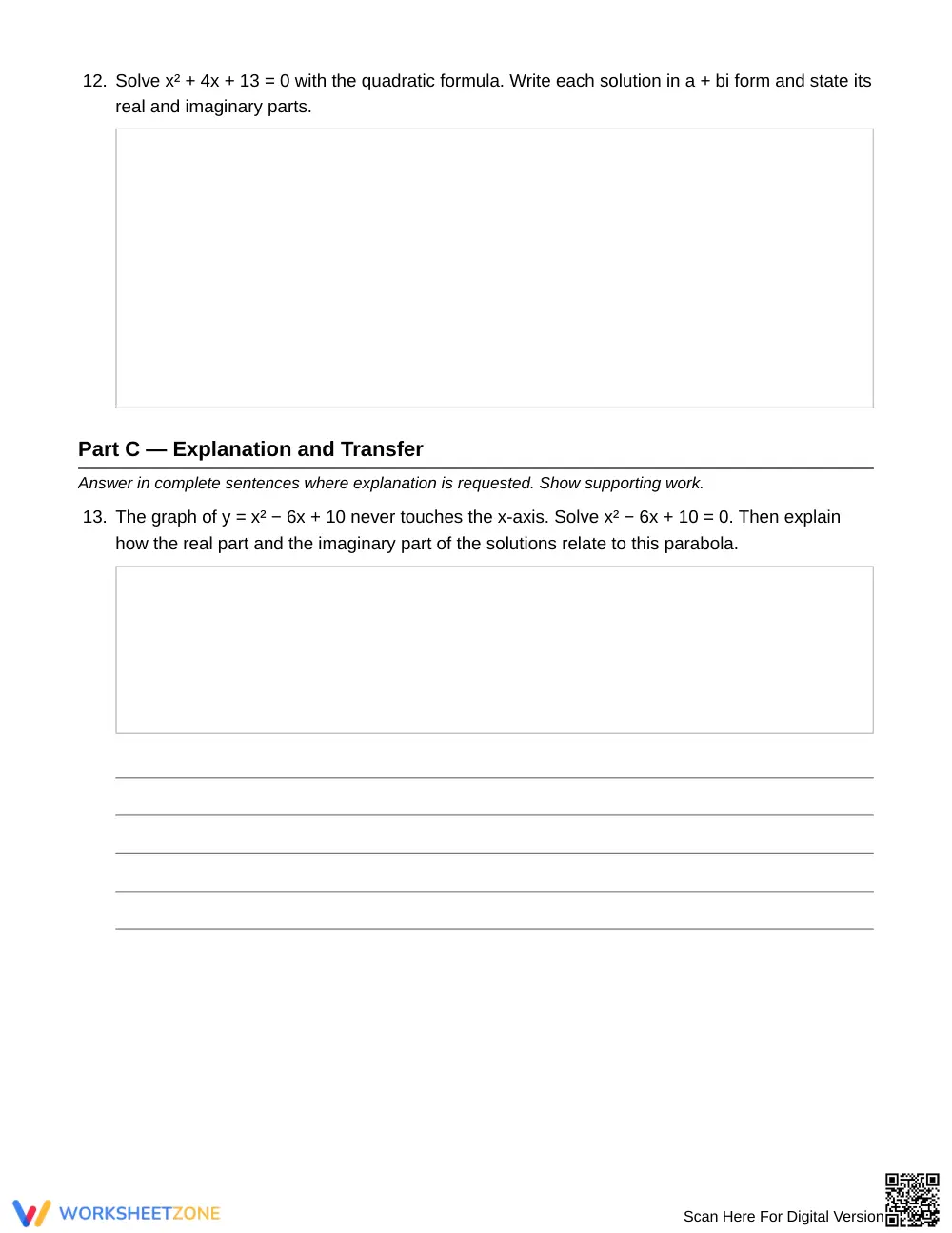
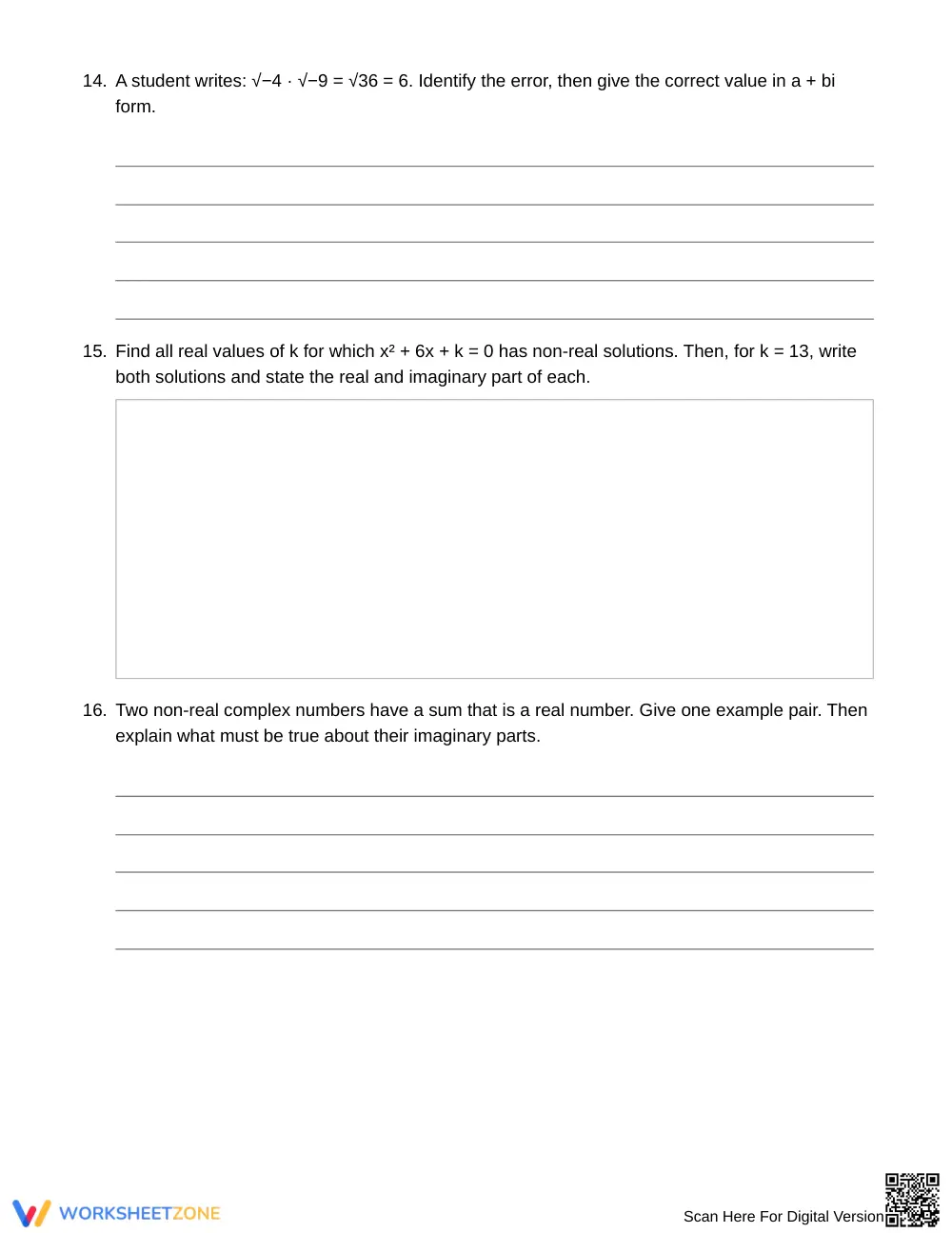
A Rules to Use box covers standard form, number types, equality, powers of i, and negative radicands. Part A has four concept items, including a classification table. Part B has eight short applications. Part C has four explanation tasks. A two-page answer key is included.
Skill Progression
- Guided practice: 4 concept problems with the rules box open for reference.
- Supported practice: 8 problems with results in a + bi form and both parts stated.
- Independent practice: 4 problems on error analysis, parabolas, and a parameter k.
The sequence follows gradual release: I Do, We Do, You Do.
Standards Alignment
HSN-CN.A.1: Know there is a complex number i such that i² = −1, and every complex number has the form a + bi with a and b real. Part B and Part C also use HSN-CN.C.7, solving quadratics with complex solutions. Both standard codes can be copied directly into lesson plans, IEP goals, or district curriculum mapping tools.
How to Use It
Assign Part A right after direct instruction on standard form, then finish Parts B and C as independent practice or homework. It also works as a review before a unit test. While students work, watch for anyone who writes the imaginary part as 3i instead of 3. Expect 30–40 minutes.
Who It's For
Grade 11 Algebra II students meeting complex numbers for the first time, or reviewing them. Students who need more support can focus on Parts A and B. Pair it with an anchor chart on powers of i.
This Grade 11 Algebra II worksheet targets HSN-CN.A.1, which asks students to know that every complex number has the form a + bi with a and b real, and to identify the real part and the imaginary part. The 16 tasks move from concept distinctions to short applications to explanation and transfer, so students practice separating a from b before using that skill in addition, subtraction, multiplication, equation solving, powers of i, and quadratic solutions. The sequence follows the gradual release model described by Fisher & Frey (2014), in which teachers shift from modeling to guided work to independent performance. A key idea students practice is that the imaginary part is the real number b, not the term bi. The five-page PDF includes a rules box and a two-page answer key, making it practical for unit practice, review, or formative checks.


