





























Paste this activity's link or code into your existing LMS (Google Classroom, Canvas, Teams, Schoology, Moodle, etc.).
Students can open and work on the activity right away, with no student login required.
You'll still be able to track student progress and results from your teacher account.


Printable Quadrant I Ordered Pairs Worksheet | Grade 4 Math

Paste this activity's link or code into your existing LMS (Google Classroom, Canvas, Teams, Schoology, Moodle, etc.).
Students can open and work on the activity right away, with no student login required.
You'll still be able to track student progress and results from your teacher account.
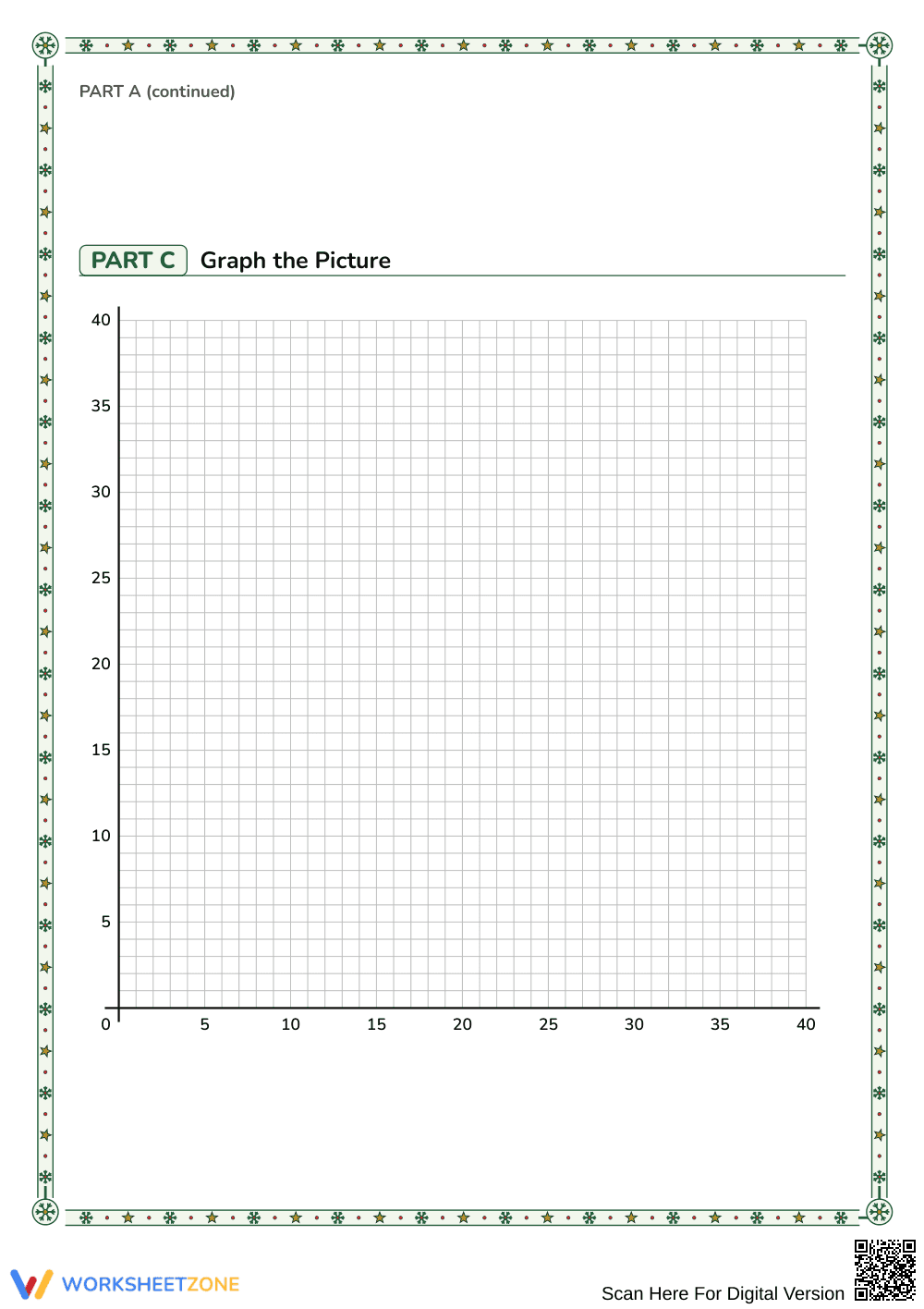
This Grade 4 math worksheet builds accuracy with plotting ordered pairs in Quadrant I through a seasonal coordinate art task. Students locate and connect points on a coordinate grid to reveal a Christmas candle with a flame, turning foundational graphing practice into a concrete, self-checking visual outcome.
At a Glance
- Grade: 4 · Subject: Math
- Standard: Coordinate Plane — Plot ordered pairs accurately on a Quadrant I coordinate grid
- Skill Focus: Plotting ordered pairs in Quadrant I to reveal a picture
- Format: 2 pages · 1 mystery picture task · 2-page answer key · PDF
- Best For: Seasonal independent Quadrant I coordinate graphing practice
- Time: 20–30 minutes
What's Inside
The worksheet spans 2 student pages and centers on 1 structured coordinate art activity titled Part A: Ordered Pairs. Students plot given x- and y-coordinates in Quadrant I and connect them in sequence to form a candle with a flame. A complete 2-page answer key is included for quick verification.
Skill Progression
- Guided practice: Model the first 2 to 3 ordered pairs together, emphasizing moving right along the x-axis before moving up along the y-axis.
- Supported practice: Students plot the base and body of the candle while checking neighbors' coordinates for alignment.
- Independent practice: Learners complete the remaining points for the candle flame on their own to finish the mystery picture.
This sequence follows an I Do, We Do, You Do gradual-release structure.
Standards Alignment
This activity aligns with Grade 4 and upper-elementary coordinate plane expectations where students graph ordered pairs of positive numbers in Quadrant I and interpret coordinate values in context. Both standard codes can be copied directly into lesson plans, IEP goals, or district curriculum mapping tools.
How to Use It
Assign this worksheet after direct instruction on x- and y-axes as a 20-to-30-minute classwork activity, or use it before a unit review as an engaging math center. While students work, circulate to spot-check whether anyone reverses x- and y-coordinates early in the sequence so misconceptions are corrected before the picture distorts.
Who It's For
Designed for Grade 4 students learning Quadrant I graphing, this resource also supports intervention groups needing visual feedback when points are plotted incorrectly. Pair it with a Quadrant I anchor chart showing x-before-y movement to reinforce axis vocabulary during independent work.
Coordinate art activities provide immediate visual feedback that helps Grade 4 students master plotting ordered pairs in Quadrant I. When learners move horizontally along the x-axis and vertically along the y-axis to reveal a candle with a flame, any misplotted coordinate visibly breaks the expected shape, prompting self-correction without waiting for teacher grading. According to Fisher & Frey (2014), purposeful gradual-release instruction—moving from teacher modeling to guided peer checks and independent execution—strengthens procedural fluency and student ownership in mathematics. By structuring 1 cohesive mystery picture task across 2 student pages with a 2-page answer key, this resource gives teachers a clear, low-friction way to reinforce coordinate plane conventions. Students practice reading and graphing positive ordered pairs accurately within a 20-to-30-minute block while building confidence with foundational spatial reasoning. Teachers can use the completed grids as quick formative checks for coordinate accuracy.


