




























Views
Downloads
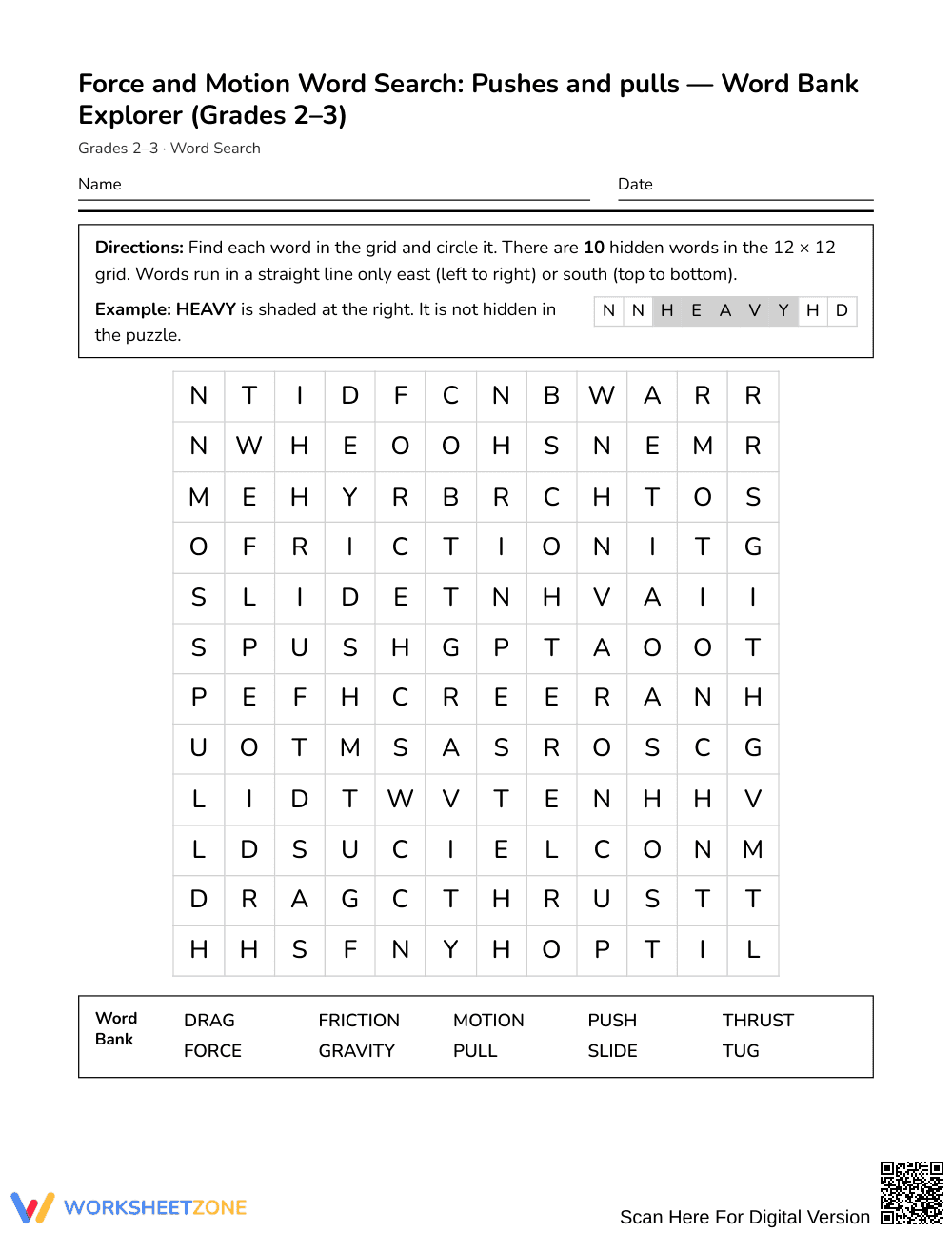

Printable Pushes and Pulls Word Search | Grades 2–3 Science

Paste this activity's link or code into your existing LMS (Google Classroom, Canvas, Teams, Schoology, Moodle, etc.).
Students can open and work on the activity right away, with no student login required.
You'll still be able to track student progress and results from your teacher account.
This science word search helps primary students build fluency with foundational force and motion vocabulary through engaging puzzle play. Learners search for key terms related to pushes and pulls, reinforcing word recognition, spelling, and scientific terminology in a low-stress format.
At a Glance
- Grade: Grades 2–3 · Subject: Science
- Standard: Not standards-assessed — vocabulary enrichment
- Skill Focus: Pushes and pulls
- Format: 1 page · 10 words · Answer key included · PDF
- Best For: Vocabulary review and early finishers
- Time: 15–20 minutes
What's Inside
This single-page activity sheet features a clear 12 by 12 letter grid accompanied by an alphabetized list of 10 targeted force and motion terms. The worksheet includes concise, grade-appropriate definition clues for each target word, reinforcing conceptual understanding alongside letter scanning. A comprehensive two-page teacher answer key provides full visual solutions showing exact word placements.
Puzzle Mechanics and Structure
Designed specifically for young elementary learners, the word search restricts word placement to two intuitive reading directions: left-to-right horizontally (East) and top-to-bottom vertically (South). There are no diagonal or backward placements, preventing unnecessary frustration while encouraging persistent visual tracking. Students consult the alphabetical word bank, read the functional definitions, and locate each hidden term within the 12 by 12 grid.
Standards Alignment
This resource serves as targeted vocabulary enrichment and is not aligned to a specific assessed standard. It functions as a complementary tool to support primary physical science units exploring motion, forces, and everyday physical interactions.
How to Use It
Distribute this activity during the introductory phase of a force and motion unit to build familiarization with new terminology, or use it after direct instruction as an engaging review station. During seatwork, observe whether students cross-reference the definition clues to confirm the meaning of terms like friction and gravity. Expected completion time is 15 to 20 minutes.
Who It's For
This activity is tailored for students in Grades 2–3 learning basic physical science concepts. It provides accessible reinforcement for English language learners and developing readers needing orthographic practice. Pair this puzzle with hands-on ramp investigations or motion anchor charts.
Explicit exposure to content-specific vocabulary accelerates elementary conceptual comprehension in foundational science education. According to Fisher & Frey (2014), intentional word exposure embedded in structured, low-stakes activities strengthens lexical retrieval and reinforces domain-specific terminology before formal assessment. This Grades 2–3 word search operationalizes that principle by presenting 10 essential force and motion terms—including gravity, friction, drag, and thrust—within a clear 12 by 12 puzzle environment. By restricting letter pathways strictly to horizontal and vertical orientations, the activity supports developing visual scanning skills without imposing excessive cognitive load. When students identify and verify these scientific terms in tandem with student-friendly definition clues, they consolidate orthographic memory and conceptual grounding. This vocabulary enrichment resource serves as an efficient supplemental tool to solidify the foundational language of forces, motion, pushes, and pulls across primary science classrooms.


