





























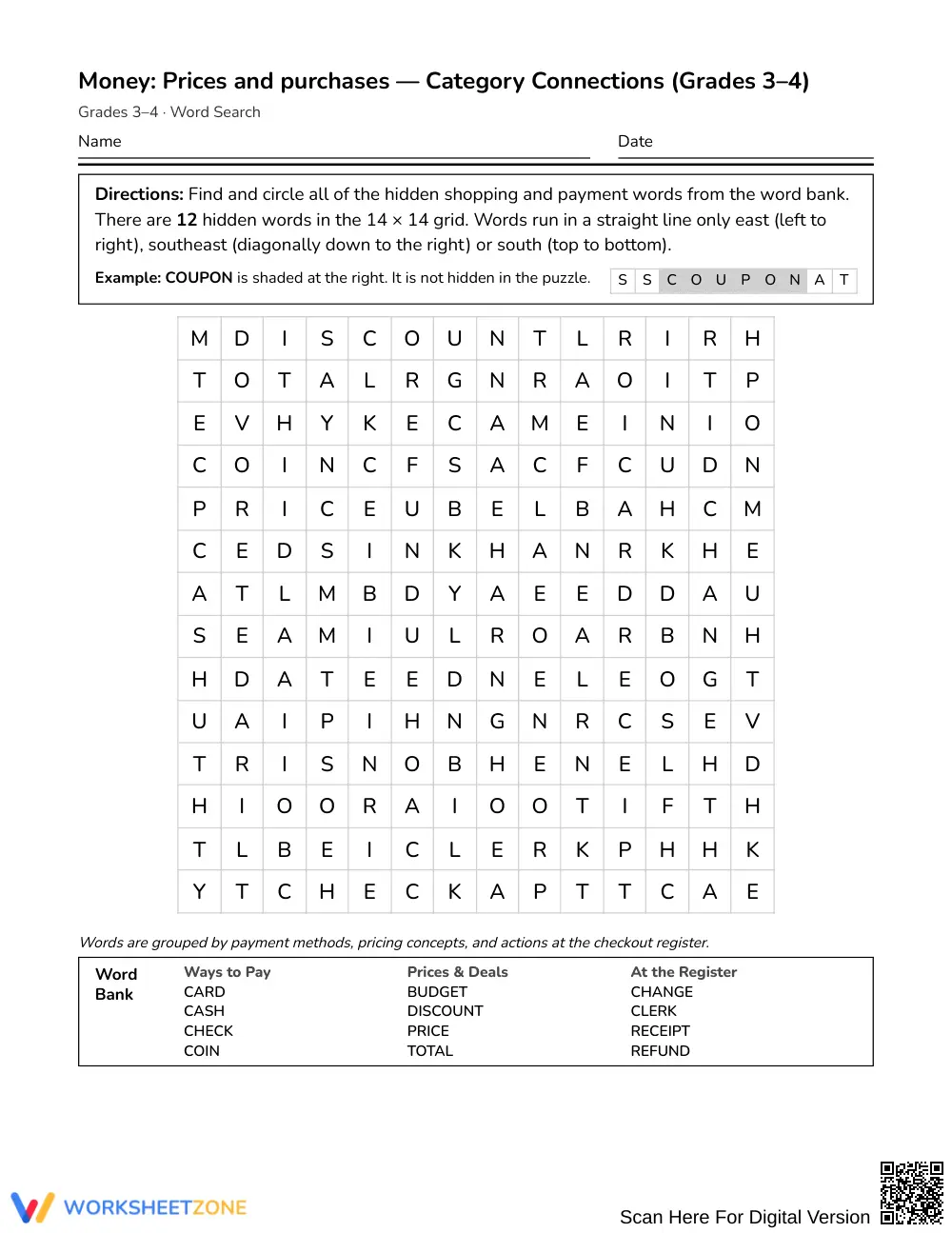


Printable Prices Word Search | Grades 3–4 Social Studies

Paste this activity's link or code into your existing LMS (Google Classroom, Canvas, Teams, Schoology, Moodle, etc.).
Students can open and work on the activity right away, with no student login required.
You'll still be able to track student progress and results from your teacher account.
This Grades 3–4 economics word search reinforces key prices and purchases vocabulary through engaging visual puzzle-solving. Students identify and circle 12 foundational commerce terms grouped across payment methods, pricing principles, and store transactions. The targeted activity builds financial literacy and conceptual familiarity, helping young learners connect everyday economic interactions with precise vocabulary.
At a Glance
- Grade: Grades 3–4 · Subject: Social Studies (Economics)
- Standard: Not standards-assessed — vocabulary enrichment for elementary financial literacy
- Skill Focus: Prices and purchases vocabulary
- Format: 1 page · 12 words · Answer key included · Printable PDF
- Best For: Vocabulary reinforcement, independent practice, or early finishers
- Time: 15–20 minutes
What's Inside
The printable word search features a clean layout designed specifically for Grades 3–4 learners. It presents 12 vocabulary words arranged into three categorized clusters: Ways to Pay, Prices & Deals, and At the Register. The single-page student activity sheet is supported by a comprehensive 3-page answer key that clearly shows word placements, facilitating quick grading or student self-checking.
Puzzle Structure and Mechanics
The activity is built on a 14 x 14 letter grid tailored for elementary search patterns. Words are hidden in three specific orientations: horizontally to the east (E), diagonally to the southeast (SE), and vertically downward to the south (S). This intentional directional constraint prevents backward reading confusion while still providing an engaging challenge. Students locate terms using the categorized word bank, reinforcing semantic connections between concepts such as budget, discount, refund, and clerk.
Standards Alignment
This social studies resource serves as supplementary vocabulary enrichment and is not aligned to a specific formal content standard. It builds conceptual background knowledge in introductory economics by helping students recognize, read, and define fundamental commerce terminology.
How to Use It
This word search works effectively at multiple points in an economics unit. Introduce it after direct instruction on spending and saving to solidify newly taught financial terms, or assign it as an independent station during social studies rotations. For formative assessment, observe whether students identify terms in clusters by concept or hunt randomly, noting which economic terms require further instruction. Most students finish within 15 to 20 minutes.
Who It's For
This activity is designed for Grades 3–4 students learning introductory economics, personal finance, or community commerce. It provides accessible vocabulary support for English language learners and developing readers through structured word categories. Pair this puzzle with an informational text on money management or a classroom store simulation to deepen contextual understanding.
Vocabulary enrichment activities that categorize domain-specific terminology strengthen reading comprehension and conceptual retention in elementary social studies. Although this Grades 3–4 prices and purchases word search is not standards-assessed, it builds critical economic literacy by exposing learners to 12 essential financial terms across practical commercial categories. As Fisher & Frey (2014) demonstrate in their research on intentional vocabulary development, structured exposure to content-area words within themed contexts enhances semantic networking, enabling elementary students to transfer foundational terminology into expressive speech and written analysis. By embedding words like budget, discount, and receipt into an accessible 14 x 14 grid, this resource supports orthographic mapping and lexical acquisition without cognitive overload. Elementary educators can readily integrate this targeted word search into economics units to solidify foundational social studies vocabulary and prepare students for complex financial literacy topics.


