



























Printable Power of a Product Worksheet | Grade 8 Math
Paste this activity's link or code into your existing LMS (Google Classroom, Canvas, Teams, Schoology, Moodle, etc.).
Students can open and work on the activity right away, with no student login required.
You'll still be able to track student progress and results from your teacher account.
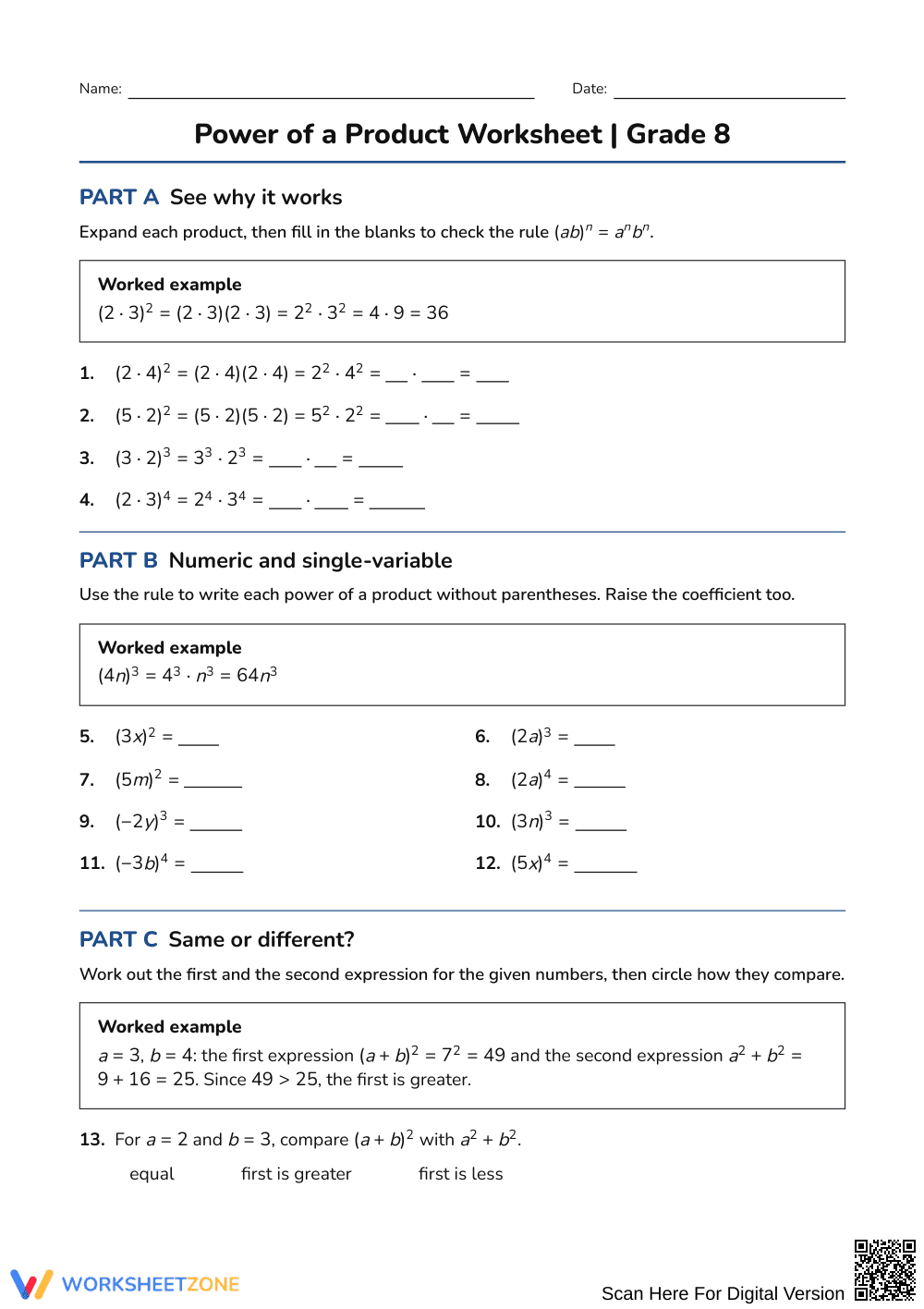
Students master the Power of a Product rule with focused, isolated practice on (ab)ⁿ = aⁿbⁿ, building confidence before tackling mixed exponent problems. This worksheet delivers clear, step‑by‑step tasks that reinforce the rule and prepare learners for deeper exponent work.
At a Glance
- Grade: 8 · Subject: Math
- Standard:
— Apply the power of a product rule to expand and simplify expressions- Skill Focus: Power of a Product rule (ab)ⁿ = aⁿbⁿ
- Format: quick 2 pages · 28 problems · Answer key included · PDF
- Best For: Reinforcing exponent rule before mixed work in class
- Time: 20–30 minutes
What's Inside
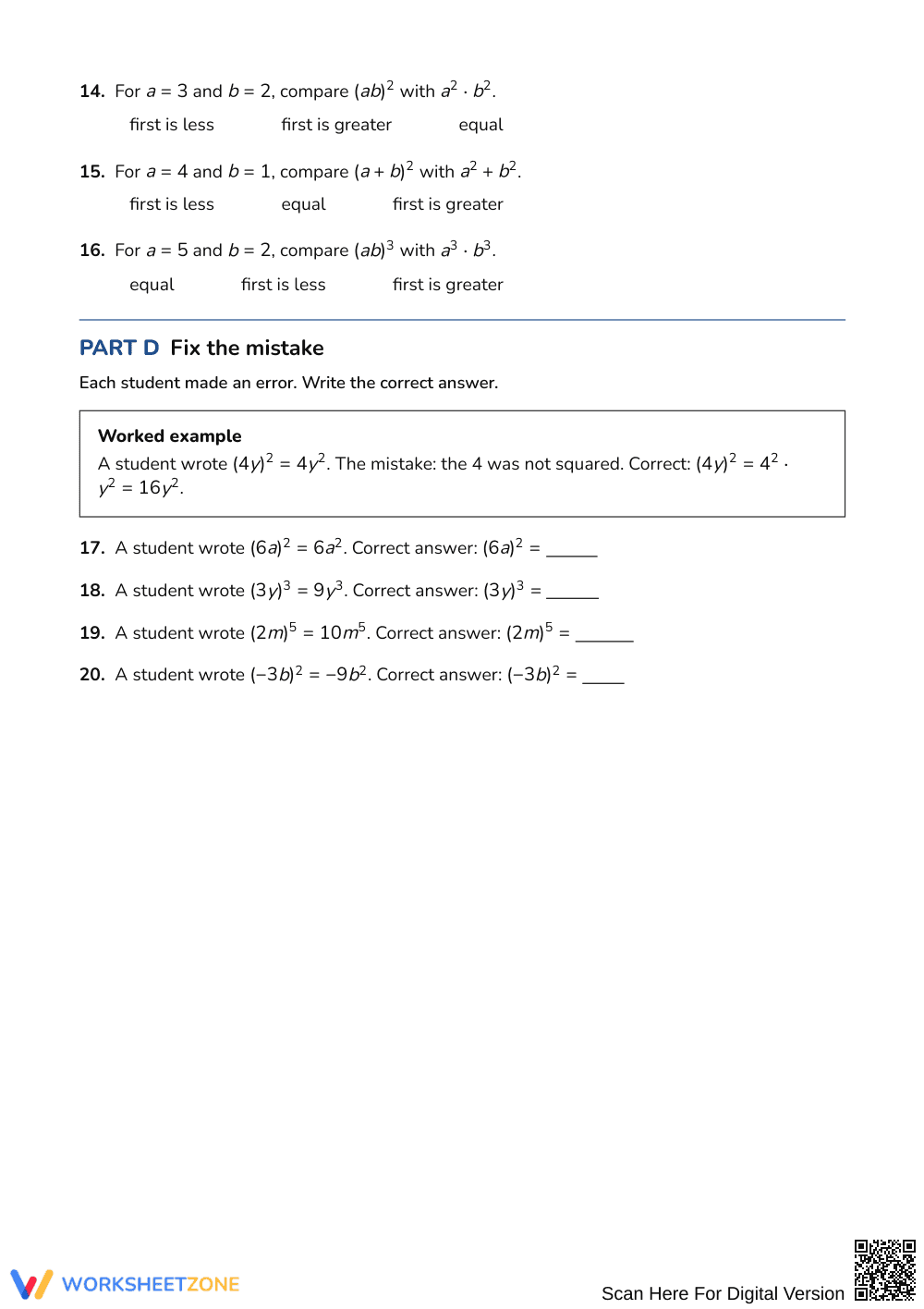
The worksheet is organized into four parts: Part A guides students through worked examples that illustrate why the rule works; Part B provides numeric and single‑variable practice converting products to powers; Part C challenges learners to compare expressions; Part D asks them to correct common errors. All 28 problems span two printable pages, and the answer key is provided on a separate two‑page PDF. Scaffolds include worked examples and a clear rule box at the start of each section.
Skill Progression
- Guided practice – 8 problems with worked examples and step‑by‑step hints.
- Supported practice – 10 problems with a word bank and partial solution frames.
- Independent practice – 10 problems requiring full independent application of the rule.
The sequence follows the classic I Do, We Do, You Do gradual‑release model.
Standards Alignment
`` – Students apply the power of a product property to simplify exponential expressions, a key component of the 8th‑grade exponent standards. This also supports related exponent‑multiplication expectations. Both standard codes can be copied directly into lesson plans, IEP goals, or district curriculum mapping tools.
How to Use It
1. Before direct instruction: Hand out Part A as a quick warm‑up to activate prior knowledge; observe whether students can state the rule without prompts. 2. During a lesson on exponents: Use Parts B and C for guided practice, circulating to note misconceptions; a teacher can note accuracy rates as a formative‑assessment cue. Expected completion time is 20–30 minutes.
Who It's For
This worksheet targets Grade 8 math learners who need solid, isolated practice on exponent rules. It differentiates through the three‑stage progression, offering extra support in the early problems and challenge in the final set. Pair it with a short instructional video on the Power of a Product property or an anchor chart summarizing the rule.
Research shows that explicit rule instruction combined with repeated, scaffolded practice improves procedural fluency in algebraic concepts (Fisher & Frey, 2014). By focusing on (ab)ⁿ = aⁿbⁿ in an isolated setting, students build a reliable mental model before encountering mixed‑skill exponent tasks. The worksheet’s answer key enables immediate feedback, reinforcing correct reasoning pathways and addressing common errors highlighted in Part D. Teachers can integrate the resource into daily drills or use it as a formative checkpoint to inform subsequent instruction, ensuring that all learners achieve mastery of the power‑of‑a‑product property.


