





























Printable Particle-Based Explanations | Grade 7 Science
Paste this activity's link or code into your existing LMS (Google Classroom, Canvas, Teams, Schoology, Moodle, etc.).
Students can open and work on the activity right away, with no student login required.
You'll still be able to track student progress and results from your teacher account.
This Grade 7 Science worksheet builds students' ability to construct, defend, and evaluate particle-based explanations of matter across three progressively demanding task types. Working through 8 problems across 5 pages, students apply the kinetic molecular model to real scenarios involving thermal expansion, diffusion, phase change, and gas compression — producing written scientific arguments grounded in particle behavior.
At a Glance
- Grade: 7 · Subject: Science
- Standard: Particle Motion & States of Matter — Explain macroscopic properties of matter using particle motion, spacing, and energy
- Skill Focus: Defending particle-based explanations of matter
- Format: 5 pages · 8 problems · Answer key included · PDF
- Best For: Guided practice after direct instruction
- Time: 35–50 minutes
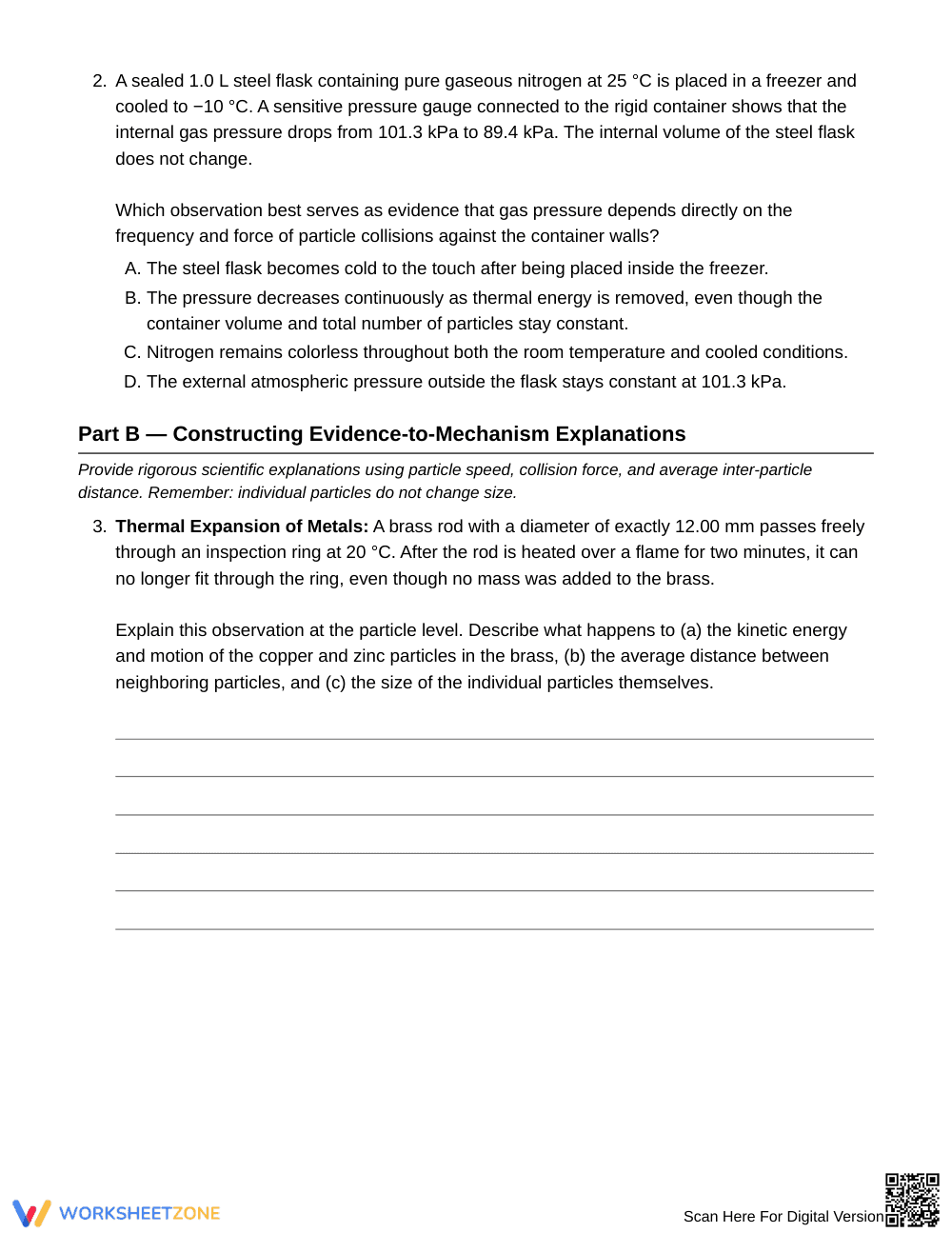
The worksheet opens with a reference box summarizing three pillars of the kinetic molecular model: constant particle identity, motion and spacing, and state characteristics. Part A features 2 multiple-choice items with data-rich scenarios. Part B includes 4 extended-response items addressing thermal expansion, diffusion, phase change, and compressibility. Part C presents 2 rebuttal tasks where students correct named misconceptions. A 3-page answer key is included.
Skill Progression
- Guided practice (Part A, 2 tasks): Students choose among four labeled options tied to experimental data, reinforcing evidence-selection habits.
- Supported practice (Part B, 4 tasks): Structured prompts break explanations into kinetic energy, particle distance, and particle size sub-questions.
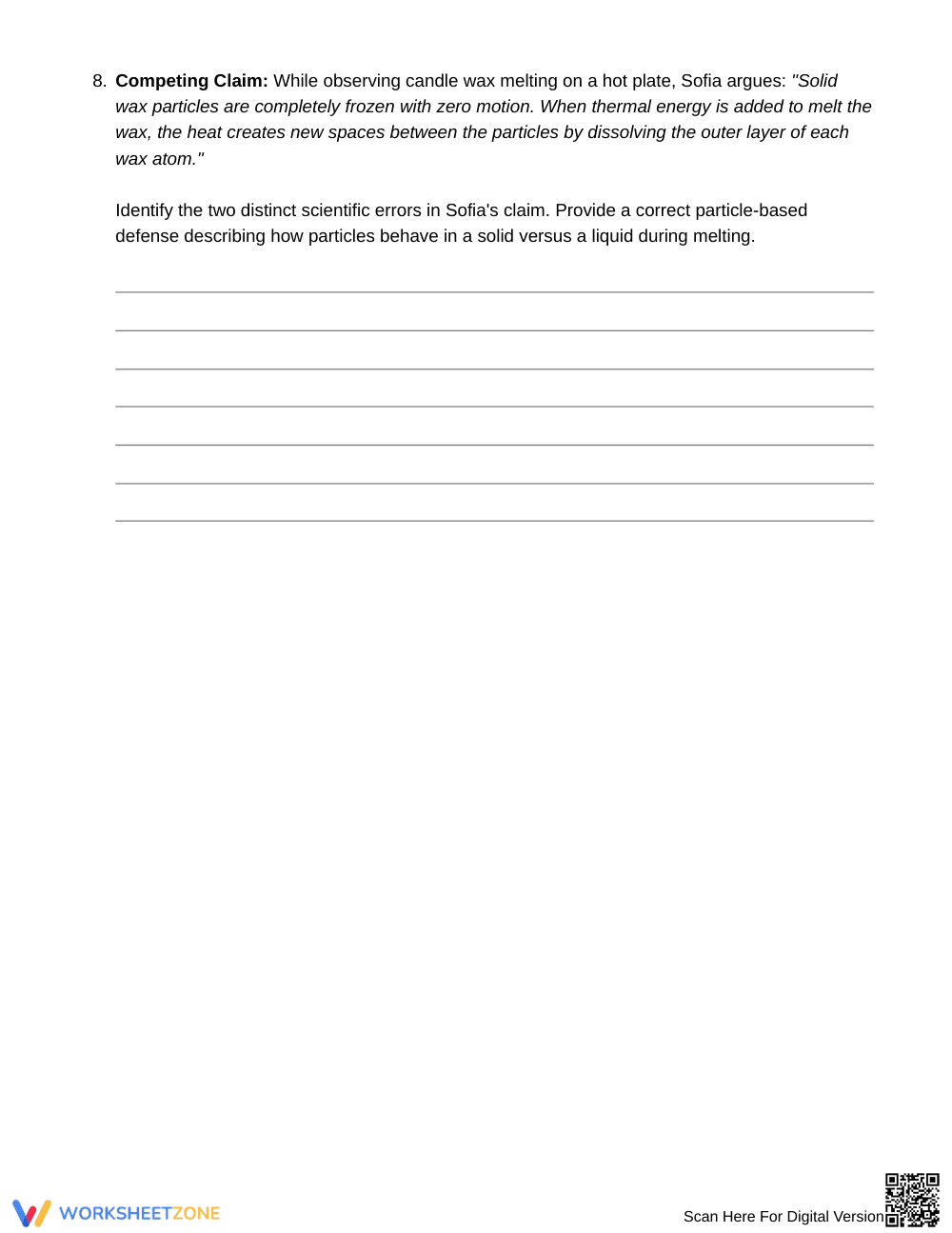
- Independent practice (Part C, 2 tasks): Students analyze a flawed claim, identify the error, and compose a full rebuttal.
How to Use It
Assign Part A after direct instruction to check whether students distinguish macroscopic observations from particle-level evidence. Use Parts B and C for post-instruction consolidation or end-of-unit performance checks; students typically finish in 35–50 minutes. Watch for students in Part B who describe particles as expanding—Part C directly resolves this misconception.
Research consistently links structured scientific argumentation practice to deeper conceptual understanding of particle models. Fisher & Frey (2014) found that gradual-release frameworks—in which students move from guided selection tasks to independent written explanation—significantly improve retention of abstract science concepts compared to single-format practice. This worksheet applies that framework directly: 2 evidence-identification items, 4 scaffolded explanation tasks, and 2 open rebuttal items give students repeated contact with the kinetic molecular model across increasing levels of cognitive demand. The skill focus of defending particle-based explanations of matter addresses one of the most commonly misunderstood ideas in middle school physical science, including the persistent belief that individual particles expand during heating. All 8 tasks are grounded in quantitative scenarios involving measured volumes, pressures, temperatures, and masses so student reasoning can be evaluated against specific data rather than vague descriptions.


