






























Paste this activity's link or code into your existing LMS (Google Classroom, Canvas, Teams, Schoology, Moodle, etc.).
Students can open and work on the activity right away, with no student login required.
You'll still be able to track student progress and results from your teacher account.


Printable Ordered Pairs Graphing Worksheet | Grade 7 Math

Paste this activity's link or code into your existing LMS (Google Classroom, Canvas, Teams, Schoology, Moodle, etc.).
Students can open and work on the activity right away, with no student login required.
You'll still be able to track student progress and results from your teacher account.
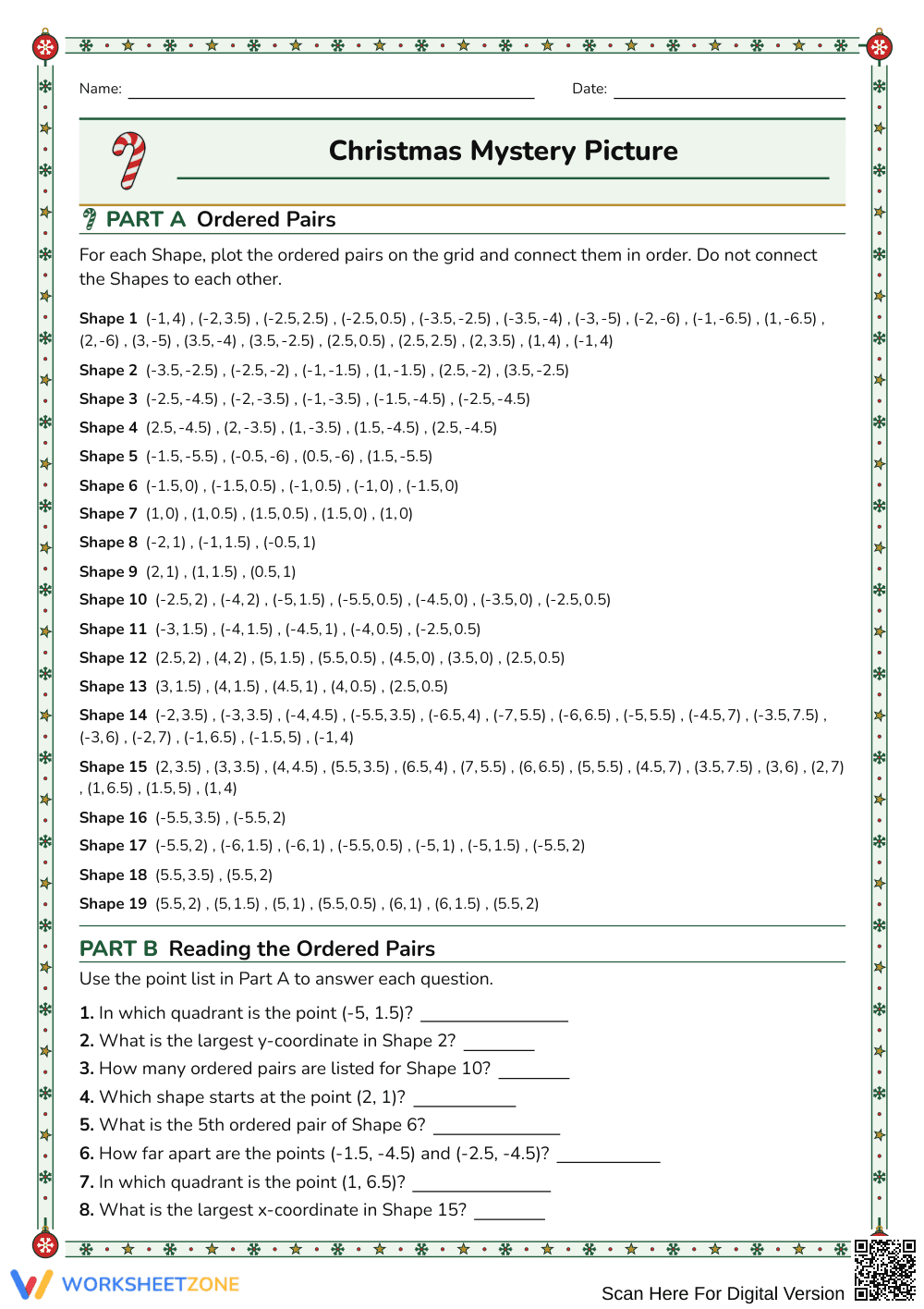
This Grade 7 coordinate plane worksheet builds fluency in plotting ordered pairs across all four quadrants using both whole and half units. Students connect sequential points in Part A to reveal a seasonal moose head mystery picture, reinforcing precision with positive and negative coordinates on a standard grid.
At a Glance
- Grade: 7 · Subject: Math
- Standard: Coordinate Plane Graphing — Plot ordered pairs with whole and half units across all four quadrants
- Skill Focus: Plotting four-quadrant ordered pairs (whole and half units)
- Format: 3 pages · 1 task · Answer key included · PDF
- Best For: Independent coordinate graphing practice
- Time: 25–35 minutes
What's Inside
This 3-page printable packet centers on a single structured graphing task titled Christmas Mystery Picture. In Part A: Ordered Pairs, students plot a sequence of positive and negative coordinates—including both whole numbers and half units—and connect the points in order to form a moose head illustration. A complete 3-page answer key is included so teachers or students can quickly verify every plotted point and line segment.
Skill Progression
- Guided practice: Review the axes, origin, and quadrant signs, then model plotting the first whole-unit and half-unit ordered pairs from Part A together.
- Supported practice: Have students plot the next section with a partner, checking that half-unit values fall accurately between grid lines.
- Independent practice: Students complete the remaining ordered pairs in the 1 mystery picture task independently to reveal the moose head.
This progression supports an I Do, We Do, You Do gradual-release structure.
Standards Alignment
This worksheet aligns with middle-grades coordinate geometry expectations requiring students to plot and interpret ordered pairs of rational numbers—including positive and negative integers and half units—across all four quadrants of the coordinate plane. It reinforces spatial reasoning, sign accuracy, and precision on scaled axes, making it easy to document directly in lesson plans, IEP goals, or district curriculum mapping tools.
How to Use It
Assign this activity after direct instruction on four-quadrant coordinate graphing as seasonal skills practice, or use it during a math center rotation for focused fluency work. Most seventh graders finish in 25 to 35 minutes. As students work, circulate and watch for common sign reversals or misplaced half-unit coordinates—the emerging moose head silhouette gives immediate visual feedback when a point is off.
Who It's For
Designed for Grade 7 math students practicing rational-number coordinates, this worksheet also works well as a review activity for eighth graders or an enrichment challenge for sixth graders ready for half-unit intervals. Pair it with a four-quadrant coordinate plane anchor chart so learners can double-check quadrant signs independently.
This Grade 7 math worksheet provides structured practice in plotting ordered pairs of whole and half units across all four quadrants of the coordinate plane to reveal a moose head mystery picture. Spanning 3 student pages with a matching 3-page answer key, the single multi-step task in Part A reinforces coordinate precision, rational-number placement, and self-monitoring through visual feedback. According to Fisher & Frey (2014), purposeful guided and independent practice helps students consolidate procedural fluency when tasks pair clear expectations with immediate feedback. By embedding coordinate graphing inside a sequential drawing task, learners must verify both the sign and fractional position of each ordered pair before connecting points. Teachers can deploy the activity in 25 to 35 minutes after direct instruction to diagnose quadrant-sign errors and build lasting confidence with rational-number graphing on the coordinate plane.


