































Printable Observations Word Search | Grades 2–3 Science

Paste this activity's link or code into your existing LMS (Google Classroom, Canvas, Teams, Schoology, Moodle, etc.).
Students can open and work on the activity right away, with no student login required.
You'll still be able to track student progress and results from your teacher account.
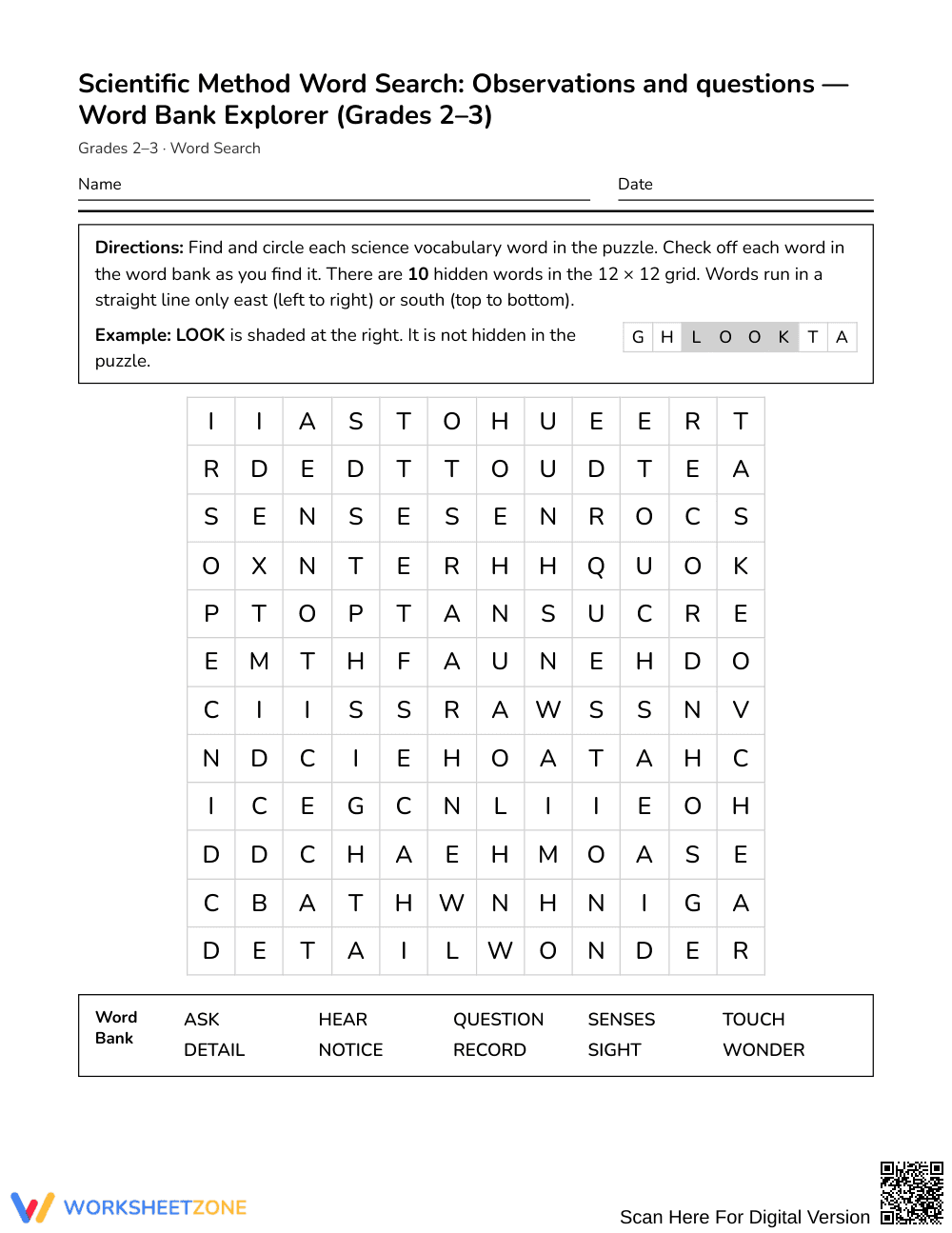
This Grades 2–3 science word search reinforces foundational inquiry vocabulary through active pattern recognition and visual scanning. Young learners locate 10 essential terms related to scientific observations and investigative questions, connecting sensory language to early scientific practices. The focused puzzle format builds spelling familiarity and academic confidence during introductory science units.
At a Glance
- Grade: Grades 2–3 · Subject: Elementary Science
- Standard: Not standards-assessed — science vocabulary enrichment and sensory observation word study
- Skill Focus: Scientific observations, sensory vocabulary, and asking questions
- Format: 1 printable page · 10 hidden vocabulary words · Full answer key included · PDF
- Best For: Introductory science vocabulary warm-up or independent early finishers
- Time: 10–15 minutes
What's Inside
This single-page printable activity features a clean 12 by 12 letter grid containing 10 target science vocabulary words. Below the puzzle grid, an alphabetical word bank displays every target term clearly, allowing students to check off words as they find them. A complete two-page answer key provides teacher solutions showing exact letter coordinates and highlighted word placements.
Puzzle Structure and Mechanics
The word search is purposefully designed for developing readers in primary grades:
- Grid Dimensions: A compact 12 by 12 letter grid keeps visual scanning manageable without overwhelming primary students.
- Word Orientations: Hidden words run strictly East (left-to-right) and South (top-to-bottom), avoiding confusing backwards or diagonal placements.
- Alphabetical Word Bank: Words are organized alphabetically from ASK to WONDER, reinforcing both dictionary order and vocabulary tracking.
Standards Alignment
This activity serves strictly as supplementary vocabulary enrichment and is not aligned to a specific standard. While it does not assess a formal science performance expectation, it builds the essential academic vocabulary students need when formulating testable questions, conducting sensory investigations, and recording scientific observations across early elementary inquiry units.
How to Use It
Use this word search as an introductory engagement hook before direct instruction on the five senses, or assign it as a quiet post-lab consolidation task after an outdoor observation walk. As students complete the puzzle in 10 to 15 minutes, circulate to observe whether learners recognize sensory terms like TOUCH, SIGHT, and HEAR, prompting them to describe how each sense aids investigation.
Who It's For
This resource is tailored for students in Grades 2–3 who are beginning formal science investigations. It offers accessible practice for English language learners and developing readers through predictable word orientations and clear font choices. Pair this puzzle naturally with an anchor chart on the five senses or a guided observation journal entry during introductory inquiry lessons.
Vocabulary acquisition forms the bedrock of early elementary scientific literacy, enabling primary students to articulate questions and systematically record observations. Although designed as non-standard vocabulary enrichment rather than a formal standards-based assessment, this Grades 2–3 science word search strengthens foundational familiarity with critical inquiry terms including senses, detail, notice, and record. According to Fisher & Frey (2014), intentional exposure to domain-specific vocabulary during introductory learning experiences significantly enhances reading comprehension and collaborative student discourse in content-area investigations. By locating 10 essential terms within an accessible 12 by 12 grid using predictable East and South orientations, young learners build word-recognition automaticity and orthographic memory without unnecessary cognitive overload. This targeted activity ensures elementary students internalize the precise academic lexicon necessary to transition smoothly from informal everyday observations into structured, evidence-based classroom scientific discussions and inquiry investigations.


