





























Paste this activity's link or code into your existing LMS (Google Classroom, Canvas, Teams, Schoology, Moodle, etc.).
Students can open and work on the activity right away, with no student login required.
You'll still be able to track student progress and results from your teacher account.


Printable Number Bonds to 10 Without the Frame

Paste this activity's link or code into your existing LMS (Google Classroom, Canvas, Teams, Schoology, Moodle, etc.).
Students can open and work on the activity right away, with no student login required.
You'll still be able to track student progress and results from your teacher account.
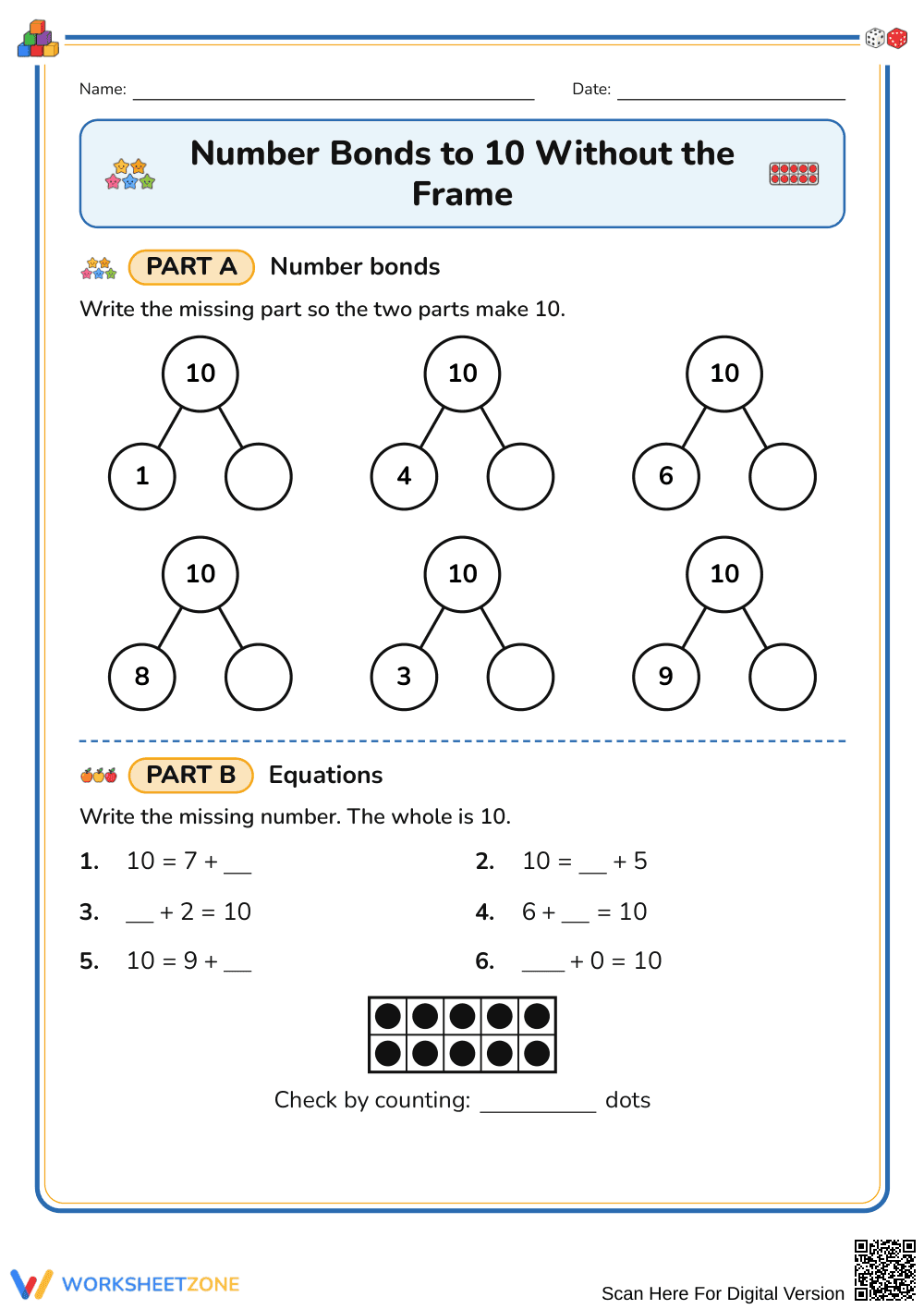
This kindergarten math worksheet strengthens mental composition and decomposition skills by guiding young learners to find missing addends that make 10 without relying on visual ten-frames. Through systematic number bonds and equations, students transition from pictorial models to abstract mental calculations, solidifying foundational addition fluency and preparing for early algebraic thinking.
At a Glance
- Grade: Kindergarten · Subject: Mathematics
- Standard:
K.OA.A.4— Find the number that makes 10 when added to any given number- Skill Focus: Finding the missing part of 10 using bonds and equations
- Format: 1 printable page · 13 total problems · Full answer key included · PDF
- Best For: Independent math practice, morning work, and quick skill checks
- Time: 10–15 minutes
What's Inside
This 1-page printable features 13 targeted tasks. Part A provides 6 number bonds where students find the missing circle value to make 10. Part B contains 6 equations with missing addends in varied positions, plus 1 dot-counting check task. A matching 1-page answer key enables rapid grading.
Skill Progression
- Guided practice (Tasks 1–6): Students complete 6 visual number bonds to identify missing pairs of 10.
- Supported practice (Tasks 7–10): Learners solve 4 horizontal addition equations to balance expressions.
- Independent practice (Tasks 11–13): Students independently evaluate remaining equations and verify totals with dot counting.
This sequence follows a gradual-release model from diagrammatic bonds to symbolic arithmetic.
Standards Alignment
This resource aligns with primary standard `K.OA.A.4`: For any number from 1 to 9, find the number that makes 10 when added to the given number. It also supports `K.OA.A.3` by decomposing 10 into pairs. Both standard codes can be copied directly into lesson plans, IEP goals, or district curriculum mapping tools.
How to Use It
Use this worksheet after direct instruction on number pairs to 10. Have students complete Part A before moving to equations in Part B. Observe whether students use mental recall or fingers for missing addends. Completion requires 10 to 15 minutes.
Who It's For
This resource serves kindergarten students developing number sense and first graders needing intervention. Provide counters for struggling students while challenging advanced learners to write fact families. Pair with a Make 10 anchor chart.
Mastering combinations that make 10 is an essential milestone in early childhood numeracy, laying the groundwork for multidigit addition and place-value comprehension. Under Common Core standard K.OA.A.4, kindergarten students must find the missing number that makes 10 when paired with any given digit from 1 to 9. According to findings from EdReports 2024, high-quality early mathematics curricula emphasize transitioning students from concrete manipulatives to abstract representations to secure conceptual fluency. This 13-task worksheet operationalizes that instructional shift by presenting number bonds and horizontal equations without ten-frame scaffolding, requiring learners to retrieve number bonds mentally. By combining visual part-whole bonds with formal algebraic equation structures, the resource supports flexible numerical reasoning. Teachers and math interventionists can cite this targeted practice set as a verified evidentiary tool for measuring progress toward single-digit addition standards and preparing students for grade-level arithmetic benchmarks.


