































Printable Multiplying by 4s Worksheet | Grade 3 Math

Paste this activity's link or code into your existing LMS (Google Classroom, Canvas, Teams, Schoology, Moodle, etc.).
Students can open and work on the activity right away, with no student login required.
You'll still be able to track student progress and results from your teacher account.
This Grade 3 math worksheet strengthens multiplication fluency by connecting equal groups of four to authentic real-world contexts. Students interpret data tables, visual garden arrays, ticket pricing, and number-line intervals to model mathematical relationships and solve multi-step problems with confidence.
At a Glance
- Grade: 3 · Subject: Math
- Standard:
3.OA.A.3— Use multiplication and division within 100 to solve real-world word problems- Skill Focus: Real-World Modeling by 4s
- Format: 3 pages · 25 structured problems · Complete answer key included · Printable PDF
- Best For: Targeted small group instruction or independent review
- Time: 25–35 minutes
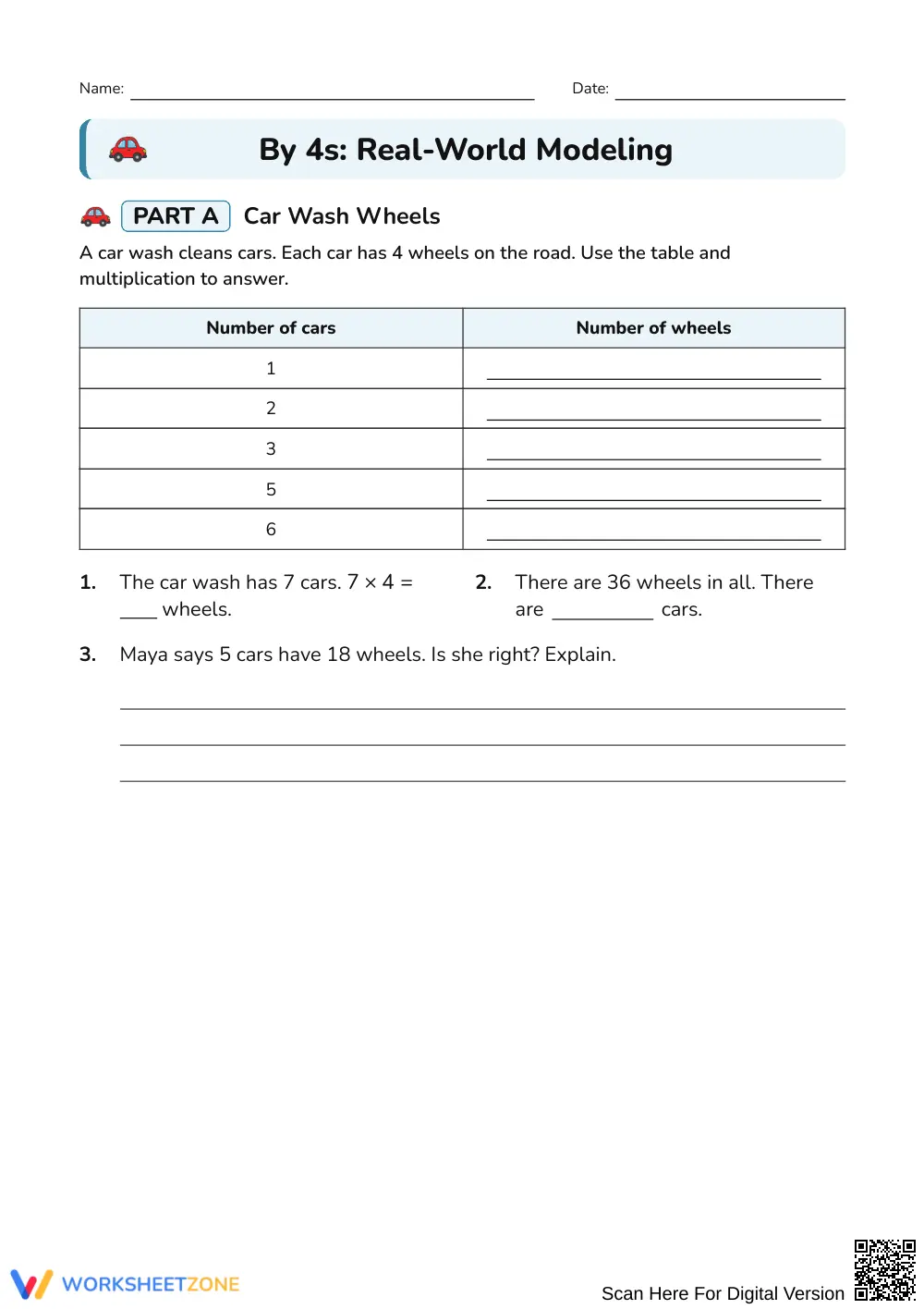
Across 3 structured pages, students complete 25 tasks organized across four thematic modeling contexts. Part A utilizes car wash wheel tables to establish four as a constant factor. Part B incorporates visual garden arrays and fact families. Part C examines ticket booth pricing with open-response justification prompts, and Part D connects repeated addition to number-line jumps. A three-page teacher answer key provides full solutions, completed tables, and model written explanations for immediate verification.
Skill Progression
- Guided Practice: Tasks 1–7 provide structured tables and clear context clues around car wash wheels, allowing students to trace patterns of four with heavy visual scaffolding.
- Supported Practice: Tasks 8–18 transition learners into visual garden arrays and ticket purchase scenarios, requiring them to identify fact families and evaluate mathematical claims with moderate prompts.
- Independent Practice: Tasks 19–25 challenge students to track distance intervals on open number lines and write repeated addition equations autonomously with minimal teacher assistance.
This structured sequence embodies the gradual-release model, moving students purposefully from teacher-led modeling to collaborative inquiry and self-directed problem solving.
Standards Alignment
This resource aligns with `3.OA.A.3` to solve word problems involving equal groups, arrays, and measurement quantities using drawings and equations. The tasks also reinforce supporting standard `3.OA.B.5`. Teachers can copy these codes directly into lesson plans, IEP goals, or curriculum mapping documents.
How to Use It
Deploy this worksheet during guided practice or assign it after direct instruction as an independent consolidation activity. In small groups, observe whether students rely on skip-counting or apply multiplication facts fluently. Expect students to finish the 25 items within a 25–35 minute instructional block.
Who It's For
This activity is designed for Grade 3 general education math students mastering multiplication facts, while offering accessible access points for Tier 2 intervention groups needing contextual representations. Students requiring additional support benefit from pairing the worksheet with a physical 100-chart or equal-groups anchor chart before tackling the written explanations.
Grounded in the instructional framework outlined by Fisher & Frey (2014), this Grade 3 mathematics resource systematically builds operational fluency under standard 3.OA.A.3 through scaffolded real-world modeling. By situating multiplication by four within practical scenarios, including vehicle wheels, garden arrays, event ticket pricing, and linear snail movements, students translate concrete observations into formal mathematical equations. The 25 structured tasks guide learners through deliberate guided, supported, and independent practice phases, fostering conceptual mastery alongside computational accuracy. Educational research underscores that connecting multi-modal visual representations and authentic word problems solidifies long-term retention of equal groups before students progress to abstract arithmetic. The inclusion of complete answer keys and student explanation prompts provides educators with clear diagnostic data on mathematical reasoning. Consequently, this resource serves as an effective, evidence-based tool for standards-aligned elementary mathematics classrooms seeking rigorous academic mastery.


