































Printable Multiply by 1 Worksheet | Grade 3 Math

Paste this activity's link or code into your existing LMS (Google Classroom, Canvas, Teams, Schoology, Moodle, etc.).
Students can open and work on the activity right away, with no student login required.
You'll still be able to track student progress and results from your teacher account.
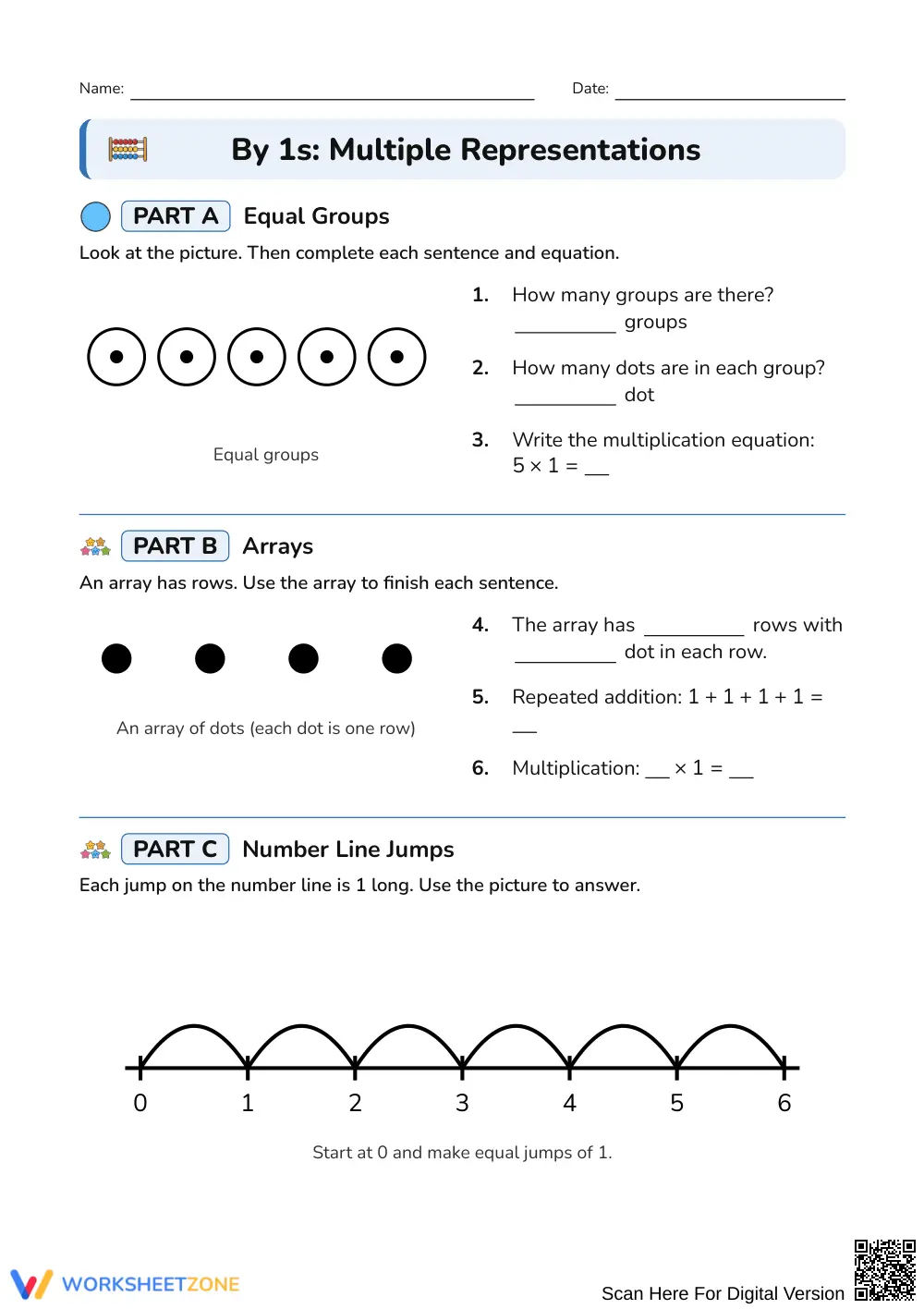
This Grade 3 math worksheet develops conceptual fluency with multiplication by one through multiple visual and symbolic representations. Students connect equal groups, arrays, number line jumps, and function tables to multiplication equations and repeated addition sentences. Working through these models solidifies the identity property of multiplication while ensuring students understand the structural meaning behind single-unit groups.
At a Glance
- Grade: 3 · Subject: Math
- Standard:
3.OA.A.1— Interpret products of whole numbers using equal groups, arrays, and jumps- Skill Focus: Multiple representations for multiplication facts of one
- Format: 2 pages · 19 problems · Answer key included · PDF
- Best For: Skill consolidation or math intervention
- Time: 20–30 minutes
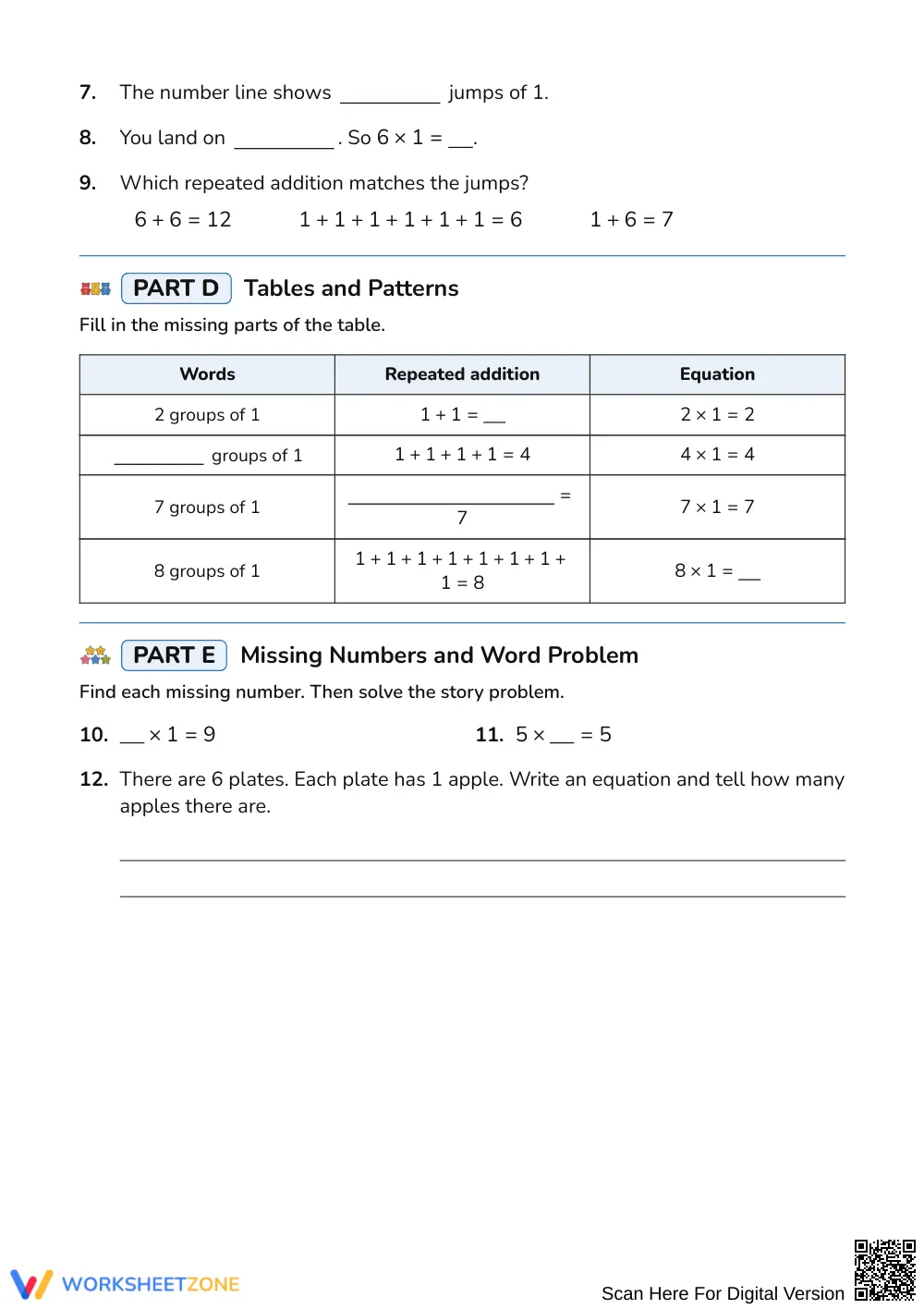
What's Inside: Across 2 complete student pages, this printable resource organizes 19 practice tasks divided into five progressive sections. Students interpret concrete pictorial diagrams of equal groups in Part A, analyze vertical dot arrays in Part B, track discrete hops on a number line in Part C, complete a three-column translation table matching words to equations in Part D, and solve unknown-factor equations alongside an applied word problem in Part E. A complete 2-page answer key provides clear solutions for rapid grading.
Skill Progression
- Guided Practice (Parts A & B, 5 tasks): High scaffold support prompts learners to identify group counts, row quantities, and unit dot amounts before writing matching repeated addition and multiplication equations.
- Supported Practice (Parts C & D, 9 tasks): Medium scaffold support requires students to connect number line lengths to repeated addition expressions and translate between verbal descriptions and symbolic tables.
- Independent Practice (Part E, 5 tasks): Low scaffold support prompts learners to find missing products without visual prompts and apply multiplication by one to solve a contextual story problem.
This structure follows an intentional gradual-release model, shifting learners from teacher-guided visual modeling to independent mathematical application.
Standards Alignment
The primary standard for this resource is `3.OA.A.1`: Interpret products of whole numbers, such as interpreting 5 × 1 as the total number of objects in 5 groups of 1 object each. In addition, the tasks reinforce foundational understanding for 3.OA.C.7 by building mental multiplication strategies through visual patterns. Both standard codes can be copied directly into lesson plans, IEP goals, or district curriculum mapping tools.
How to Use It
Use this worksheet after direct instruction on equal groups to solidify conceptual understanding, or assign it during targeted small-group intervention for students who struggle to connect multiplication equations to visual representations. During completion, monitor whether students recognize that jumps of one on a number line directly equal the total number of jumps; this observation reveals whether they understand the unit size concept. Expect students to finish all 19 tasks within 20 to 30 minutes.
Who It's For
This resource supports Grade 3 general education classes, Tier 2 math intervention cohorts, and special education students who benefit from visual scaffolds and explicit translation between mathematical models. It pairs naturally with an anchor chart demonstrating equal groups and an introductory lesson on the identity property of multiplication.
According to Fisher & Frey (2014), implementing purposeful gradual-release frameworks with structured representations significantly strengthens mathematical reasoning and conceptual transfer. This Grade 3 worksheet operationalizes standard 3.OA.A.1 by guiding students through 19 structured items that translate multiplication facts of one across physical groups, arrays, number lines, tabular models, and contextual word problems. By explicitly connecting equal groups of one to repeated addition, the activity establishes a reliable schema for early operational fluency. The inclusion of a 2-page answer key ensures teachers can quickly identify procedural misconceptions, track mastery milestones, and measure progress accurately during daily instructional blocks.


