




























Views
Downloads

Printable Missing Dimension Area Worksheet | Grade 6 Math

Paste this activity's link or code into your existing LMS (Google Classroom, Canvas, Teams, Schoology, Moodle, etc.).
Students can open and work on the activity right away, with no student login required.
You'll still be able to track student progress and results from your teacher account.
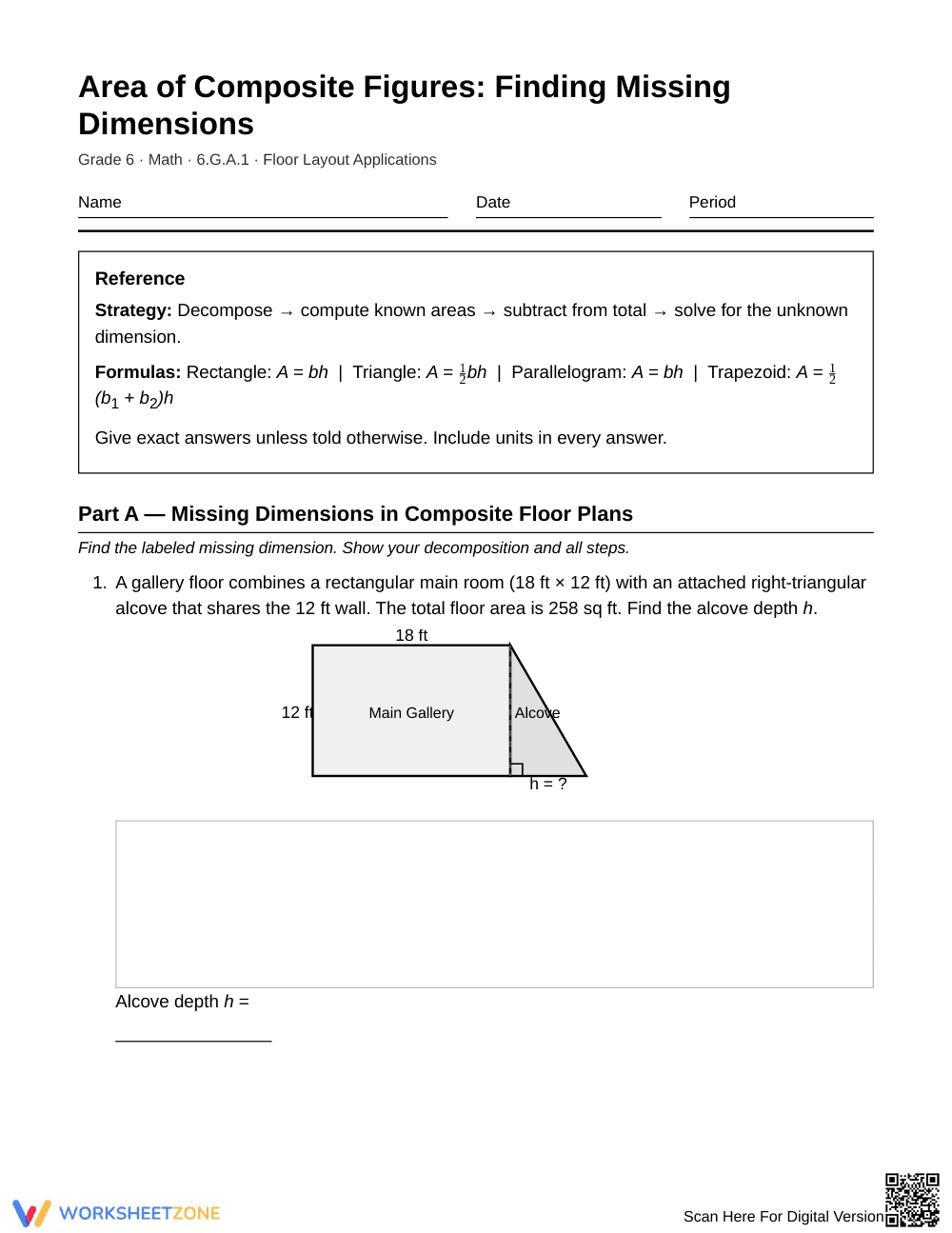
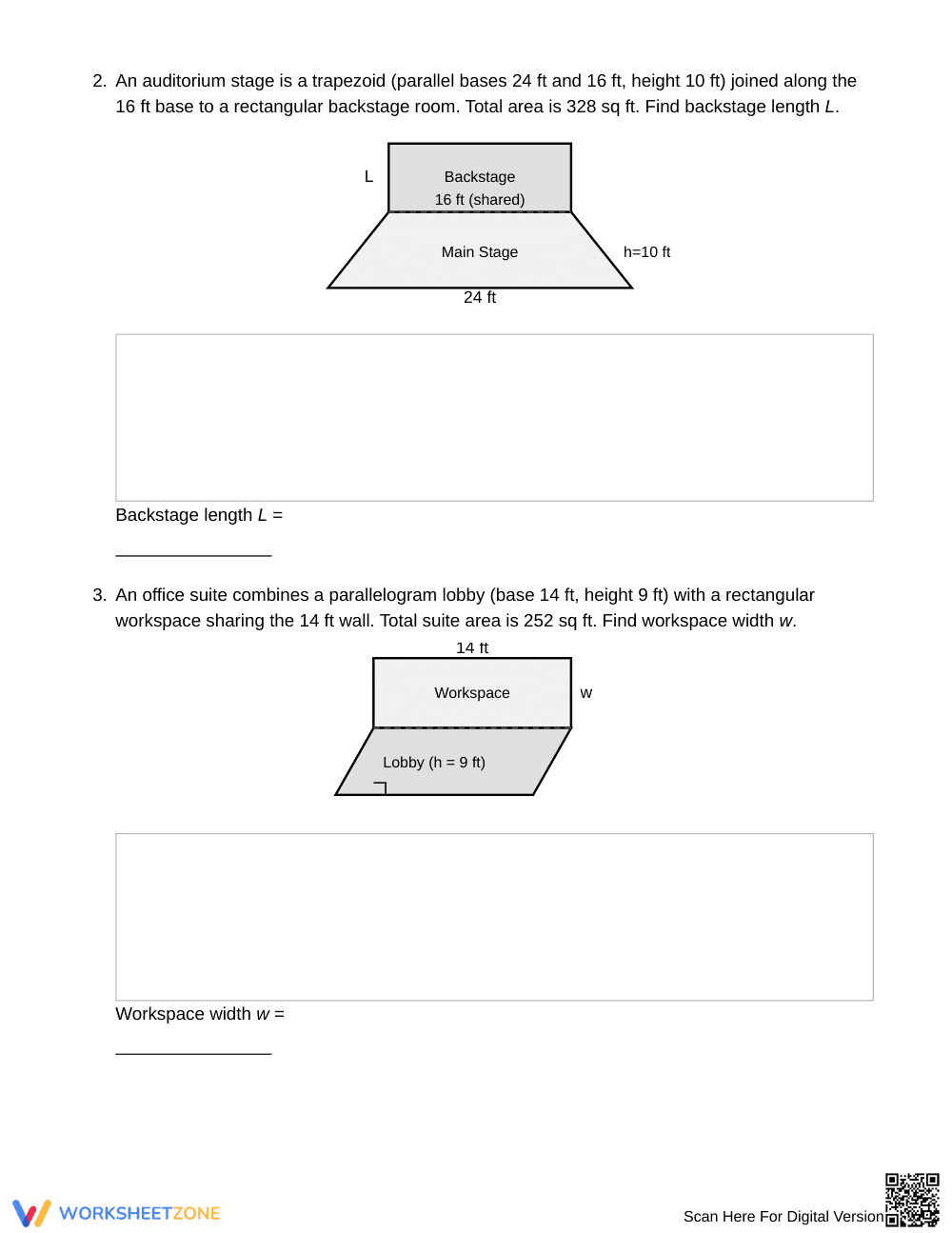
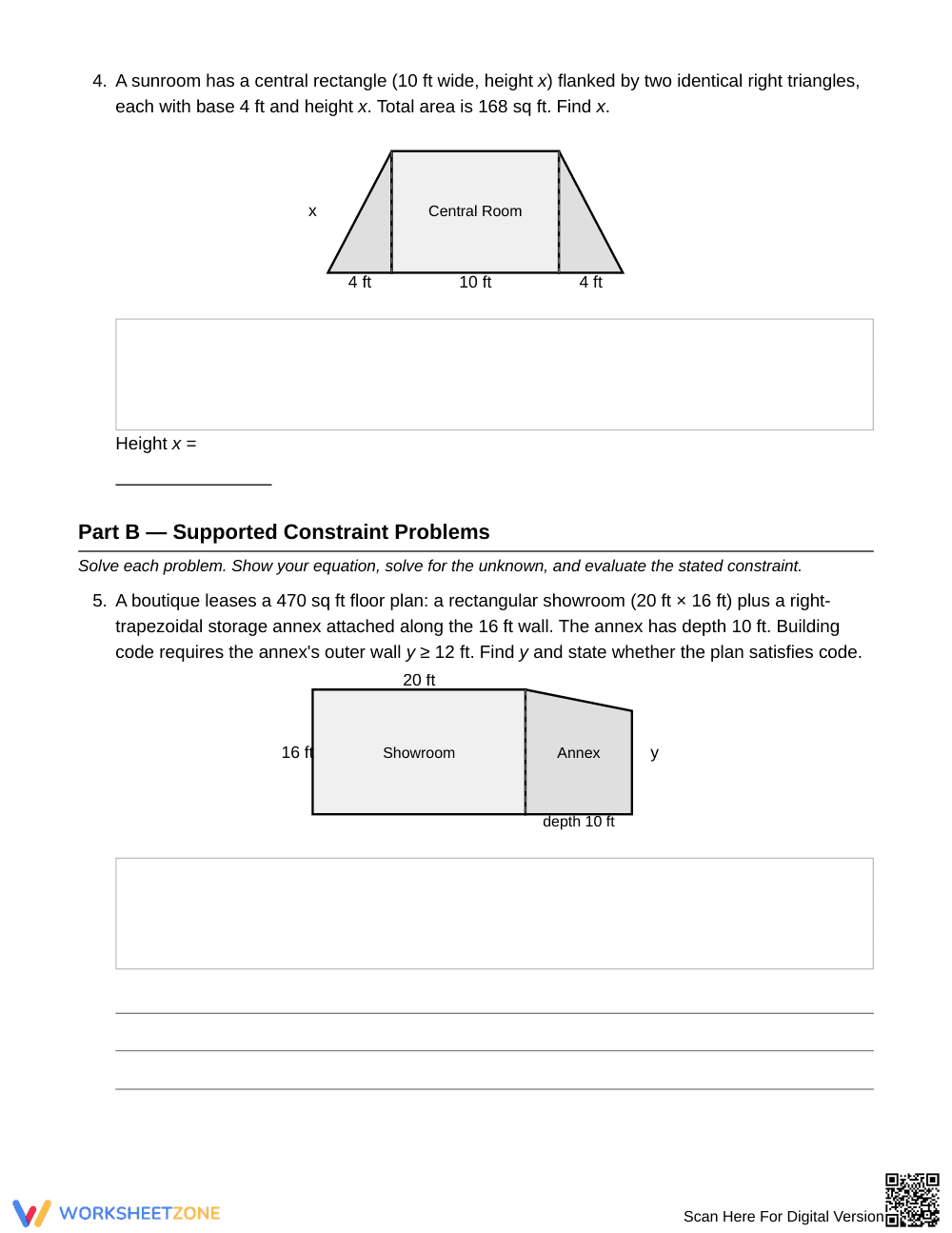
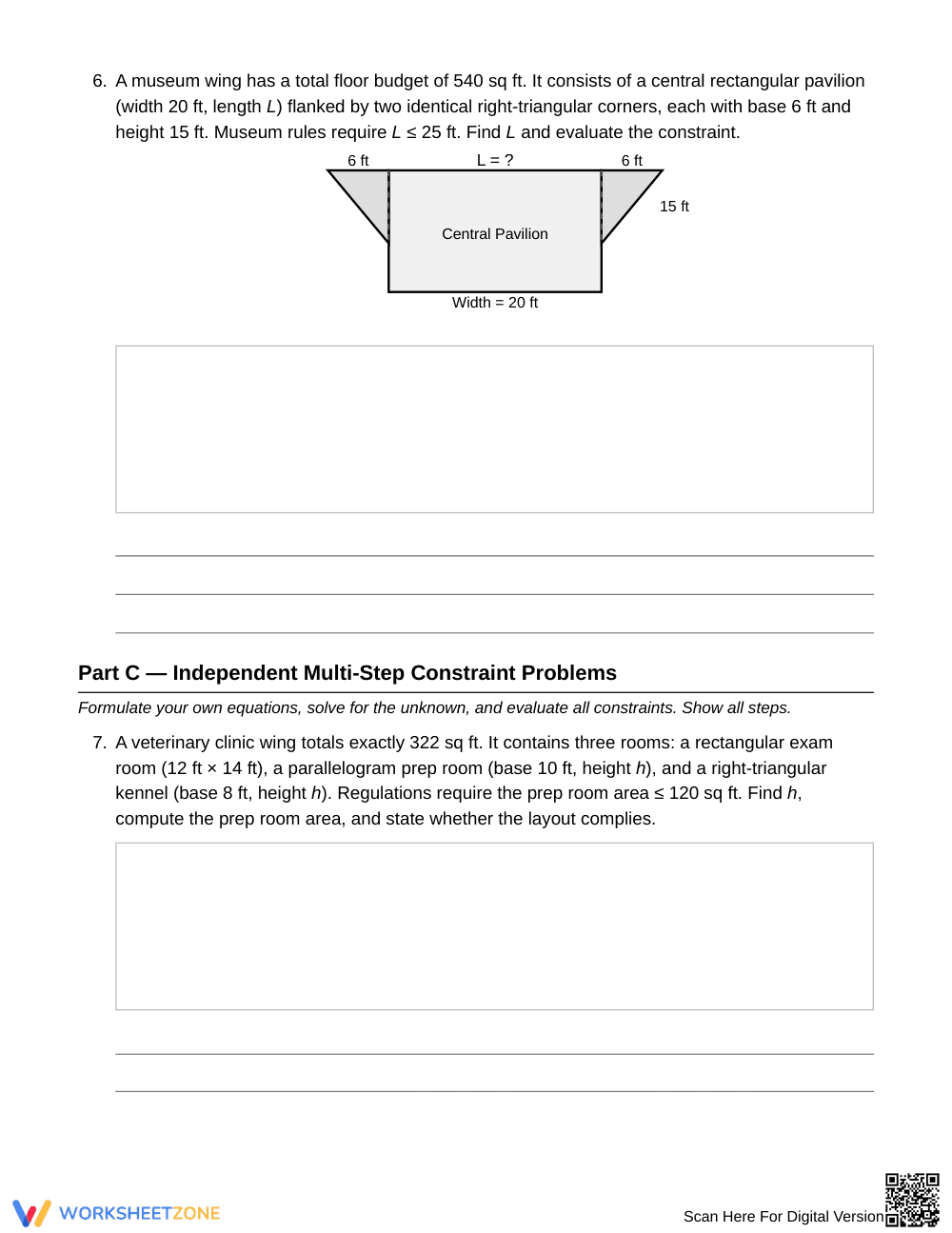
This Grade 6 geometry worksheet helps students find missing side lengths and heights in composite figures. By decomposing floor plans into rectangles, triangles, and trapezoids, learners write equations to isolate unknown dimensions, building the spatial reasoning required for authentic architectural problem solving.
At a Glance
- Grade: 6 · Subject: Math
- Standard:
6.G.A.1— Decompose composite figures into polygons to determine missing dimensions- Skill Focus: Find a Missing Dimension from a Composite Area
- Format: 6 pages · 10 problems · Answer key included · PDF
- Best For: Guided geometry practice and skill mastery
- Time: 45–60 minutes
This 6-page printable resource features 10 scaffolded problems across four distinct parts, plus a comprehensive 3-page answer key. Students utilize a built-in formula reference box, interpret visual diagrams, verify real-world building code constraints, and complete an open-ended studio apartment design on a grid.
Skill Progression
- Guided practice (Part A, 4 problems): Students decompose diagrammed two-room floor plans to calculate unknown alcove depths and room widths.
- Supported practice (Part B, 2 problems): Learners set up algebraic equations and evaluate building code inequalities.
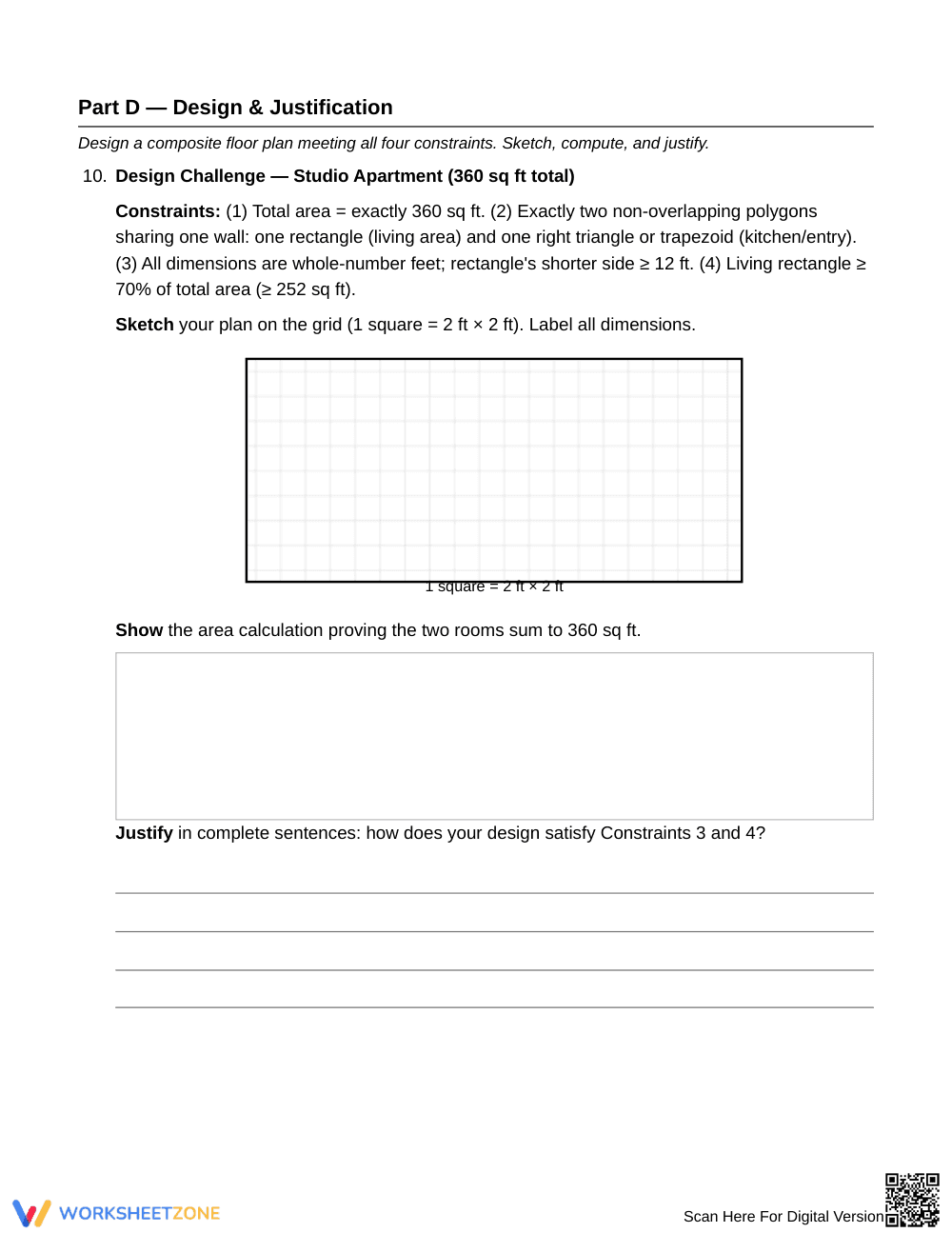
- Independent practice (Parts C & D, 4 problems): Students solve multi-room layouts independently and create a constrained architectural blueprint.
This gradual-release model guides students from visual decomposition to independent geometric problem solving.
Standards Alignment
This resource aligns with `6.G.A.1`: Find the area of right triangles, other triangles, special quadrilaterals, and polygons by composing into rectangles or decomposing into shapes to solve mathematical problems. It also supports 6.EE.B.7 through single-variable equation modeling. Both standard codes can be copied directly into lesson plans, IEP goals, or district curriculum mapping tools.
How to Use It
Assign this worksheet following direct instruction on polygon area formulas. For small-group intervention, have students color-code individual sub-regions before writing algebraic equations. Formative assessment tip: verify students halve the base-height product on triangular sections before subtracting from total area. Students typically complete all 10 tasks in 45 to 60 minutes.
Who It's For
This activity supports Grade 6 math students, advanced Grade 5 classes, and Grade 7 intervention groups. Formula reference cues assist struggling learners, while the Part D design challenge extends proficient thinkers. Pair this worksheet with graph paper manipulatives or an introductory polygon decomposition lesson.
Under Common Core standard 6.G.A.1, Grade 6 students decompose composite figures into triangles and quadrilaterals to determine unknown linear dimensions and total areas. According to Fisher & Frey (2014), structured instructional frameworks that transition from visual modeling to independent application accelerate mathematical reasoning and conceptual retention in middle school learners. This 6-page worksheet operationalizes that methodology through 10 sequenced geometry problems requiring students to calculate sub-areas, subtract from known totals, and isolate variables. By engaging with realistic floor plans, building code constraints, and an open-ended studio apartment design task, students build durable connections between geometric decomposition and algebraic equations. The resource provides educators with verifiable evidence of student mastery in spatial measurement, multi-step problem solving, and mathematical modeling, ensuring middle school learners develop the foundational geometric competencies necessary for advanced secondary mathematics coursework.


