































Printable Microscope Word Search | Grades 4–5 Science

Paste this activity's link or code into your existing LMS (Google Classroom, Canvas, Teams, Schoology, Moodle, etc.).
Students can open and work on the activity right away, with no student login required.
You'll still be able to track student progress and results from your teacher account.
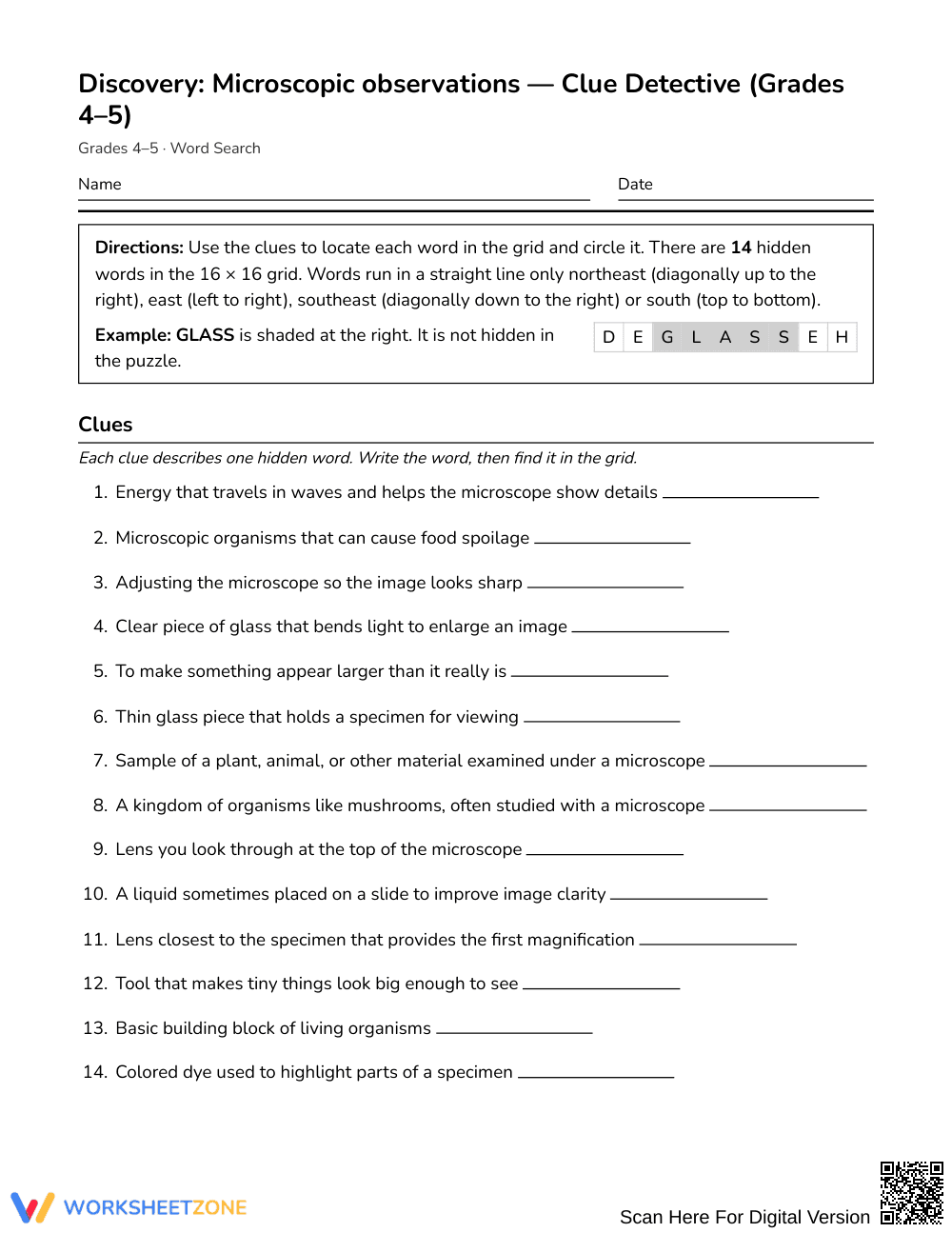
This Grades 4–5 science word search builds student mastery of microscopic observations by reinforcing key scientific terminology through clue-based retrieval. Students connect essential microscope vocabulary to clear scientific definitions, cementing concepts like magnification, specimens, and lenses before locating each term in an engaging puzzle format.
At a Glance
- Grade: Grades 4–5 · Subject: Science
- Standard: Not standards-assessed — vocabulary enrichment
- Skill Focus: Microscopic observations, laboratory equipment, and cell biology terminology
- Format: 2 student pages · 14 hidden vocabulary words · Full answer key included · PDF
- Best For: Science vocabulary reinforcement, station work, and pre-lab review
- Time: 20–30 instructional minutes
This 2-page science activity contains 14 hidden words embedded within a themed letter grid, accompanied by a comprehensive 3-page answer key showing all word placements. Rather than relying on rote word searches, each term includes a clue explaining scientific functions, such as how an objective lens provides magnification or how a slide holds a specimen. The resource features a shuffled word bank and clear definitions to prompt active cognitive engagement.
Puzzle Structure and Mechanics
The puzzle is structured across a dense 16 x 16 letter grid designed to develop visual scanning and spatial tracking skills. Words are hidden across four specific search directions: northeast (NE), east (E), southeast (SE), and south (S). Students read 14 targeted descriptive clues to identify terms like ocular, specimen, and bacteria. After matching the definitions to words in the shuffled word bank, learners locate each term along the diagonal and linear letter paths.
Standards Alignment
This activity serves strictly as vocabulary enrichment and is not aligned to a specific state or national content standard. It reinforces essential academic vocabulary and contextual understanding required for microscope investigations, optics, and cell study across upper elementary science curricula.
How to Use It
Use this resource before direct instruction as an engaging pre-teaching hook to introduce unfamiliar microscope terminology. Alternatively, deploy it after hands-on lab sessions as a quiet consolidation activity. For formative assessment, circulate as students match clues to check whether they can explain the purpose of parts like the objective lens before searching the grid. Students typically complete the 14 words within 20 to 30 minutes.
Who It's For
This puzzle is designed for Grades 4–5 science students exploring life science and optics. For differentiated support, pair emerging readers with a peer partner or highlight clue keywords, while advanced learners can write original sentences for each identified term. Pair this printout directly with an introductory microscope anchor chart or a hands-on slide preparation lab.
Designed for Grades 4–5 science instruction, this 14-word puzzle supports microscopic observations through targeted vocabulary enrichment rather than a formal standard code. According to Fisher & Frey (2014), intentional disciplinary literacy routines that integrate domain-specific vocabulary with contextual definitions build stronger conceptual schema than isolated memorization exercises. By pairing scientific descriptions of lenses, specimens, magnification, and ocular components with active spatial retrieval across a 16 x 16 letter grid, students reinforce fundamental science terminology essential for laboratory readiness. The two-page activity prompts learners to process functional clues before locating words positioned across four directional orientations, bridging passive reading and active concept recall. With an included three-page answer key, this resource provides teachers with a structured, verified tool to reinforce science language before or after hands-on microscope investigations, ensuring elementary students master the precise vocabulary required for advanced scientific inquiry.


