





























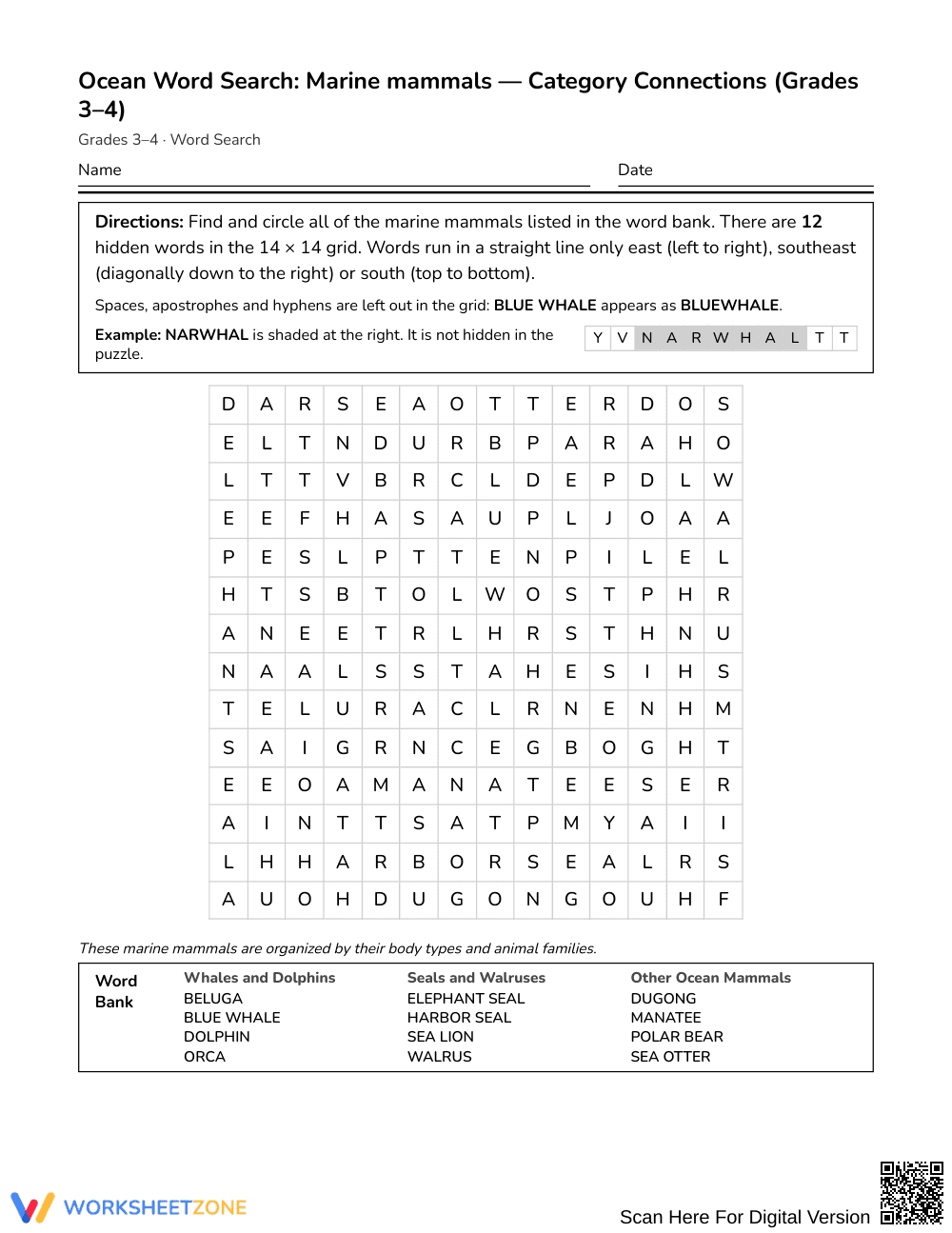


Printable Marine Mammals Word Search | Grades 3–4 Science

Paste this activity's link or code into your existing LMS (Google Classroom, Canvas, Teams, Schoology, Moodle, etc.).
Students can open and work on the activity right away, with no student login required.
You'll still be able to track student progress and results from your teacher account.
This Grades 3–4 ocean science word search introduces students to marine mammals through engaging vocabulary practice. Learners discover twelve ocean species while exploring animal classification, family groups, and distinct physical adaptations. Designed for immediate classroom use, this activity builds scientific literacy and spelling confidence in a self-contained, print-and-go format.
At a Glance
- Grade: Grades 3–4 · Subject: Science
- Standard: Not standards-assessed — vocabulary enrichment for elementary life science units
- Skill Focus: Marine mammal identification and animal classification
- Format: 1 page · 12 words · 3-page answer key included · PDF
- Best For: Science centers, sub plans, or early finishers
- Time: 15–20 minutes
What's Inside
This 1-page printable features a word search activity centered on ocean life. It contains 12 target vocabulary words grouped into meaningful biological categories rather than an unorganized alphabetical list. The resource includes comprehensive descriptive clues for each animal and comes with a 3-page answer key showing full letter solutions for effortless grading.
Puzzle Structure and Mechanics
The puzzle utilizes a clear 14 x 14 grid designed specifically for elementary learners. Words are hidden in three standard directions: east (horizontally forward), southeast (diagonally downward), and south (vertically downward), preventing the visual confusion of reverse-spelled terms. Students locate animals organized across three distinct families: Whales and Dolphins, Seals and Walruses, and Other Ocean Mammals. Accompanying clues detail key physical traits and habitats for every animal.
Standards Alignment
This word search serves strictly as a vocabulary enrichment resource and is not aligned to a formal academic content standard. It reinforces essential life science terminology and supports spelling awareness within elementary animal classification units without requiring formal standard benchmarking.
How to Use It
Deploy this word search during an animal classification unit as an engaging warm-up before direct instruction or as an independent task during science stations. When observing students at work, check whether they read the clues to associate anatomical features with each animal name before searching the grid. Students typically complete the 12-word puzzle in 15 to 20 minutes.
Who It's For
This resource is tailored for Grades 3–4 science students developing foundational life science vocabulary. It offers accessible practice for visual learners and early finishers needing constructive tasks. Pair this word search with an ocean habitats reading passage or an animal classification anchor chart to deepen conceptual understanding.
Vocabulary enrichment activities support domain-specific knowledge acquisition in elementary science classrooms. According to Fisher & Frey (2014), intentional exposure to technical terminology within organized conceptual categories helps students bridge the gap between everyday conversational language and academic life science concepts. This 1-page ocean word search reinforces recognition of twelve distinct marine mammals by structuring target terms across biological groupings, including whales, dolphins, seals, and walruses. Accompanying descriptive clues provide context regarding anatomical adaptations, feeding habits, and marine habitats. Integrating focused vocabulary puzzles during animal classification units strengthens orthographic mapping, letter-pattern recognition, and scientific literacy without placing heavy cognitive demands on emerging readers. Classroom teachers can deploy this activity during introductory classification lessons, independent literacy rotations, or as an engaging sponge activity to reinforce key biological terminology efficiently and systematically across diverse third- and fourth-grade learning environments.


