

































Printable Mapping Sequences Worksheet | Grade 10 Geometry

Paste this activity's link or code into your existing LMS (Google Classroom, Canvas, Teams, Schoology, Moodle, etc.).
Students can open and work on the activity right away, with no student login required.
You'll still be able to track student progress and results from your teacher account.
This Grade 10 Geometry worksheet builds students' ability to compare, evaluate, and justify alternative rigid-motion mapping sequences. Across 12 carefully structured problems, students move from reading composite transformations to testing sequence equivalence to critiquing flawed arguments, developing the precise geometric reasoning required by HSG-CO.A.5.
At a Glance
- Grade: 10 · Subject: Geometry
- Standard:
HSG-CO.A.5— Draw transformed figures and specify sequences of transformations that map one figure onto another- Skill Focus: Comparing alternative rigid-motion mapping sequences
- Format: 5 pages · 12 problems · Answer key included · PDF
- Best For: Guided practice after transformation instruction
- Time: 40–55 minutes
Worksheet Structure
The 5-page resource is divided into three distinct sections following an intentional gradual-release model:
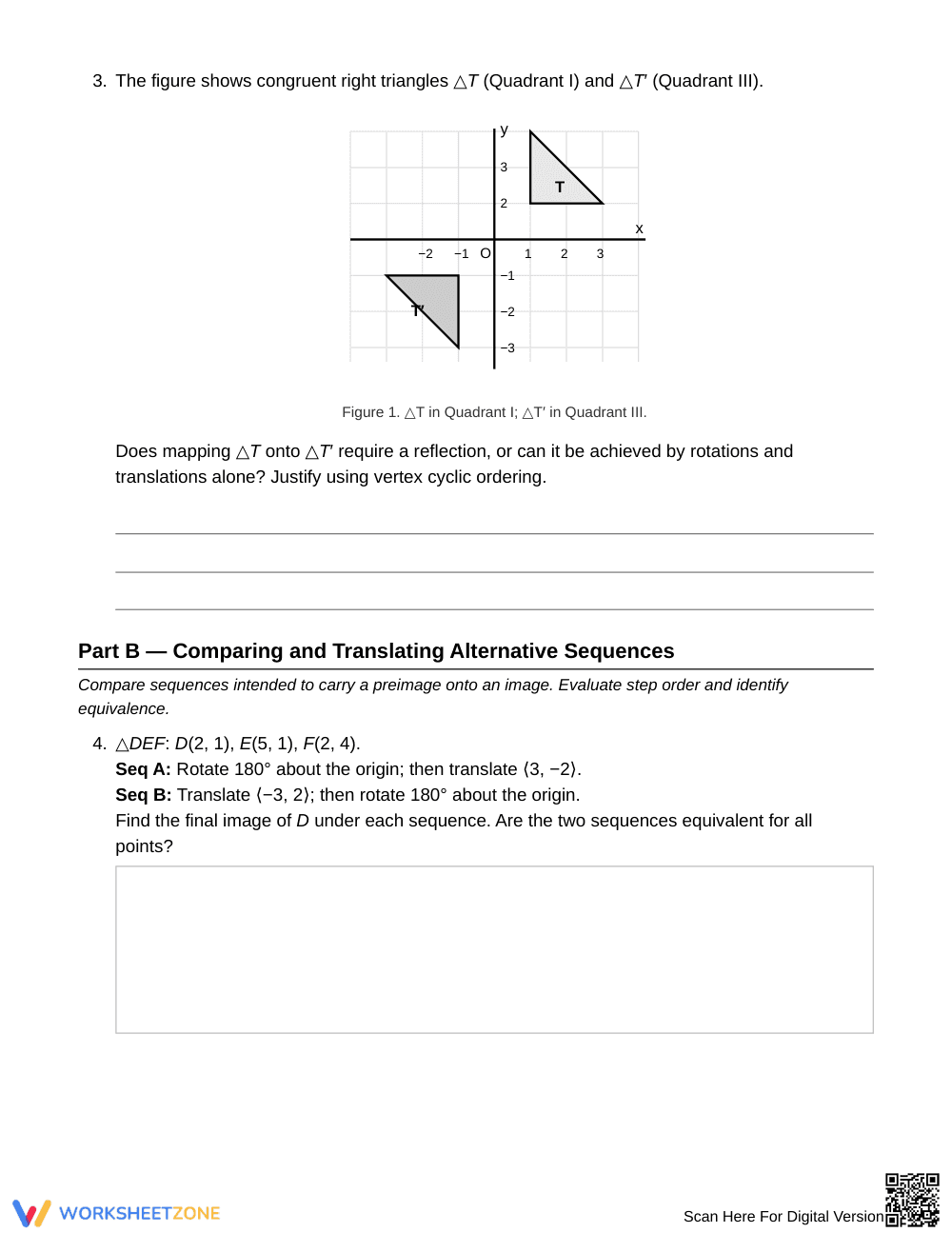
- Part A (3 problems): Guided interpretation of composite transformations. Students calculate intermediate coordinates, determine single equivalent transformations, and analyze orientation changes.
- Part B (6 problems): Supported sequence evaluation. Students complete comparison tables for competing sequences, examine reflection commutativity, and test full sequences across all vertices of a triangle.
- Part C (3 problems): Independent critique and argumentation. Students evaluate competing claims, construct numerical counterexamples, and write justifications based on isometry classification.
Standards Alignment
This worksheet is aligned directly to primary standard HSG-CO.A.5, requiring students to specify and justify transformation sequences carry one geometric shape onto another. It also supports HSG-CO.A.3 through orientation analysis and reflection symmetry concepts.
How to Use It
Assign Part A immediately following direct instruction on composite transformations to assess baseline comprehension. If students struggle with equivalent single transformations, review the intersecting-reflections theorem before proceeding. Utilize Parts B and C during subsequent class periods for partner problem-solving or independent practice during your congruence unit consolidation phase. To support diverse learners, provide transformation anchor charts for students needing visual aids, and encourage advanced learners to write general algebraic proofs for non-commutative sequences rather than single counterexamples.
This 5-page, 12-problem worksheet targets HSG-CO.A.5 by having students specify and compare sequences of rigid motions that carry one figure onto another. National assessment data consistently identifies transformation sequence analysis as a persistent instructional gap in high school geometry curricula. Research by Fisher & Frey (2014) on gradual-release instruction supports the three-part progression used throughout this resource: reference-scaffolded interpretation items precede multi-step sequence comparisons, which lead directly into open-ended argumentation tasks where learners construct counterexamples and critique mathematical claims. This deliberate scaffolding ensures that procedural fluency with coordinate rules develops alongside conceptual mastery of orientation, commutativity, and isometry classification. With a complete answer key containing exact coordinates and written justifications, this resource functions effectively for formative assessment, targeted intervention, partner problem-solving, or structured review during your congruence unit. Secondary mathematics educators can use these structured activities to build rigorous geometric reasoning across all student ability levels.


