


























Views
Downloads

Printable Major Bones Word Search | Grades 2–3 Science
Paste this activity's link or code into your existing LMS (Google Classroom, Canvas, Teams, Schoology, Moodle, etc.).
Students can open and work on the activity right away, with no student login required.
You'll still be able to track student progress and results from your teacher account.
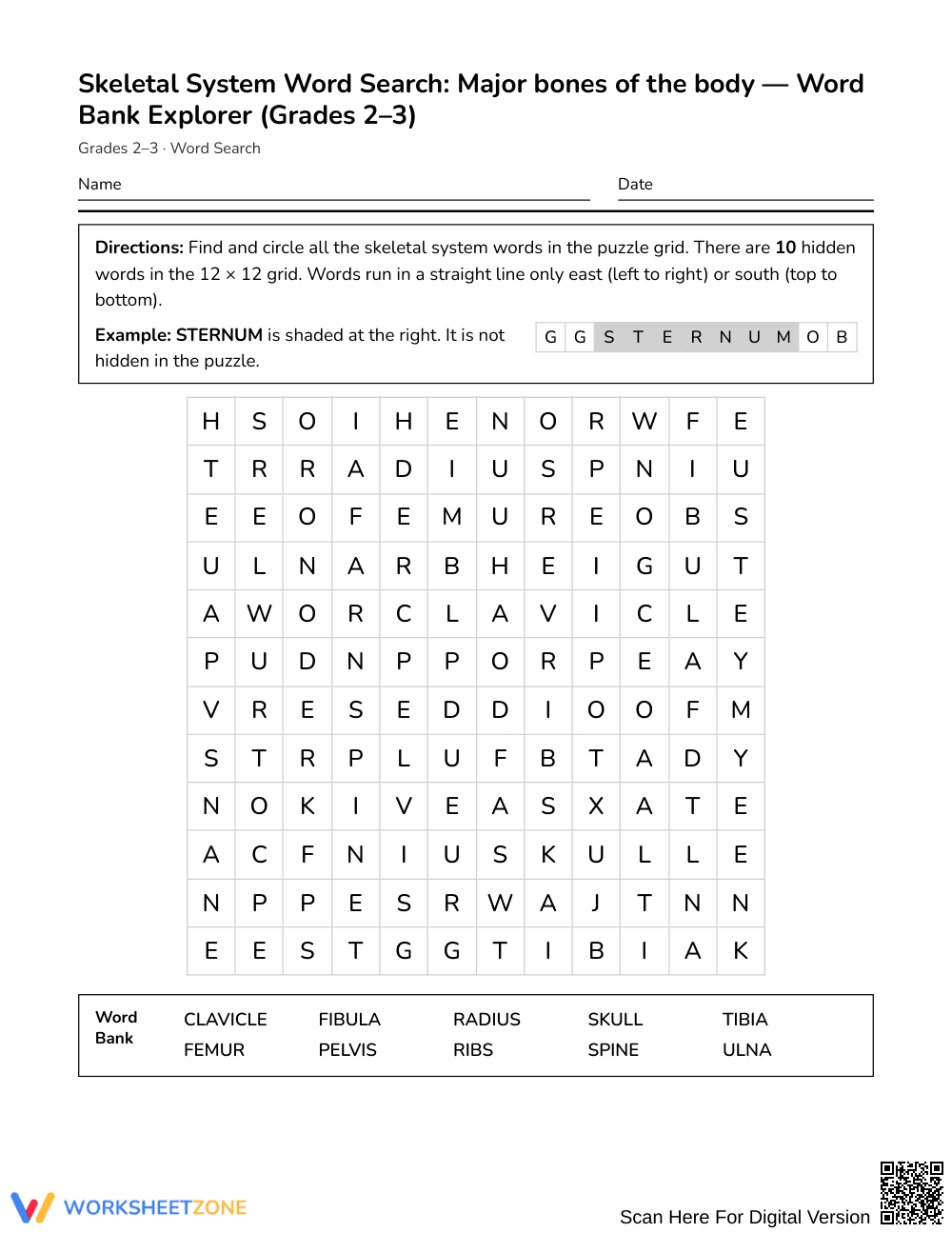
This Grades 2–3 skeletal system word search introduces learners to major bones of the body through focused vocabulary recognition. Students identify anatomical terms in an accessible puzzle format that reinforces correct spelling and scientific naming conventions. The activity builds foundational human anatomy vocabulary while keeping young elementary students actively engaged in independent science learning.
At a Glance
- Grade: Grades 2–3 · Subject: Science
- Standard: Not standards-assessed — vocabulary enrichment
- Skill Focus: Major bones of the body
- Format: 1 page · 10 words · Answer key included · PDF
- Best For: Science centers and early finishers
- Time: 15–20 minutes
The single-page printable features an uncluttered puzzle layout tailored for early elementary students. It provides an alphabetical word bank containing ten foundational skeletal terms, alongside brief descriptive clues for each bone. A two-page answer key provides clear visual overlays displaying all word locations, making student self-checking and grading quick and straightforward.
This vocabulary activity utilizes a 12 by 12 grid specifically designed for beginning puzzle solvers. Hidden words run only from left to right horizontally (East) and top to bottom vertically (South), avoiding diagonal or backward placements that often frustrate emerging readers. Students locate each term from an alphabetical word bank, circling targeted anatomy vocabulary while practicing systematic letter-by-letter scanning.
This resource serves as targeted vocabulary enrichment and is not aligned to a formal state or national content standard. Instead, it supports foundational science literacy by reinforcing key anatomical terminology encountered across elementary life science units. Students gain familiarity with technical vocabulary before encountering more complex human body systems curricula.
Deploy this activity during independent practice after direct instruction introducing the skeletal system, or use it as an engaging science station. For a quick formative check, circulate as students work to verify whether they recognize bone locations on their own bodies as they find each term. Most students complete the 10-word puzzle within 15 to 20 minutes.
This word search is designed for second and third grade science students learning human body systems. It supports visual learners and emerging readers through clean spacing and predictable word directions. Pair this worksheet directly with a classroom skeleton model, anatomy anchor chart, or introductory reading passage on the human body.
Elementary science instruction benefits significantly from intentional vocabulary acquisition strategies that pair visual word recognition with conceptual definitions. According to Fisher & Frey (2014), purposeful word-learning routines build the foundational domain knowledge required for complex reading comprehension in informational texts. When primary students encounter technical anatomical terms such as femur, clavicle, and pelvis through structured search tasks, they develop orthographic familiarity that reduces cognitive load during subsequent science reading. Incorporating controlled puzzle activities with predictable search orientations—such as left-to-right and top-to-bottom configurations—allows developing readers to concentrate on orthographic patterns without experiencing spatial disorientation. This focused exposure reinforces domain-specific spelling and memory retention, establishing an essential vocabulary base before learners tackle more demanding physiological processes. Consequently, structured vocabulary enrichment serves as a critical bridge between early spoken science concepts and formal written scientific literacy across early elementary classrooms.


