




























Views
Downloads



Printable Law of Cosines Proof Worksheet | Grade 11-12 Math

Paste this activity's link or code into your existing LMS (Google Classroom, Canvas, Teams, Schoology, Moodle, etc.).
Students can open and work on the activity right away, with no student login required.
You'll still be able to track student progress and results from your teacher account.
This worksheet guides students through a complete proof of the Law of Cosines, c² = a² + b² − 2ab·cos C, by dropping an altitude and applying the Pythagorean Theorem. Students work through the acute and obtuse cases, then use the result to classify triangles and recover the Pythagorean Theorem.
At a Glance
- Grade: 11–12 · Subject: Math
- Standard:
HSG-SRT.D.10— Prove the Law of Cosines and use it to solve problems- Skill Focus: Altitude-based proof of the Law of Cosines
- Format: 3 pages · 17 problems · Answer key included · PDF
- Best For: Proof practice after introducing the formula
- Time: 25–35 minutes
What's Inside
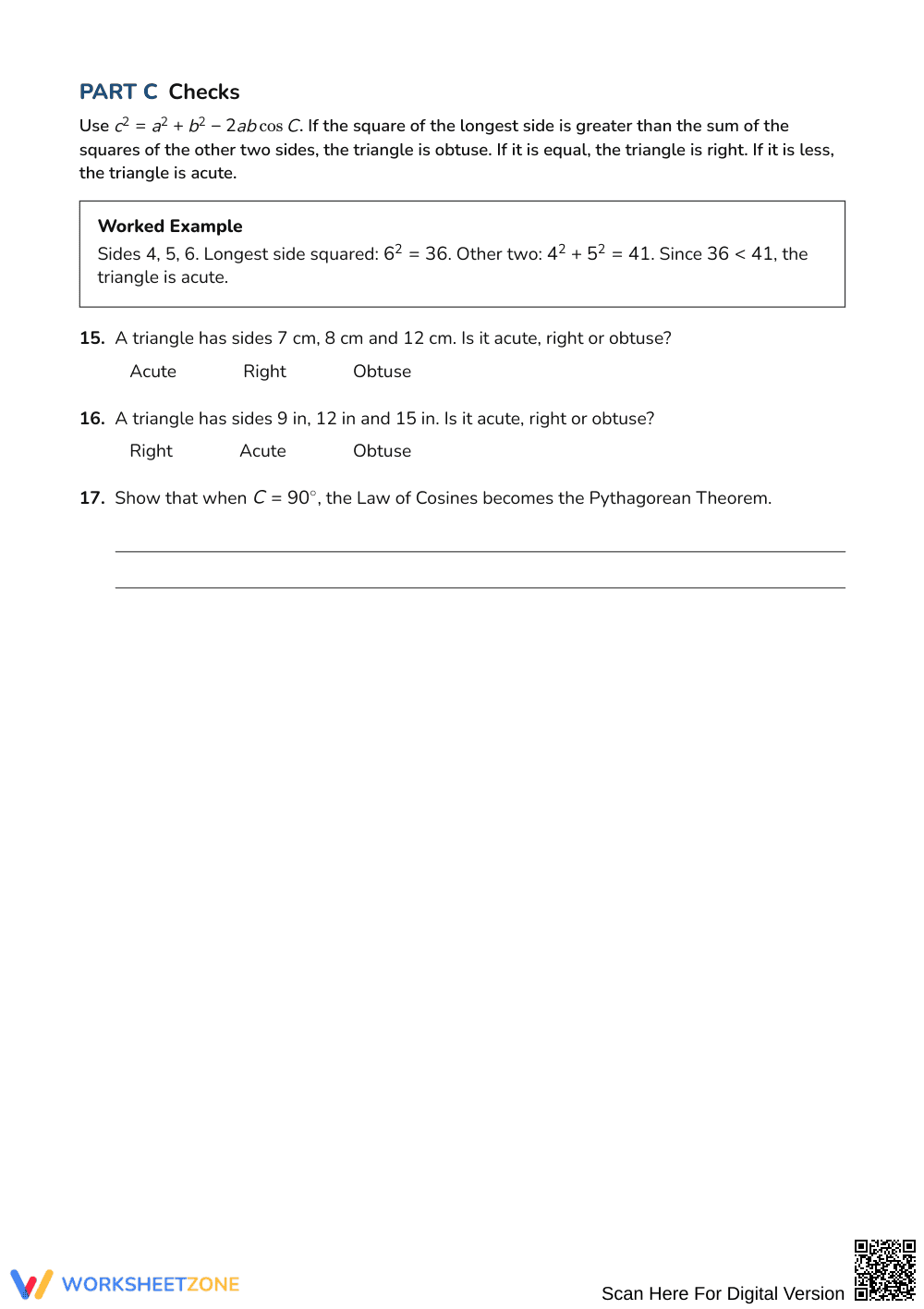
The worksheet has three parts on 3 pages. Parts A and B are fill-in-the-blank proofs with a labeled diagram (not drawn to scale) and a setup box. Part C opens with a rule for comparing the square of the longest side to the sum of the other two squares, then gives a worked example, two classification questions (acute, right or obtuse) and one show-that question for C = 90°. A 3-page answer key lists every missing expression and answer.
Skill Progression
- Guided practice: Part A walks through the acute case, with each step scaffolded and the missing expression written in a blank.
- Supported practice: Part B adapts the same argument to an obtuse triangle, where the altitude falls outside the triangle and students use 180° − C.
- Independent practice: Part C asks students to classify two triangles and show that the formula reduces to the Pythagorean Theorem.
The structure follows gradual release: I Do, We Do, You Do.
Standards Alignment
HSG-SRT.D.10 — Prove the Laws of Sines and Cosines and use them to solve problems. This worksheet addresses the Law of Cosines half of the standard. The standard code can be copied directly into lesson plans, IEP goals, or district curriculum mapping tools.
How to Use It
- During direct instruction: Work Part A together on the board, then have pairs complete Part B.
- After instruction: Assign Part C as independent practice or an exit task.
Formative-assessment tip: watch how students handle the sign of CD in the obtuse case, since that is where reasoning most often breaks down. Expect 25–35 minutes in total.
Who It's For
Students in Grades 11–12 Geometry, Precalculus or Trigonometry who know right-triangle trigonometry and the Pythagorean identity. Students who need more support can complete Part A first and review the worked example before Part C. It pairs well with a direct instruction lesson on the Law of Cosines.
The Proving the Law of Cosines: Guided Proof worksheet for Grades 11–12 Math addresses HSG-SRT.D.10, which asks students to prove the Laws of Sines and Cosines and use them to solve problems. In 3 pages and 17 tasks, students complete the proof of c² = a² + b² − 2ab·cos C for an acute triangle, adapt it to an obtuse triangle using the supplementary angle 180° − C, and then apply the formula to classify triangles and show that it reduces to the Pythagorean Theorem when C = 90°. The sequence follows the gradual release model described by Fisher & Frey (2014), moving from full scaffolding to independent reasoning. Each step is short enough to complete in class, which keeps attention on the reasoning behind the algebra. A three-page answer key shows each missing expression and every classification, so teachers can check proof logic quickly and give targeted feedback.


