




























Printable June Pollinators Word Search | Grades 4–5 Science
Paste this activity's link or code into your existing LMS (Google Classroom, Canvas, Teams, Schoology, Moodle, etc.).
Students can open and work on the activity right away, with no student login required.
You'll still be able to track student progress and results from your teacher account.
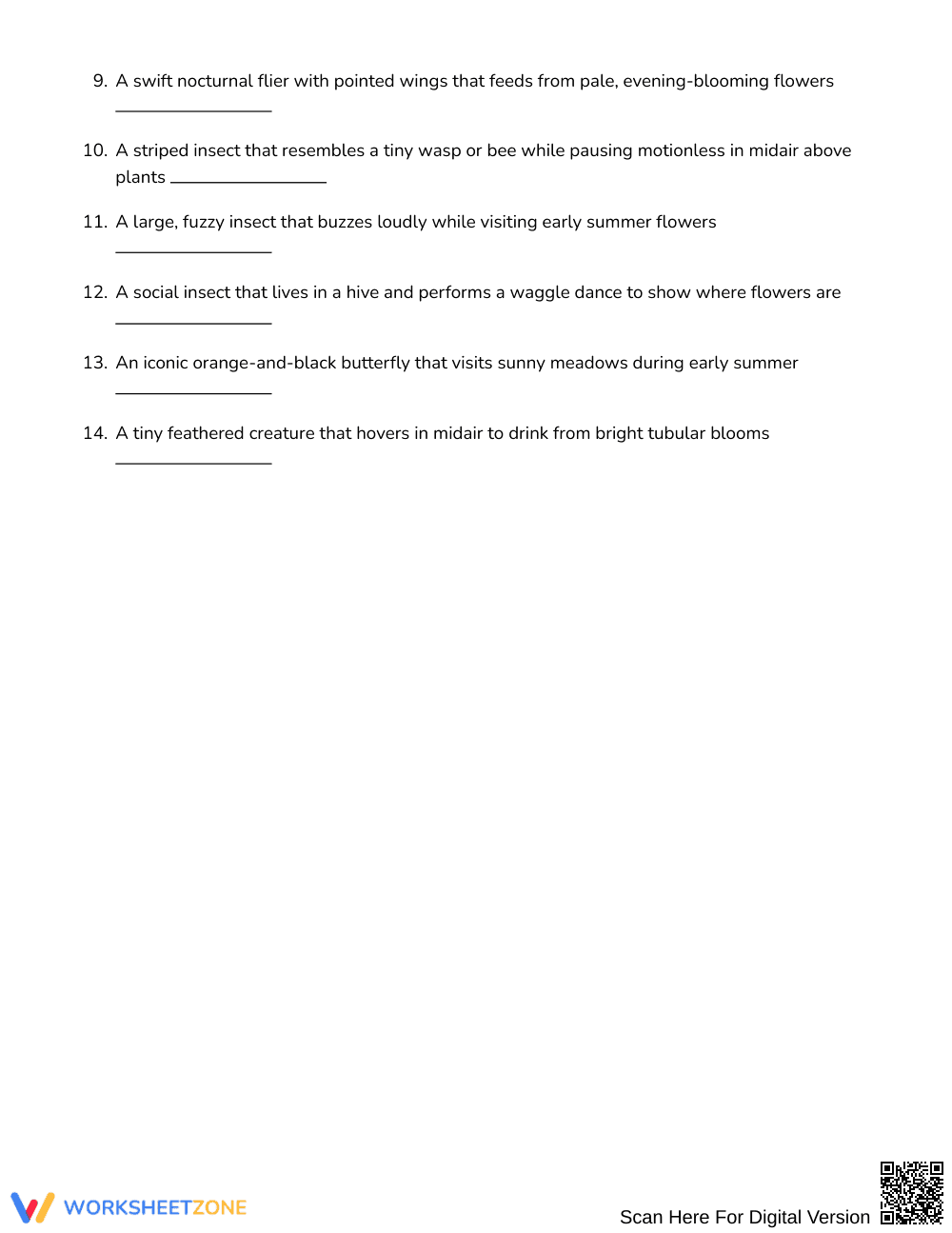
This science word search builds life science vocabulary by challenging Grades 4–5 students to identify summer pollinators and plant structures. Learners read descriptive clues to solve 14 target words before finding them in the grid, reinforcing key biology concepts such as pollination, nectar foraging, and insect anatomy.
At a Glance
- Grade: Grades 4–5 · Subject: Elementary Life Science
- Standard: Not standards-assessed — vocabulary enrichment and seasonal science reinforcement
- Skill Focus: Pollinators in June vocabulary, plant anatomy, and insect adaptations
- Format: 3 pages · 14 words · Full answer key included · Printable PDF
- Best For: Independent science centers, seasonal review, and early finishers
- Time: 20–30 minutes total student completion time
What's Inside
This 3-page printable resource includes a clue detective word search puzzle and a full 3-page answer key. Rather than relying on a simple word bank, the activity provides 14 informational clues describing pollinators, plant anatomy, and insect behaviors. Students solve each clue to identify terms like bumblebee, proboscis, and anther, then locate them in the puzzle grid. The included answer key highlights all word paths for rapid grading.
Puzzle Structure and Mechanics
The activity features a 16 x 16 letter grid containing 14 hidden vocabulary words. Words are placed in four directions: northeast, east, southeast, and south. Learners read informational clues to deduce each term and consult a shuffled word bank for spelling support, connecting vocabulary directly to biological concepts.
Standards Alignment
This activity provides vocabulary enrichment and is not aligned to a formal science standard. It serves as supplemental practice to reinforce domain-specific language, seasonal biology themes, and reading comprehension in upper elementary science.
How to Use It
Use this word search after direct instruction on plant reproduction as a reinforcing review, or assign it as an independent science center task. As students work, check whether they solve the science clues before searching the grid to formatively assess vocabulary understanding. Expected completion time is 20 to 30 minutes.
Who It's For
This puzzle is designed for Grades 4–5 students studying life science and ecosystems. Support English language learners by pairing them with peers or providing an illustrated pollinator anchor chart. It pairs naturally with an informational text on June insects or a flower anatomy lesson.
Research by Fisher & Frey (2014) emphasizes that developing domain-specific vocabulary through contextual clues improves student comprehension and knowledge retention in elementary science instruction. This June pollinators word search engages Grades 4–5 learners with 14 descriptive science clues covering insect pollination, foraging behaviors, and plant reproduction structures. While not assessed under a specific standard code, this enrichment activity strengthens scientific literacy by requiring students to connect definitions to terms such as milkweed, honeybee, and proboscis before locating them in a 16 x 16 letter grid. Searching across four directional paths reinforces visual tracking, spelling accuracy, and word recognition in young learners. The resource offers an effective, low-stress practice opportunity for science stations, early finishers, and seasonal thematic units, helping students build confidence with foundational biology concepts while deepening their overall understanding of seasonal natural ecosystems.


