





























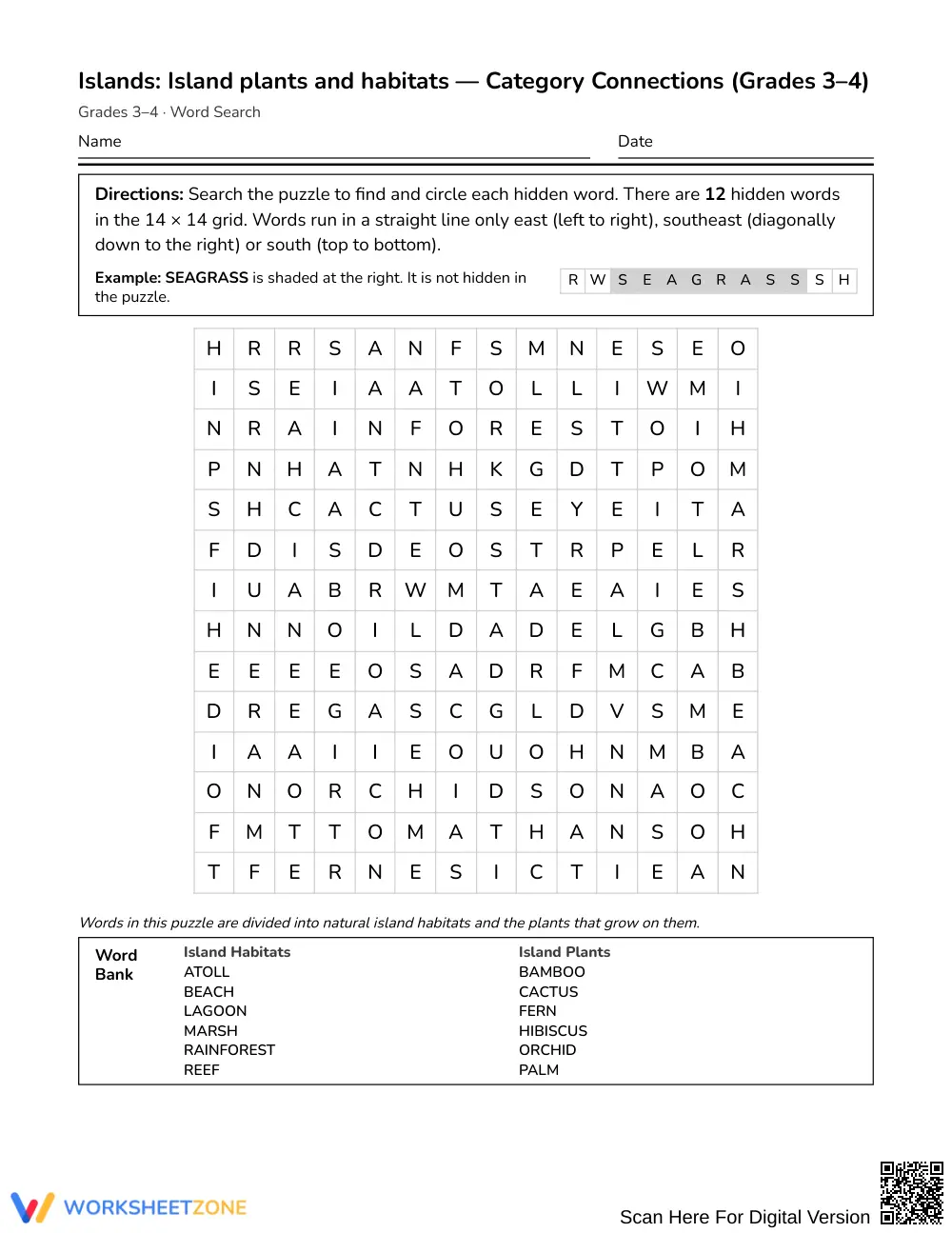


Printable Island Habitats Word Search | Grades 3–4 Science

Paste this activity's link or code into your existing LMS (Google Classroom, Canvas, Teams, Schoology, Moodle, etc.).
Students can open and work on the activity right away, with no student login required.
You'll still be able to track student progress and results from your teacher account.
This Grades 3–4 science word search reinforces vocabulary related to island plants and habitats through targeted word recognition. Students identify twelve specialized science terms divided into distinct ecological groups, solidifying their understanding of unique island ecosystems. This activity strengthens domain-specific reading skills and scientific terminology retention across introductory life science and Earth science lessons.
At a Glance
- Grade: Grades 3–4 elementary classrooms · Subject: Science
- Standard: Not standards-assessed — vocabulary enrichment
- Skill Focus: Island botanical life, tropical ecosystems, and specialized coastal habitats
- Format: 1 student page · 12 hidden words · 3 answer key pages included · Printable PDF
- Best For: Science vocabulary reinforcement, independent seatwork, and fast finishers
- Time: 15–25 minutes of focused learning
What's Inside
This 1-page science word search challenges learners to locate 12 words embedded in a letter puzzle. Words are organized into two categorical banks: Island Habitats (atoll, beach, lagoon, marsh, rainforest, and reef) and Island Plants (bamboo, cactus, fern, hibiscus, orchid, and palm). A comprehensive 3-page answer key provides clear visual solutions highlighting word placements.
Puzzle Mechanics
The activity features a 14 x 14 grid where all 12 words are placed along three specific pathways: East (horizontally left to right), South (vertically top to bottom), and Southeast (diagonally downward). The categorized word bank prompts students to connect habitat types with compatible plant life while scanning letter clusters.
Standards Alignment
This resource serves as supplemental vocabulary enrichment and is not aligned to a formal state standard. It builds foundational scientific literacy and spelling familiarity with island biomes, supporting general elementary science curricula that introduce habitats, adaptations, and plant biodiversity.
How to Use It
Introduce this word search after direct instruction on world biomes to reinforce ecosystem terminology during independent practice, or distribute it during station rotations as a quiet vocabulary review. Formatively assess student understanding by noting whether learners can orally define target words like "atoll" or "reef" upon discovery. Most students will finish the puzzle in 15 to 25 minutes.
Who It's For
This activity is designed for Grades 3–4 students developing life science vocabulary. It offers accessible practice for visual learners and English language learners through clear directional scanning, and pairs naturally with an informational reading passage or anchor chart detailing island flora and geographic landforms.
This Grades 3–4 science word search delivers focused vocabulary enrichment centering on island plants and habitats. By organizing 12 distinct terms into clear categories of natural island habitats and specialized vegetation, the activity reinforces domain-specific terminology across a 14 x 14 letter grid. Grounded in instructional frameworks synthesized by Fisher & Frey (2014), intentional exposure to disciplinary vocabulary through low-stakes print puzzles promotes orthographic mapping, letter-sequence recognition, and conceptual categorization. Students actively scan directional letter paths to locate terrestrial and marine terms including rainforest, lagoon, bamboo, and orchid. This 1-page printable tool serves as an efficient supplemental resource for science centers, independent review, or fast-finisher routines, strengthening environmental literacy and reading comprehension without requiring elaborate instructional prep. The accompanying answer key ensures that educators and students can verify word locations immediately during self-directed study or peer review sessions.


