




























Printable Ice and Snow Word Search | Grades 8–9 Science
Paste this activity's link or code into your existing LMS (Google Classroom, Canvas, Teams, Schoology, Moodle, etc.).
Students can open and work on the activity right away, with no student login required.
You'll still be able to track student progress and results from your teacher account.
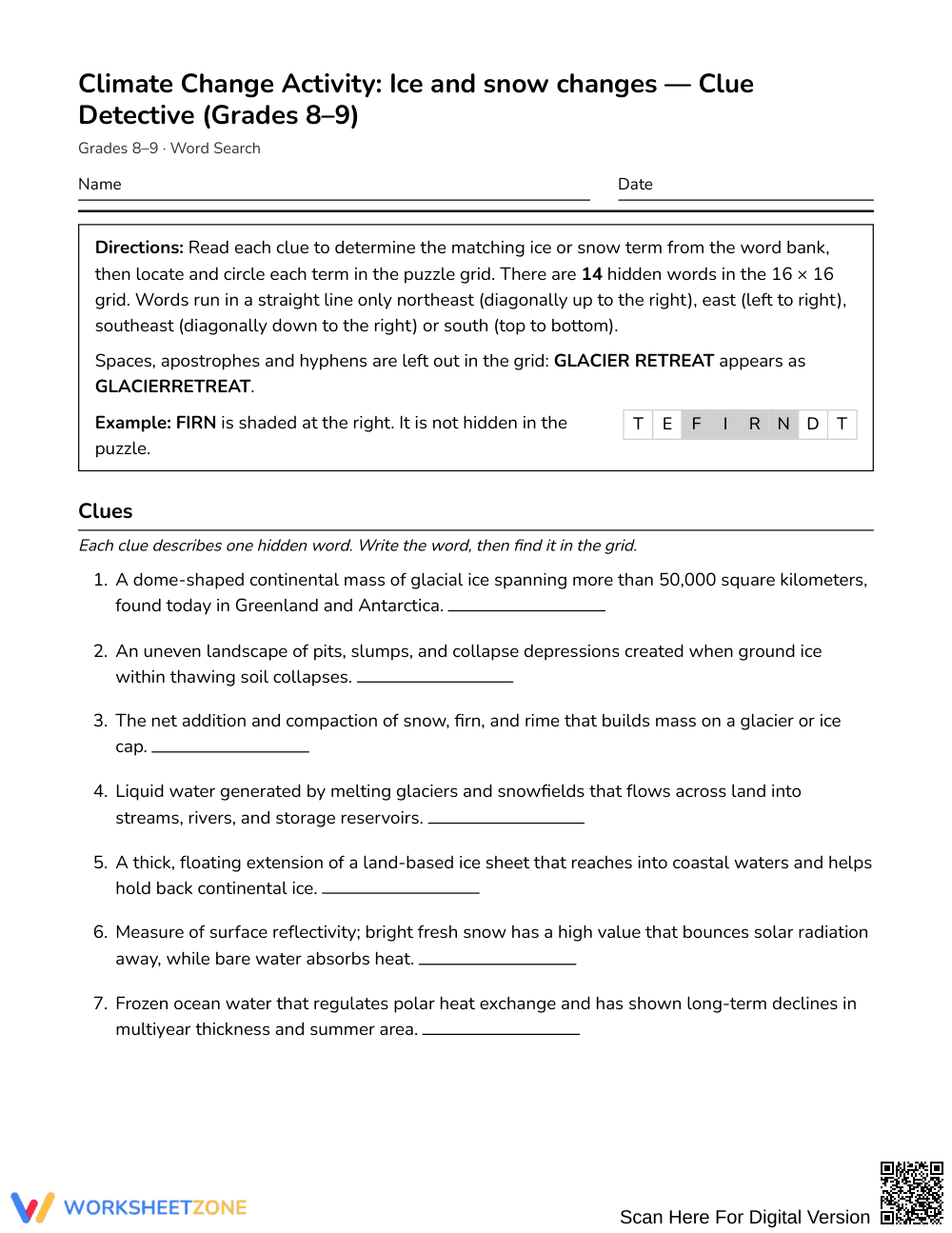
Build foundational earth science vocabulary with this targeted cryosphere activity. Students examine climate change mechanisms by matching 14 scientific definitions to key terminology before locating each hidden term. Designed for secondary science classrooms, this puzzle connects complex geophysical processes like glacier retreat and permafrost thawing directly to clear academic language.
At a Glance
- Grade: Grades 8–9 · Subject: Science
- Standard: Not standards-assessed — vocabulary enrichment
- Skill Focus: ice and snow changes
- Format: 3 pages · 14 words · Answer key included · PDF
- Best For: Vocabulary review and sub plans
- Time: 25–35 minutes
What's Inside
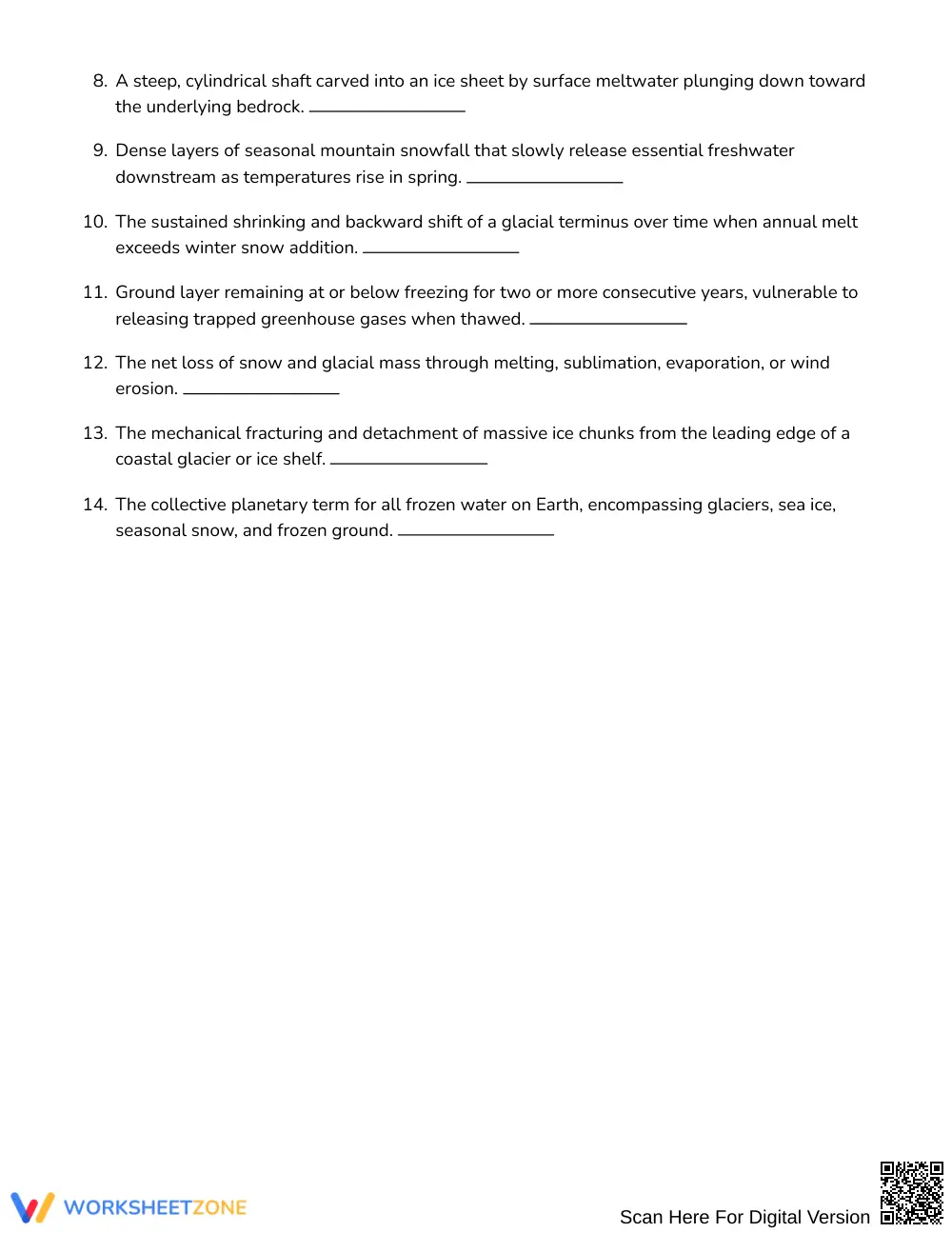
This 3-page printable resource features a clue-driven vocabulary challenge followed by a comprehensive 3-page answer key. Rather than scanning for a simple list, students read 14 rigorous scientific clues describing phenomena such as albedo, calving, and ablation. Students identify the correct term from a shuffled word bank before locating it in the puzzle.
Puzzle Mechanics and Structure
The activity is built upon a 16 × 16 letter grid containing 14 hidden vocabulary terms. Words run along four distinct vector paths: northeast, east, southeast, and south. The inclusion of diagonal orientations increases visual scanning engagement without overwhelming middle and early high school learners. By pairing descriptive clues with spatial search tasks, the activity reinforces conceptual recall alongside spelling accuracy.
Standards Alignment
This activity is designed specifically for vocabulary enrichment and is not aligned to a single standard. It directly reinforces essential academic terminology required to understand broader climate science, glacial dynamics, and atmospheric feedback loops across secondary general science and earth systems curricula.
How to Use It
Use this activity directly after introductory lectures on the cryosphere to reinforce unfamiliar terms, or deploy it as an engaging, low-stress sub plan. While students work, circulate to observe whether they can define terms like albedo and thermokarst using the clues before consulting peer notes. Most students complete the full 14-word search within 25 to 35 minutes.
Who It's For
This puzzle is ideal for Grades 8–9 earth science, environmental science, and physical geography classes. It offers helpful reinforcement for visual learners and English language learners needing contextual definitions for multi-syllable domain words. Pair this resource with a diagram showing glacial mass balance or satellite photography of polar ice extent.
Research from Fisher & Frey (2014) highlights that intentional exposure to disciplinary vocabulary within academic contexts significantly strengthens long-term comprehension of complex informational texts. When secondary science students actively process precise terminology like ablation, cryosphere, and sea ice through context-rich definitions, they construct durable mental frameworks for understanding dynamic planetary systems. Grounding vocabulary acquisition in structured clues rather than rote memorization allows eighth and ninth graders to bridge conceptual gaps between observable local weather and global climate feedback loops. The clear clues and spatial identification tasks prompt repeated retrieval of high-utility terms, ensuring learners retain the core scientific language necessary for subsequent data analysis and reading tasks in earth science units.


