




























Views
Downloads




Printable i² Error Repair Worksheet | Grade 11 Algebra II

Paste this activity's link or code into your existing LMS (Google Classroom, Canvas, Teams, Schoology, Moodle, etc.).
Students can open and work on the activity right away, with no student login required.
You'll still be able to track student progress and results from your teacher account.
This worksheet builds Grade 11 Algebra II accuracy with complex numbers by having students find and fix errors in worked solutions. Students locate the first mistake, explain why it is wrong, and rewrite the solution correctly, strengthening i² reasoning, conjugates, and modulus.
At a Glance
- Grade: 11 · Subject: Algebra II
- Standard: Complex numbers — locate, explain, and correct errors in worked solutions
- Skill Focus: Correcting i² and conjugation errors
- Format: 5 pages · 10 problems · Answer key included · PDF
- Best For: Error analysis after complex number lessons
- Time: 30–40 minutes
What's Inside
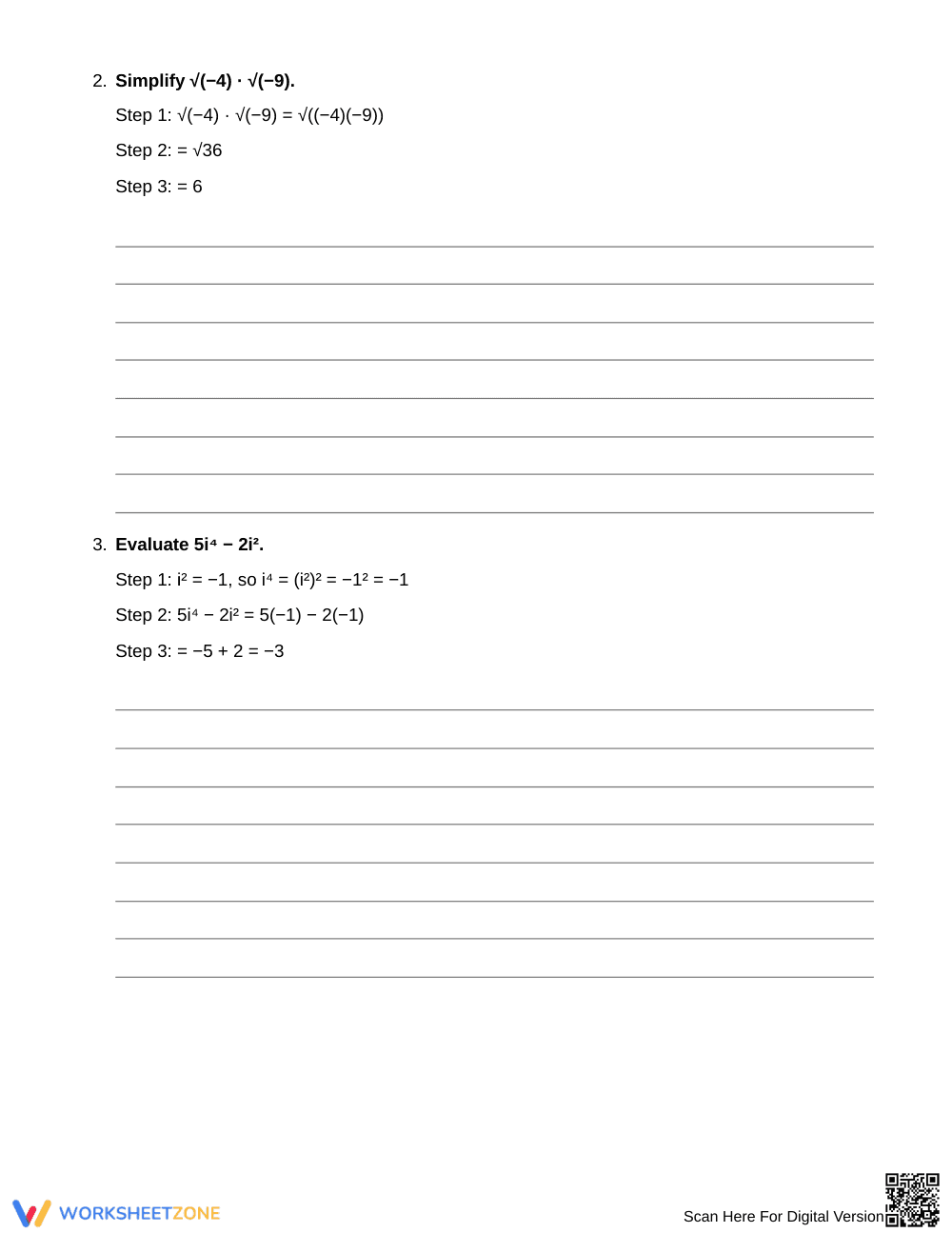
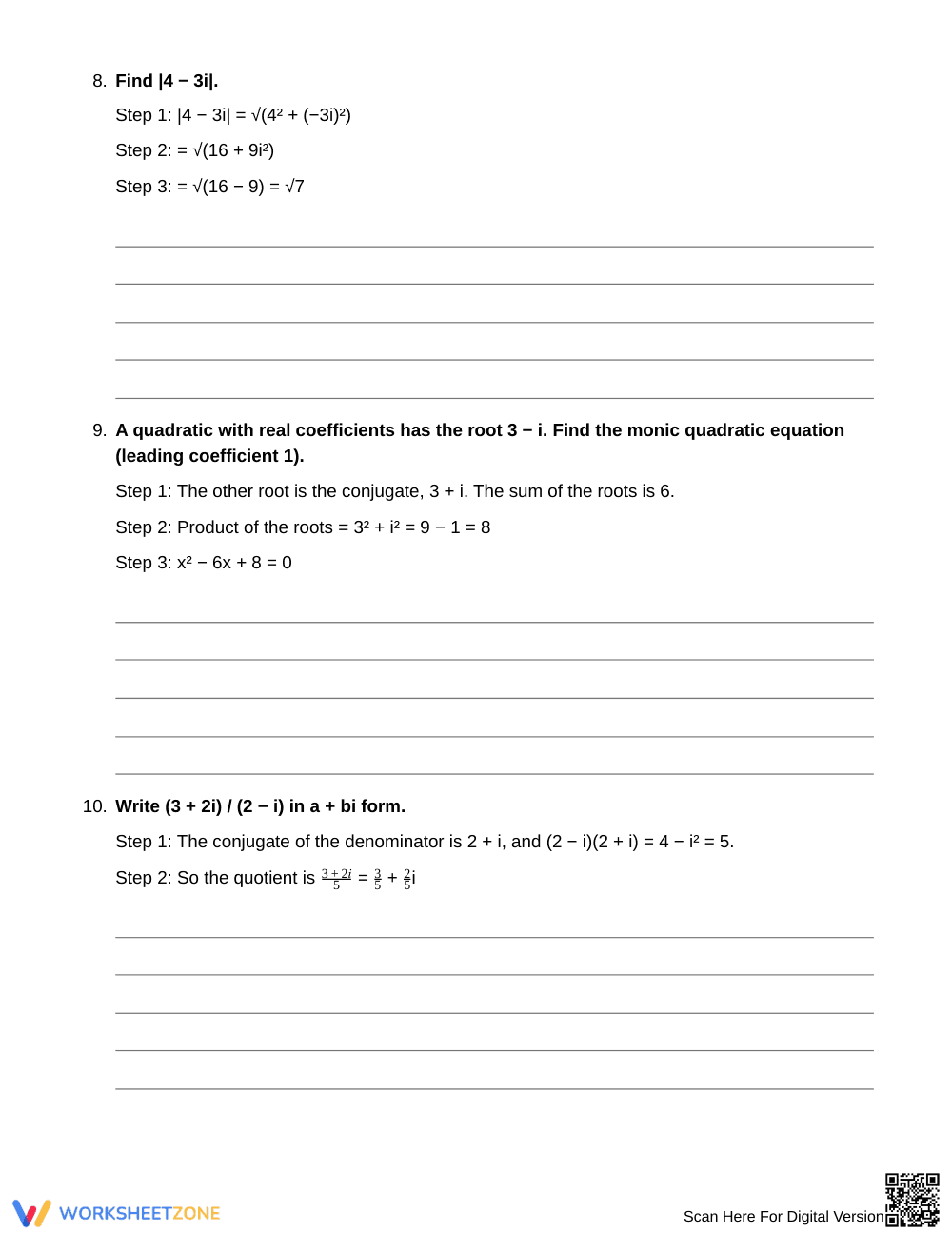
Five pages hold a reference box, one model repair, and 10 error-analysis problems: 5 on i² (products, radicals, powers of i, quadratics) and 5 on conjugation and modulus (division, z · z̄, |z|, building a quadratic from roots). Each worked solution contains one first error, and answers are exact a + bi form. A two-page answer key is included.
Skill Progression
- Guided practice: 1 model repair shows the locate, explain, correct routine, with a reference box on conventions.
- Supported practice: 5 Part A problems on i² errors, with the reference box available.
- Independent practice: 5 Part B problems on conjugation and modulus, using the same three tasks without further modeling.
This sequence follows gradual release: I Do, We Do, You Do.
Standards Alignment
No standard code was supplied for this worksheet. It supports Algebra II complex-number work: performing operations, using conjugates to divide, and solving quadratics with complex solutions. Add your state's code when copying it into lesson plans, IEP goals, or curriculum mapping tools.
How to Use It
- After direct instruction: Assign Part A to pairs, discuss common errors as a class, then have students complete Part B independently.
- Before a quiz: Use Part B as a targeted review of conjugates and modulus.
Formative tip: check whether explanations name the rule, such as i² = −1, or simply recompute the answer. Expect 30–40 minutes.
Who It's For
Grade 11 Algebra II students who have had initial instruction on complex numbers. Students who need support can complete Part A only with the reference box, while advanced students can write their own flawed solutions for classmates to repair. Pair it with a conjugate and division anchor chart.
Correcting i² and Conjugation Errors is a Grade 11 Algebra II worksheet on complex numbers that asks students to locate the first incorrect step in 10 worked solutions, explain the mathematical reason it fails, and rewrite the work correctly in exact a + bi form. Part A targets i² mistakes, including sign errors in i⁴, the square root product rule for negative radicands, and square roots of negative discriminants. Part B targets conjugation and modulus errors in division, products with conjugates, absolute value, and building a quadratic from complex roots. The structure follows the gradual-release model described by Fisher & Frey (2014): a worked model repair, supported practice, then independent practice. The five-page PDF includes a two-page answer key and takes about 30 to 40 minutes. No state standard code was supplied, so teachers should map it to their local complex-number standard.


