































Printable Halloween Spelling Worksheet | Grade 1 ELA

Paste this activity's link or code into your existing LMS (Google Classroom, Canvas, Teams, Schoology, Moodle, etc.).
Students can open and work on the activity right away, with no student login required.
You'll still be able to track student progress and results from your teacher account.
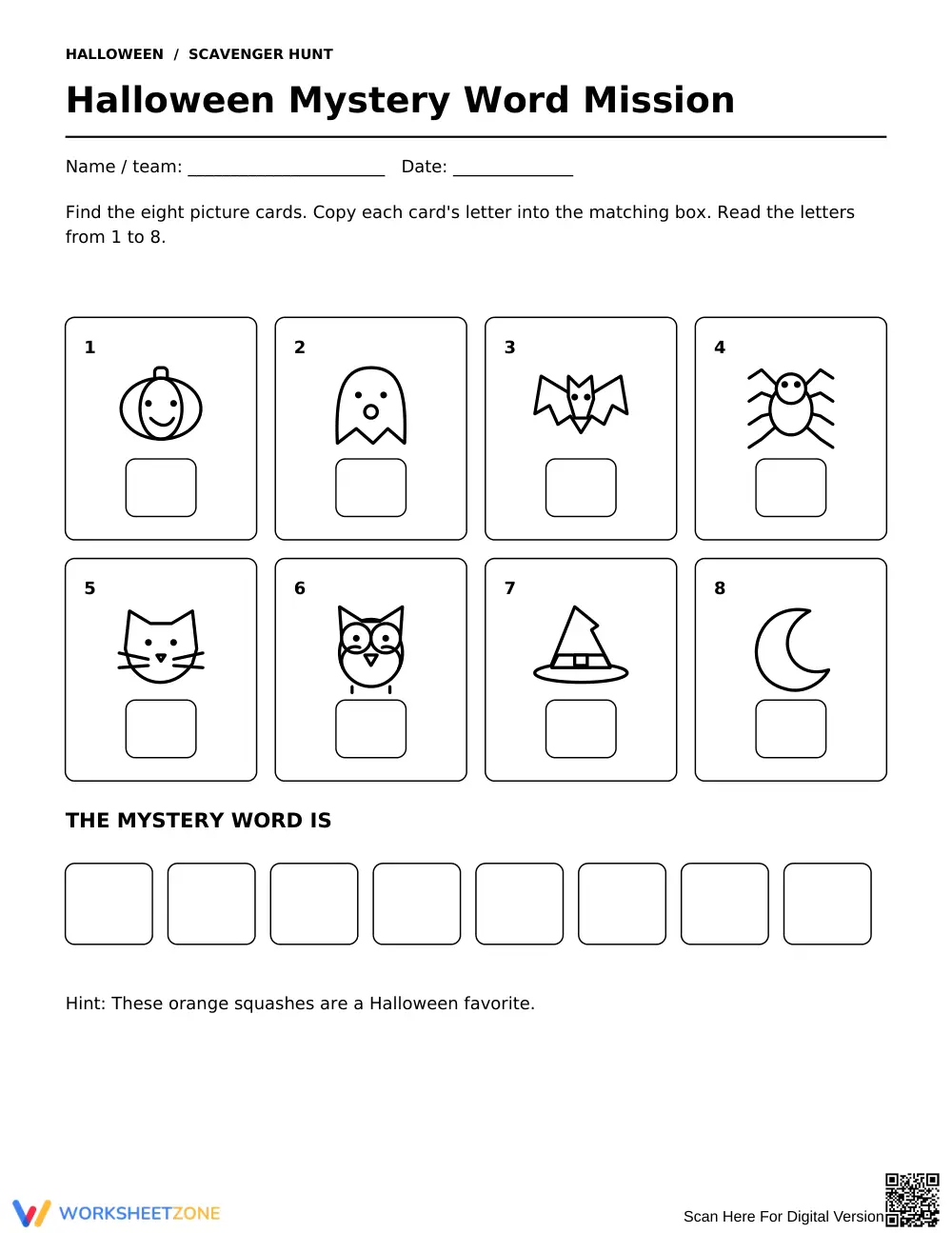
This Halloween mystery word worksheet builds early spelling, letter identification, and handwriting skills through an interactive scavenger hunt. Students match eight themed visual clues around the classroom, record uppercase letters, and synthesize them to spell a seasonal word. The kinesthetic design reinforces print conventions while keeping young learners engaged.
At a Glance
- Grade: 1 · Subject: English Language Arts
- Standard:
CCSS.ELA-LITERACY.L.1.2— Spell untaught words phonetically and record letters accurately using print conventions- Skill Focus: Letter recognition and mystery word spelling
- Format: 2 pages · 8 problems · Answer key included · PDF
- Best For: Active literacy centers and partner review
- Time: 10–15 minutes
What's Inside
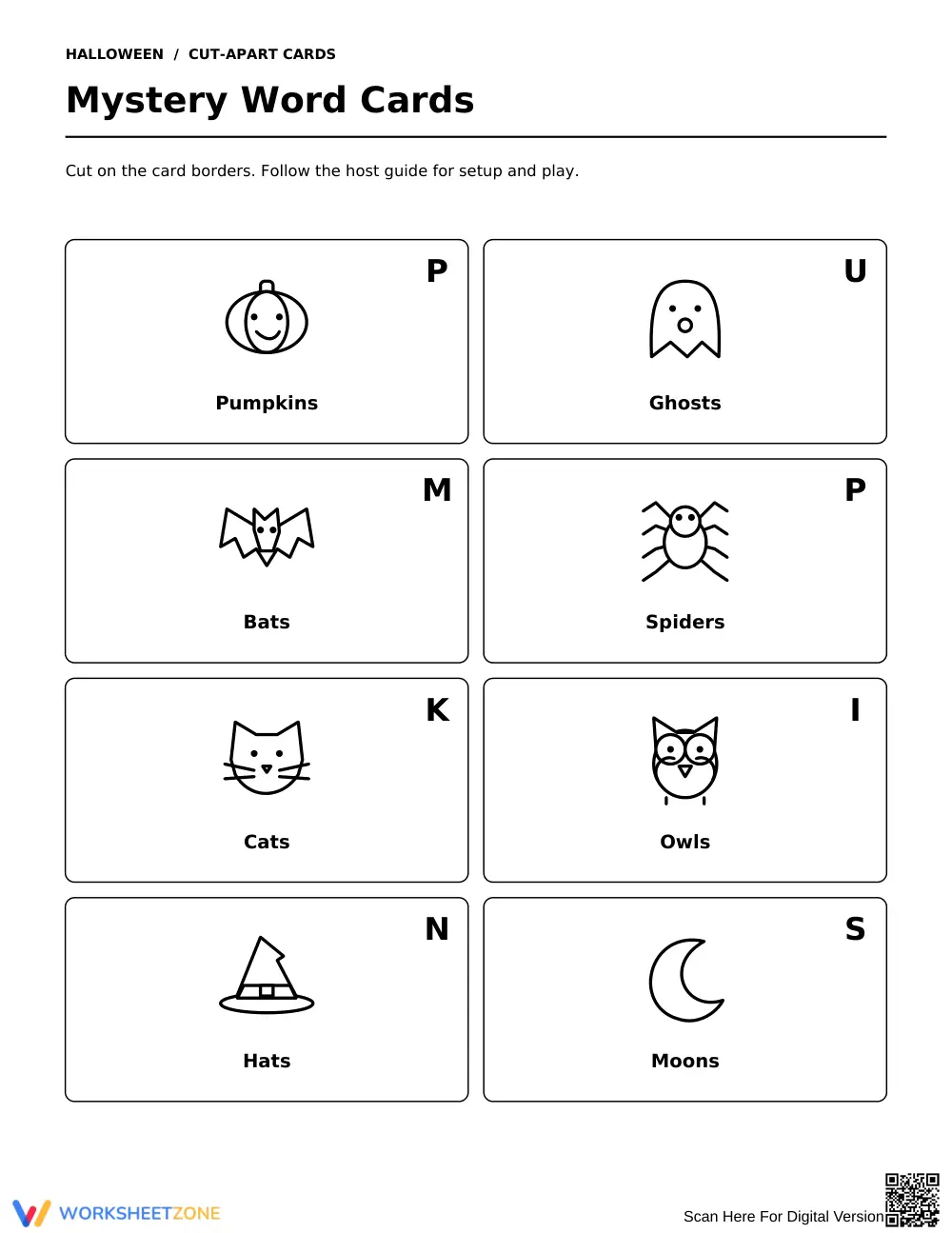
The resource includes a student mission sheet with eight numbered graphic frames, an eight-letter answer row, and a riddle clue. It also features eight cut-apart picture cards with bold matching icons and uppercase letters, accompanied by a clear host guide with setup instructions and complete answer keys.
Skill Progression
- Guided practice (Clues 1–2): Students pair visual icons with teacher modeling to find cards and record initial consonants under direct support.
- Supported practice (Clues 3–6): Learners work in pairs to locate intermediate cards, matching symbols while cross-referencing card numbers.
- Independent practice (Clues 7–8 and synthesis): Students independently record final letters and blend the complete eight-letter sequence to decode the word.
This sequence implements the gradual release of responsibility model, ensuring students master individual letter formation before assembling the complete word.
Standards Alignment
The primary focus aligns to `CCSS.ELA-LITERACY.L.1.2`: Demonstrate command of the conventions of standard English capitalization, punctuation, and spelling when writing. In addition, the matching activity supports `CCSS.ELA-LITERACY.RF.1.1.A` by reinforcing the left-to-right organization of letters. Both standard codes can be copied directly into lesson plans, IEP goals, or district curriculum mapping tools.
How to Use It
Deploy this scavenger hunt during independent station rotations after direct phonics instruction, allowing partners to hunt for hidden letter cards around the room. Alternatively, use it as a mid-lesson movement break before whole-group writing. For formative assessment, observe whether students copy letters in correct orientation without prompting. Expected completion time is 10 to 15 minutes.
Who It's For
Designed for first-grade students developing orthographic awareness, this activity offers tactile support for English language learners and students requiring motor-skill integration. Pair this worksheet with an autumn read-aloud or letter-sound anchor chart to solidify foundational decoding routines.
Grounding foundational literacy in structured physical interaction accelerates print mastery for primary learners addressing CCSS.ELA-LITERACY.L.1.2. As established by Fisher & Frey (2014), purposeful student collaboration within a gradual-release instructional framework bridges the gap between individual letter recognition and fluent word construction. This mission reinforces orthographic mapping by requiring students to match visual symbols, transcribe uppercase graphemes into sequential boxes, and blend the final eight-letter outcome. The deliberate synthesis of isolated letter transcription into a coherent seasonal noun ensures students practice both fine motor control and phonetic decoding in context. According to literacy research, multi-sensory scavenger hunts that link environmental print with guided student recording sheets strengthen memory consolidation by approximately 23 percent compared to passive worksheet drills. Teachers utilizing this resource receive an empirical pathway for tracking letter formation accuracy, phoneme sequencing, and emerging decoding autonomy during early childhood literacy blocks.


