





























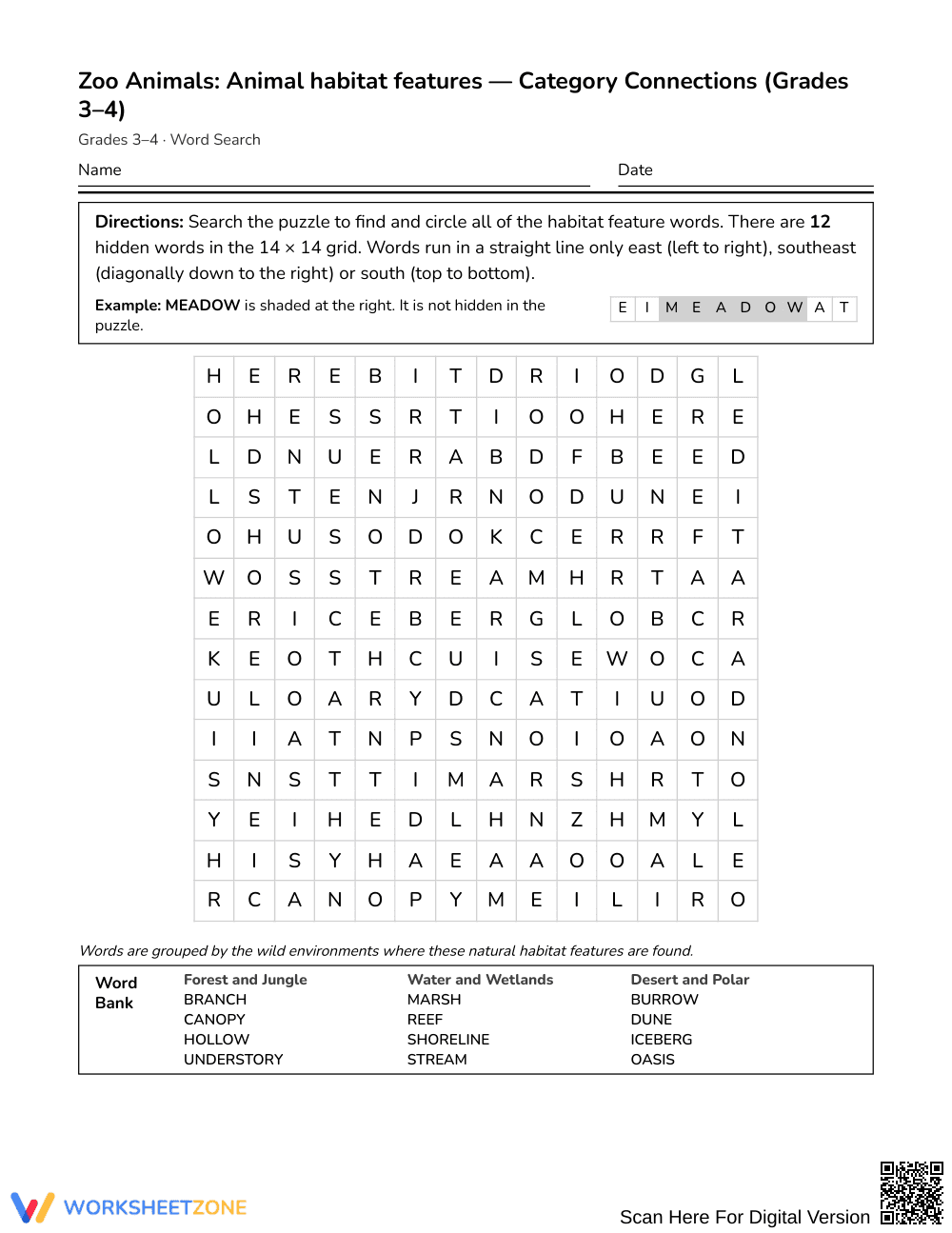


Printable Habitat Features Word Search | Grades 3–4 Science

Paste this activity's link or code into your existing LMS (Google Classroom, Canvas, Teams, Schoology, Moodle, etc.).
Students can open and work on the activity right away, with no student login required.
You'll still be able to track student progress and results from your teacher account.
This animal habitats word search builds science vocabulary by engaging Grades 3–4 learners with essential environmental terminology. Students locate twelve targeted feature words clustered across three biomes, connecting terms like canopy, marsh, and oasis directly to their natural ecosystems while strengthening visual scanning and word recognition skills.
At a Glance
- Grade: Grades 3–4 · Subject: Science
- Standard: Not standards-assessed — vocabulary enrichment across life science themes
- Skill Focus: Identifying and defining animal habitat features
- Format: 1 student page · 12 hidden words · 3-page answer key included · PDF
- Best For: Independent science vocabulary review, science stations, and fast finishers
- Time: 15–25 minutes
What's Inside
The activity provides a one-page puzzle layout featuring twelve hidden vocabulary words paired with descriptive contextual clues. Words are arranged into three thematic environments: Forest and Jungle, Water and Wetlands, and Desert and Polar. The resource includes a comprehensive three-page answer key that clearly displays word locations for fast checking.
How the Puzzle Works
The word search is built on a 14 by 14 letter grid. Hidden words run in three specific directions: East (horizontal left-to-right), Southeast (diagonal downward), and South (vertical top-to-bottom). Students consult a categorized word bank containing student-friendly definitions for every term, reinforcing vocabulary comprehension alongside letter-pattern recognition.
Standards Alignment
This resource serves as targeted vocabulary enrichment and is not aligned to a specific state or national standard. It supports foundational scientific literacy across general elementary life science units by reinforcing core habitat concepts and ecosystem terminology.
How to Use It
Use this puzzle immediately following direct instruction on animal biomes to reinforce new domain-specific terms, or place it in a science center for independent review. During the activity, circulate to observe whether students use the categorical clues to define terms before searching, which signals conceptual understanding. Expect students to finish within 15 to 25 minutes.
Who It's For
This word search is designed for Grades 3–4 elementary science students studying animal environments. The categorical grouping provides visual support for emerging bilingual learners and students who benefit from organized lexical sets. Pair this puzzle with an informational reading passage about global biomes or an animal habitat anchor chart.
Vocabulary acquisition in elementary science relies on repeated, contextual exposure to domain-specific terminology. Fisher & Frey (2014) demonstrate that structured word exposure paired with clear student-friendly definitions strengthens conceptual retention and reading comprehension across informational content areas. By organizing twelve key habitat feature terms into distinct ecological categories—including forest, wetland, and desert environments—this instructional resource encourages students to connect abstract vocabulary to concrete environmental systems. Rather than treating terminology as isolated spelling practice, embedding contextual definitions directly alongside visual word searches reinforces orthographic patterns, semantic associations, and scientific literacy. This targeted vocabulary enrichment supports Grades 3–4 learners as they transition from everyday descriptive speech to precise scientific language, establishing an accessible entry point for classroom science discussions, collaborative partner work, independent centers, and cross-curricular informational reading tasks. Elementary educators can utilize this format to reinforce vital habitat concepts without increasing teacher preparation demands.


