


























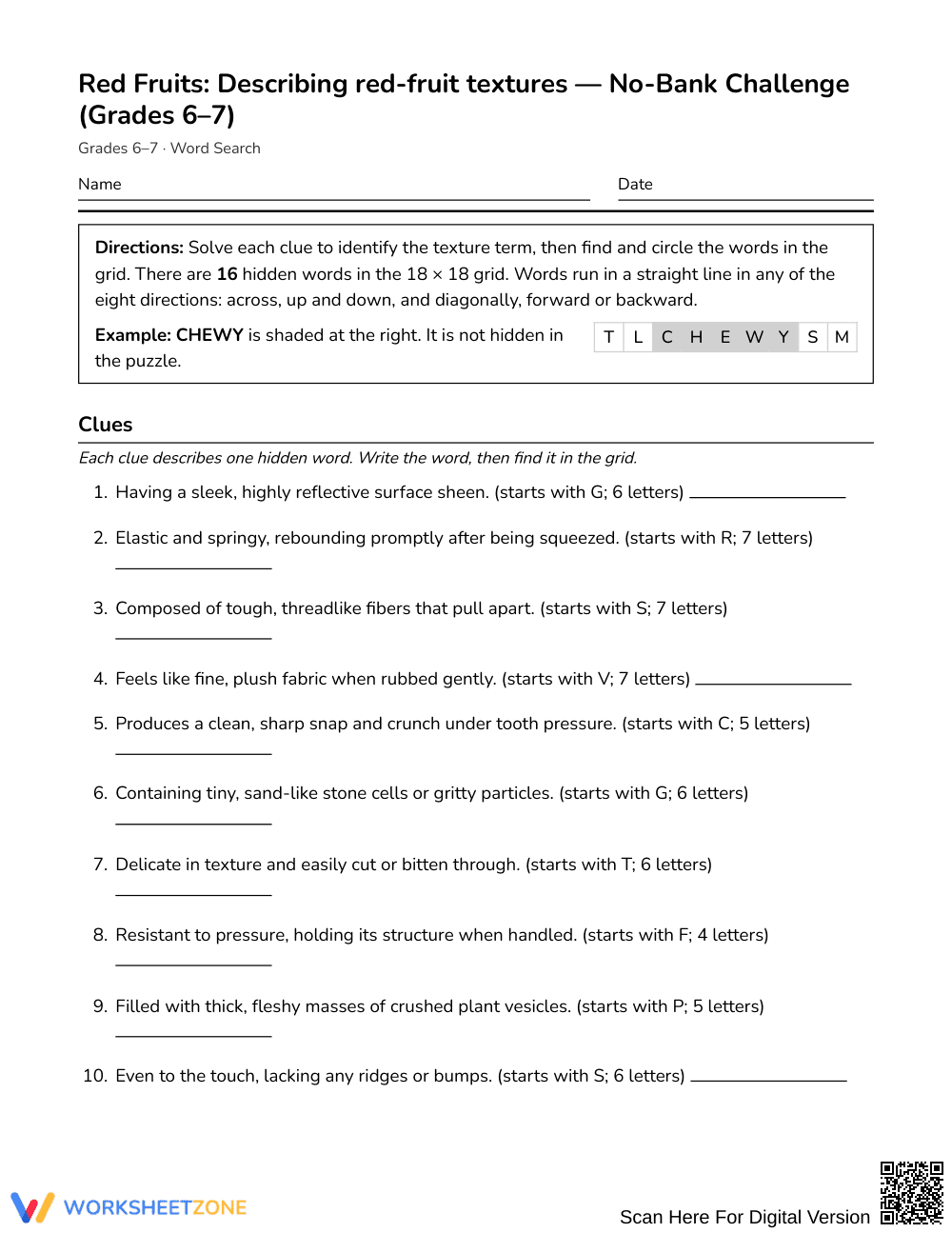


Printable Fruit Texture Word Search | Grades 6–7 ELA
Paste this activity's link or code into your existing LMS (Google Classroom, Canvas, Teams, Schoology, Moodle, etc.).
Students can open and work on the activity right away, with no student login required.
You'll still be able to track student progress and results from your teacher account.
Build sensory descriptive language with this no-bank vocabulary challenge designed for middle school writers. Students decode precise tactile definitions for red-fruit surfaces and flesh consistencies, identifying 16 descriptive terms within an expansive letter grid. This activity strengthens close-reading habits and enriches descriptive writing without requiring rote memorization.
At a Glance
- Grade: Grades 6–7 · Subject: ELA
- Standard: Not standards-assessed — vocabulary enrichment
- Skill Focus: Describing red-fruit textures
- Format: 3 pages · 16 words · Answer key included · PDF
- Best For: Sensory writing support and early finishers
- Time: 20–30 minutes
What's Inside: This 3-page printable set delivers an authentic cognitive challenge by omitting traditional word lists. Instead, learners read 16 distinct analytical clues detailing tactile properties such as firmness, moisture, and fiber structure. After inferring each texture descriptor, students search for the target words. A comprehensive 3-page solution key shows the exact spatial placement of every entry.
Puzzle Mechanics and Structure
- Clue-Driven Decoding: Students must solve rigorous definitions before searching, ensuring deep semantic engagement rather than passive letter-matching.
- Multi-Directional Grid: The puzzle features a challenging 18 × 18 letter matrix spanning all 8 compass trajectories: north, northeast, east, southeast, south, southwest, west, and northwest.
- No-Bank Format: Working without a visible word list encourages independent vocabulary retrieval and active structural analysis of descriptive language.
Standards Alignment
This resource serves as targeted vocabulary enrichment and is not aligned to a specific state or national standard. It provides supplementary practice in applying domain-specific sensory adjectives to enhance student descriptive writing and reading comprehension.
How to Use It
Deploy this activity during a sensory descriptive writing unit or as an engaging transition exercise following direct instruction on vivid adjectives. For a formative check, observe whether students deduce nuanced terms like pulpy or rubbery from the clue context before searching the grid. Most learners will complete the full investigation in 20 to 30 minutes.
Who It's For
This word search fits general education students in Grades 6–7 who are expanding their descriptive prose beyond common adjectives. Pair this puzzle with mentor texts featuring culinary descriptions or an anchor chart highlighting the five senses to help students transfer these texture words directly into their personal narratives.
Explicit instruction in sensory vocabulary allows middle school learners to move beyond generic phrasing toward vivid, precise textual descriptions. According to Fisher & Frey (2014), intentional word exposure coupled with cognitive retrieval tasks significantly accelerates vocabulary acquisition and language retention across secondary literacy environments. When students analyze textured attributes such as fibrous pulp, granular stone cells, or crisp tactile resistance, they construct sophisticated mental models of descriptive language. This 18 × 18 word puzzle bridges contextual definition analysis with pattern recognition across 16 rigorous sensory terms. By working through multi-directional configurations without a pre-printed word bank, learners actively retrieve semantic associations and retain domain-specific vocabulary necessary for descriptive writing benchmarks.


