


























Views
Downloads

Printable Friendship Worksheet | Grade 3 SEL
Paste this activity's link or code into your existing LMS (Google Classroom, Canvas, Teams, Schoology, Moodle, etc.).
Students can open and work on the activity right away, with no student login required.
You'll still be able to track student progress and results from your teacher account.
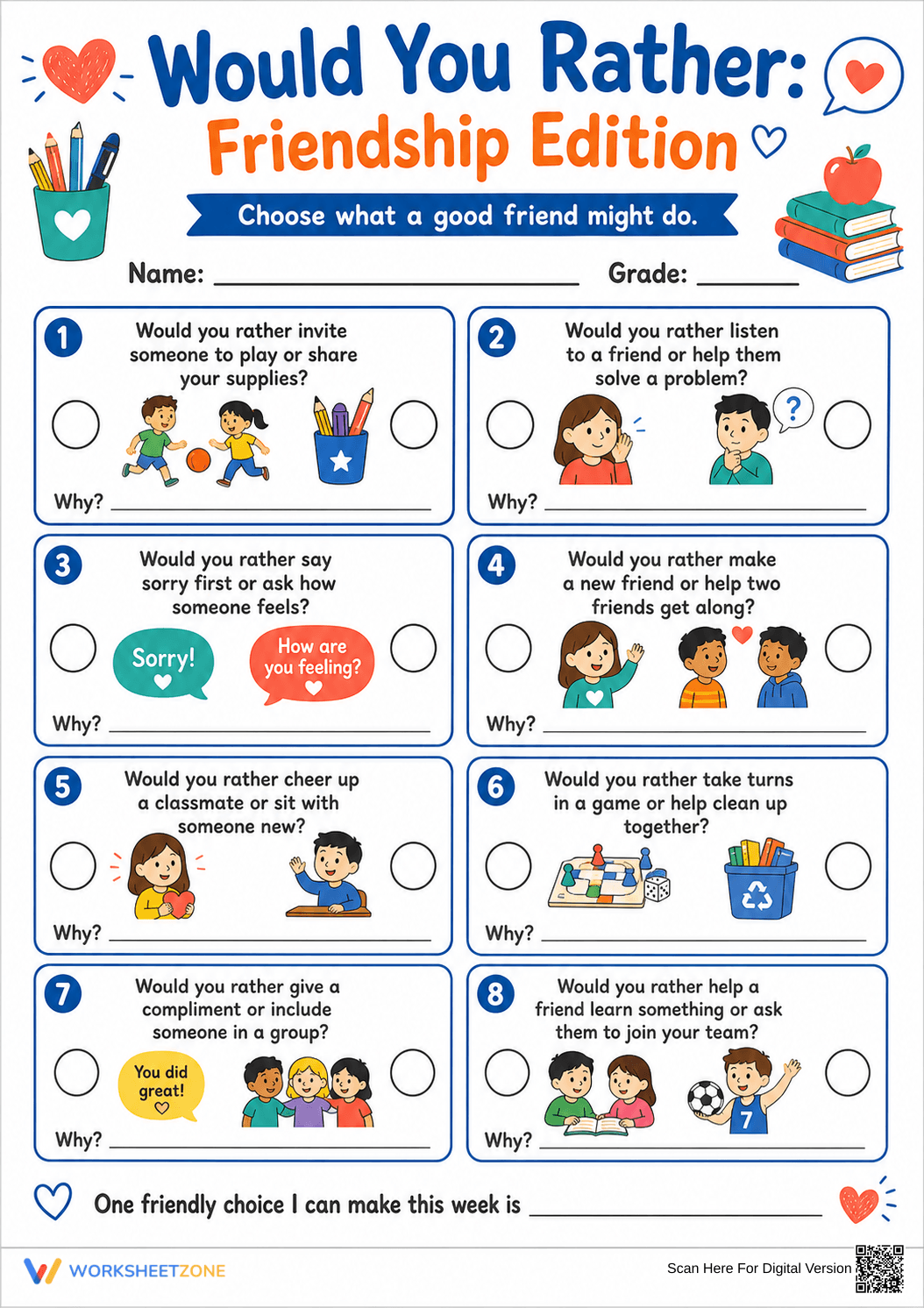
This friendship-building worksheet helps students evaluate positive social choices and articulate their reasoning. By engaging with relatable "Would You Rather" scenarios, learners practice empathy, conflict resolution, and peer support. The activity encourages thoughtful reflection on how everyday actions impact classroom community and personal relationships.
At a Glance
- Grade: 3 · Subject: SEL
- Standard:
CCSS.ELA-LITERACY.SL.3.1— Engage effectively in collaborative discussions- Skill Focus: Relationship building and empathy
- Format: 1 page · 9 problems · No answer key · PDF
- Best For: Morning work or SEL blocks
- Time: 15–20 minutes
Inside this single-page resource, educators will find eight illustrated "Would You Rather" choice cards and one concluding reflection prompt. Each card presents two positive friendship behaviors, such as inviting someone to play versus sharing supplies, alongside a brief space for students to explain their "Why?" The visual layout uses cheerful graphics and clear check-circles to make decision-making accessible and engaging for young learners.
Enjoy a streamlined workflow:
- Print (1 minute): Generate enough copies for your class directly from the PDF file. The design ensures clear printing.
- Distribute (1 minute): Hand out the sheets during morning meeting, advisory, or a dedicated social-emotional learning period.
- Review (3 minutes): Briefly read the instructions aloud and model one example to show how to write a thoughtful "Why?" response.
With under five minutes of total teacher prep time, this activity is highly suitable for emergency sub plans or spontaneous community-building moments.
This activity aligns with CCSS.ELA-LITERACY.SL.3.1: "Engage effectively in a range of collaborative discussions (one-on-one, in groups, and teacher-led) with diverse partners on grade 3 topics and texts, building on others' ideas and expressing their own clearly." It also supports foundational social-emotional competencies in relationship skills and responsible decision-making. Both standard codes can be copied directly into lesson plans, IEP goals, or district curriculum mapping tools.
Use this worksheet as a pair-share activity before discussing classroom expectations. Have students complete the sheet independently, then partner up to compare their choices and practice active listening. Alternatively, use it as a restorative reflection tool during morning meetings to set a positive tone for the week. As a formative assessment observation tip, circulate while students write their "Why?" responses to identify who might need additional support in articulating empathetic reasoning. Expected completion time ranges from 15 to 20 minutes.
This resource is for elementary students developing interpersonal skills. The visual cues and short writing spaces provide natural differentiation for reluctant writers or English Language Learners who benefit from structured choices. It pairs perfectly with a read-aloud book about friendship or a classroom anchor chart detailing the traits of a good friend.
Integrating structured social-emotional learning activities into the daily academic schedule significantly enhances classroom climate and individual student well-being. This resource directly targets CCSS.ELA-LITERACY.SL.3.1, helping students engage effectively in collaborative discussions by evaluating positive peer interactions. According to a comprehensive EdReports 2024 analysis of elementary curricula, instructional materials that embed explicit relationship-building prompts alongside core literacy tasks yield substantially higher rates of student engagement and peer empathy. When young learners are consistently asked to justify their social choices in writing, they develop stronger cognitive frameworks for conflict resolution, active listening, and mutual respect. By utilizing this targeted practice tool, educators provide a safe, low-stakes environment for children to explore complex social dynamics. This intentional focus on interpersonal skill development ultimately fosters a more inclusive, supportive school community where every student feels valued and understood.


