





























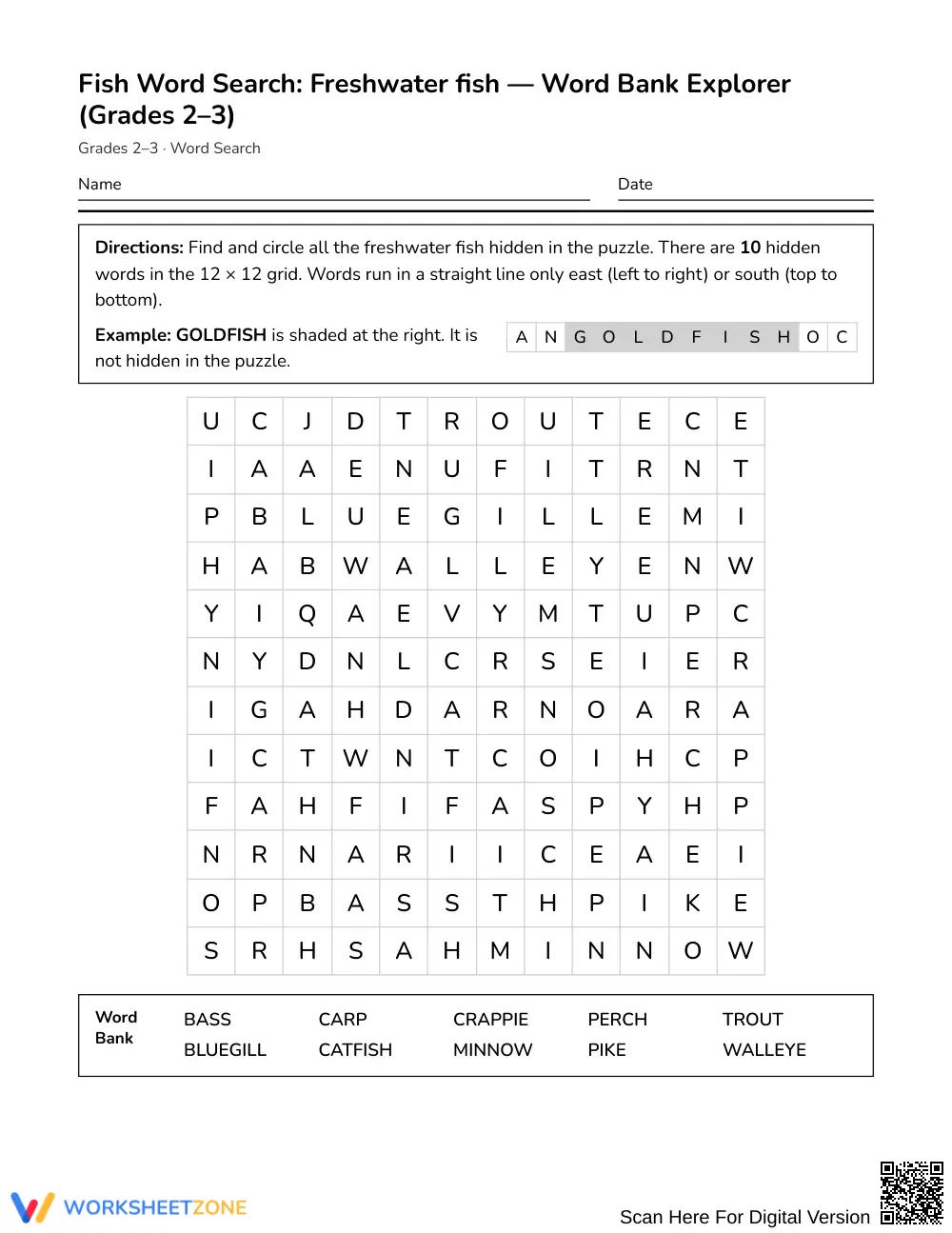


Printable Freshwater Fish Word Search | Grades 2–3 Science

Paste this activity's link or code into your existing LMS (Google Classroom, Canvas, Teams, Schoology, Moodle, etc.).
Students can open and work on the activity right away, with no student login required.
You'll still be able to track student progress and results from your teacher account.
This Grades 2–3 freshwater fish word search builds aquatic biology vocabulary through focused word recognition. Students identify ten common freshwater fish species within an accessible letter grid, strengthening spelling awareness, visual scanning, and classification knowledge. The engaging puzzle format reinforces key life science terminology while keeping young learners actively invested during independent science practice.
At a Glance
- Grade: Grades 2–3 · Subject: Elementary Life Science
- Standard: Not standards-assessed — supplemental vocabulary enrichment for animal classification units
- Skill Focus: Freshwater fish identification and vocabulary
- Format: 1 printable page · 10 hidden words · 3-page answer key included · PDF
- Best For: Science warm-up, early finisher enrichment, or sub plans
- Time: 10–15 minutes
What's Inside
This single-page science word search features an uncluttered layout tailored specifically for early elementary learners. The printable sheet presents a clean 12 by 12 letter grid alongside an alphabetized word bank containing ten target freshwater species. A three-page answer key provides complete letter-by-letter solutions, allowing educators to verify completed student papers quickly without manual searching.
Puzzle Structure and Mechanics
Designed to support developing readers, the puzzle places all ten words in only two beginner-friendly reading directions: East (left to right) and South (top to bottom). Because letters never run backwards or diagonally, students practice natural left-to-right tracking. Learners reference the alphabetical word bank to locate each freshwater fish name systematically across the 12 by 12 grid.
Standards Alignment
This animal classification word search is designed strictly for vocabulary enrichment and is not aligned to an assessed state standard. It reinforces content-area terminology, scientific naming recognition, and orthographic familiarity, making it an effective supplemental resource for elementary life science units studying aquatic habitats and living organisms.
How to Use It
Incorporate this puzzle after direct instruction on aquatic ecosystems to reinforce species identification, or introduce it as a low-stress morning warm-up before an animal classification unit. During independent work time, circulate to observe visual search patterns, noting whether students cross-reference the alphabetical bank systematically. Most second- and third-grade learners finish finding all ten words within 10 to 15 minutes.
Who It's For
This activity supports second- and third-grade students exploring freshwater habitats, vertebrates, or animal classification. It offers accessible language exposure for English learners and developing readers needing low-frustration print engagement. Pair this word search directly with an illustrated freshwater habitat anchor chart or a read-aloud text about river and lake wildlife.
According to Fisher & Frey (2014), content-area vocabulary acquisition relies on varied, low-stakes exposures that familiarize elementary learners with domain-specific terminology before demanding complex written application. Although this printable word search is not standards-assessed and carries no formal standard code, it serves an essential vocabulary enrichment role within early life science education. Searching for ten target freshwater fish names within a 12 by 12 grid reinforces orthographic mapping, letter-sequence recognition, and systematic visual scanning. These foundational literacy behaviors directly support scientific reading fluency. By limiting word orientations to left-to-right and top-to-bottom trajectories, the activity reduces unnecessary cognitive friction while consolidating students' mental models of aquatic organisms. Educational researchers emphasize that pairing targeted lexical search tasks with visual anchor resources deepens conceptual retention across early elementary animal classification units, providing meaningful reinforcement for emerging science readers without requiring instructional overhead.


