































Printable Fish Habitats Word Search | Grades 4–5 Science

Paste this activity's link or code into your existing LMS (Google Classroom, Canvas, Teams, Schoology, Moodle, etc.).
Students can open and work on the activity right away, with no student login required.
You'll still be able to track student progress and results from your teacher account.
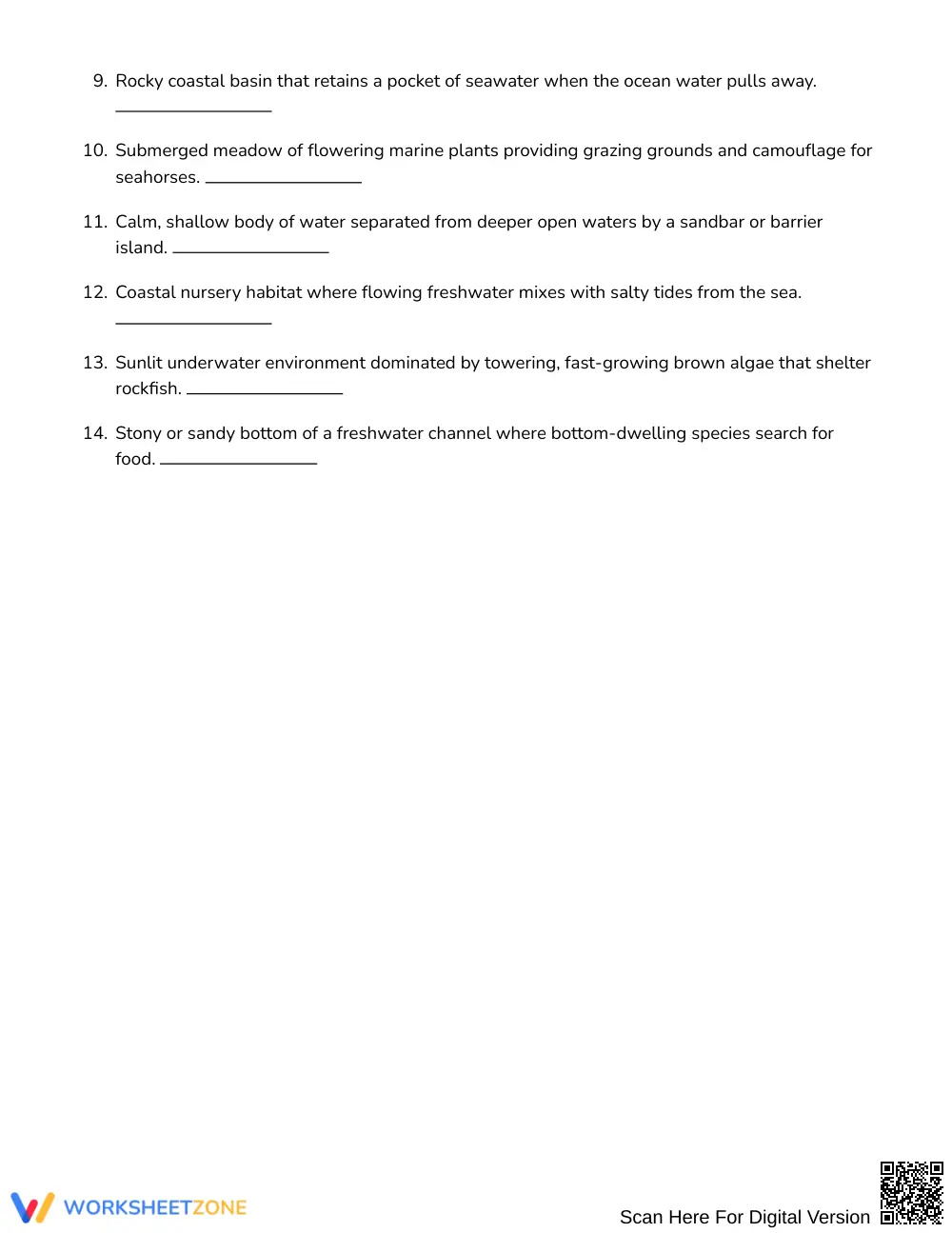
This science word search helps Grades 4–5 students reinforce key vocabulary for aquatic ecosystems and animal habitats. Learners read descriptive clues about marine and freshwater environments, match definitions to terms, and locate 14 target words within the letter grid, strengthening domain-specific scientific literacy.
At a Glance
- Grade: Grades 4–5 · Subject: Science
- Standard: Not standards-assessed — vocabulary enrichment
- Skill Focus: Fish habitats
- Format: 3 pages · 14 words · Answer key included · PDF
- Best For: Science centers and vocabulary review
- Time: 20–30 minutes
What's Inside
The 3-page printable activity features a Clue Detective layout featuring 14 distinct fish habitat terms. Students work from an informational clue list covering diverse ecosystems such as coral reefs, estuaries, and ocean trenches. A shuffled word bank provides reference support, while a full 3-page answer key clearly highlights grid coordinates for every word.
How the Puzzle Works
Students search for 14 hidden habitat words embedded across a 16 × 16 letter grid. Words run in four specific orientations: northeast, east, southeast, and south. Rather than relying solely on rote scanning, students read definition-based clues to deduce each term before finding it, turning puzzle-solving into an active reading and vocabulary exercise.
Standards Alignment
This activity serves strictly as supplementary vocabulary enrichment for an animal habitats unit and is not tied to a specific assessed academic standard. It supports domain-specific terminology building within elementary life science curricula.
How to Use It
Deploy this word search during an aquatic ecosystems unit either as an independent science station or as post-lesson review after direct instruction. During class, monitor students as they read the clues to verify that they understand ecological terms like estuaries and mangrove swamps. Most upper-elementary learners complete the puzzle within 20 to 30 minutes.
Who It's For
This resource is designed for Grades 4–5 science classes exploring biological communities and marine adaptations. It offers natural scaffolding for visual learners through defined directional paths and pairs effectively with an introductory marine biomes reading passage or classroom habitat anchor chart.
Designed for Grades 4–5 elementary science classrooms, this 14-word fish habitats puzzle promotes retention of essential life science vocabulary through active clue decoding. Students investigate marine and freshwater environments—ranging from sunlit kelp forests and tide pools to deep ocean trenches and inland streams—by synthesizing textual clues before locating terms within a 16 by 16 grid. While the activity serves primarily as non-assessed vocabulary enrichment rather than a standard-aligned assessment, research by Fisher & Frey (2014) highlights that intentional exposure to domain-specific terminology across content areas strengthens overall reading comprehension and conceptual mastery. The structured format provides purposeful reinforcement during animal habitat units, encouraging learners to associate specialized ecological definitions with correct scientific terms. Complete with a 3-page solution guide mapping all directional orientations, this printable resource gives educators a reliable, low-prep tool for science centers, vocabulary review, or independent study.


