




























Views
Downloads

Printable February Weather Word Search | Grades 2–3 Science

Paste this activity's link or code into your existing LMS (Google Classroom, Canvas, Teams, Schoology, Moodle, etc.).
Students can open and work on the activity right away, with no student login required.
You'll still be able to track student progress and results from your teacher account.
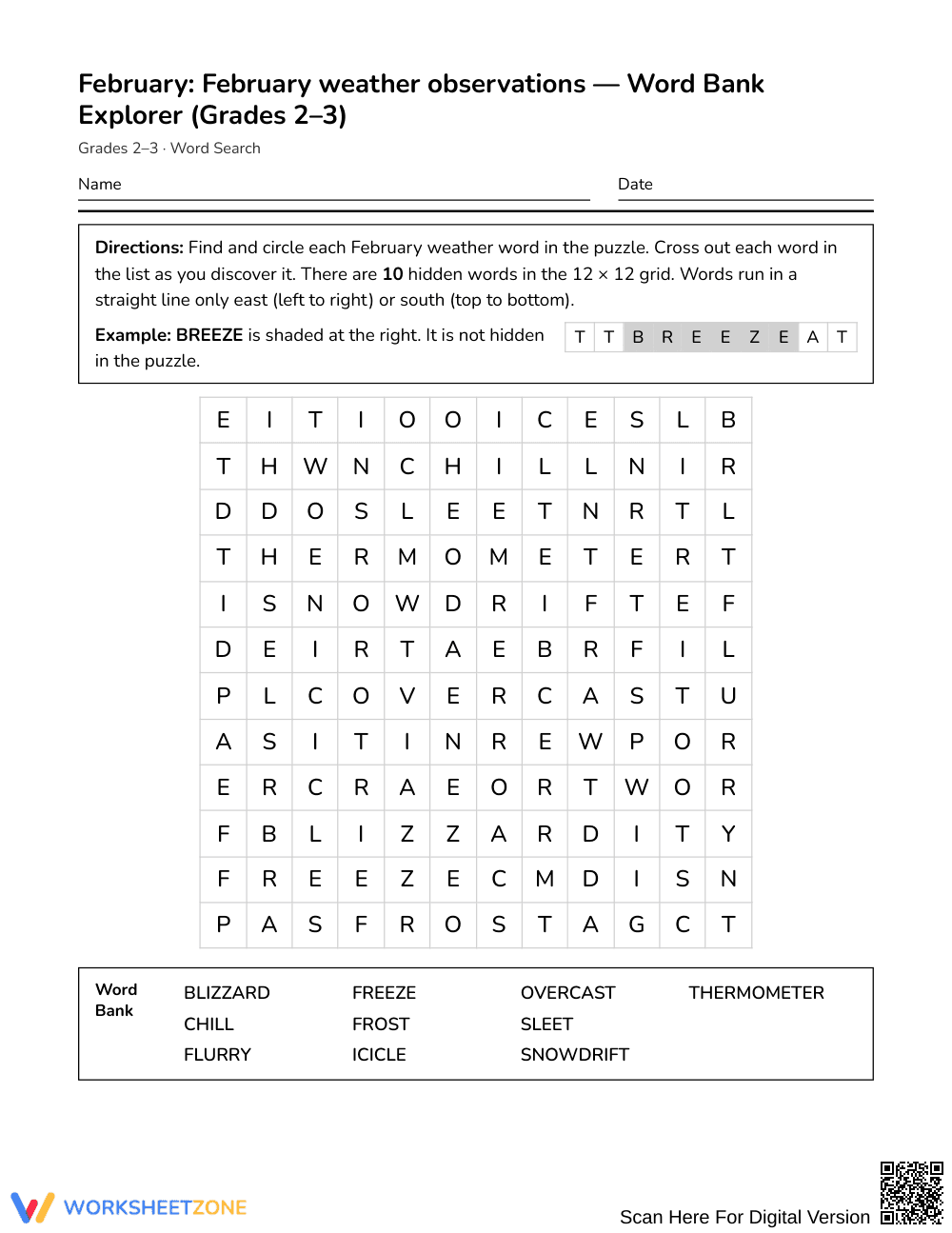
This Grades 2–3 science word search reinforces winter weather vocabulary through engaging pattern recognition. Students identify and record 10 seasonal weather terms, connecting observational concepts like blizzards, frost, and thermometers to foundational science language. It strengthens reading precision and domain-specific terminology during midwinter earth science units.
At a Glance
- Grade: Grades 2–3 · Subject: Science
- Standard: Not standards-assessed — vocabulary enrichment
- Skill Focus: February weather observations
- Format: 1 page · 10 words · Answer key included · PDF
- Best For: Science warm-ups and morning work
- Time: 15–20 minutes
This single-page printable resource features a clean word search puzzle paired with an alphabetical word bank and accompanying definitions. Students locate 10 weather-related vocabulary words across the letter grid while checking terms off their list. A two-page answer key provides clear visual solutions showing exact letter placements, making student self-checking or rapid teacher assessment simple and direct.
The puzzle features a compact 12 by 12 letter grid tailored specifically for early elementary learners. To keep searching accessible and developmentally appropriate, words run in only two directions: horizontally from left to right (East) and vertically from top to bottom (South). No backwards or diagonal placements are used, preventing visual frustration. Students scan the grid using the alphabetical word bank and descriptive vocabulary clues to find and circle each hidden term.
This activity serves strictly as vocabulary enrichment and is not aligned to an academic content standard. It is designed to reinforce topic-specific science terminology, build word familiarity, and support spelling retention during seasonal earth and space science studies.
Use this word search during your midwinter weather unit as a low-stress morning arrival task or as an independent follow-up after direct instruction on winter weather patterns. During completion, observe whether students read full words or merely hunt for initial letter clusters, which highlights orthographic awareness. Most learners will complete the search within 15 to 20 minutes.
This activity is designed for second and third graders building winter science vocabulary. For emerging readers, encourage partner pairing or highlight first letters in the grid; advanced learners can write original observational sentences using each term. Pair this puzzle naturally with daily outdoor temperature logging, classroom thermometer readings, or seasonal trade books about winter storms.
According to Fisher & Frey (2014), intentional exposure to domain-specific academic vocabulary across diverse learning formats significantly strengthens reading comprehension and foundational subject knowledge in developing students. While this February weather observations activity is not standards-assessed and functions primarily as vocabulary enrichment rather than a formal testing benchmark, structured word searches reinforce orthographic mapping, pattern detection, and lexical familiarity in early elementary learners. By locating 10 essential seasonal terms within a controlled 12 by 12 letter grid running strictly East and South, second and third graders actively practice visual scanning, letter sequence recognition, and spelling verification. Integrating purposeful vocabulary review alongside daily science observations bridges informal student terminology with formal scientific language, giving young readers the lexical confidence and background knowledge needed to participate actively in meaningful classroom discussions about seasonal atmospheric conditions.


