
































Printable Evidence Revision Word Search | Grades 7–8 Science

Paste this activity's link or code into your existing LMS (Google Classroom, Canvas, Teams, Schoology, Moodle, etc.).
Students can open and work on the activity right away, with no student login required.
You'll still be able to track student progress and results from your teacher account.
Opening
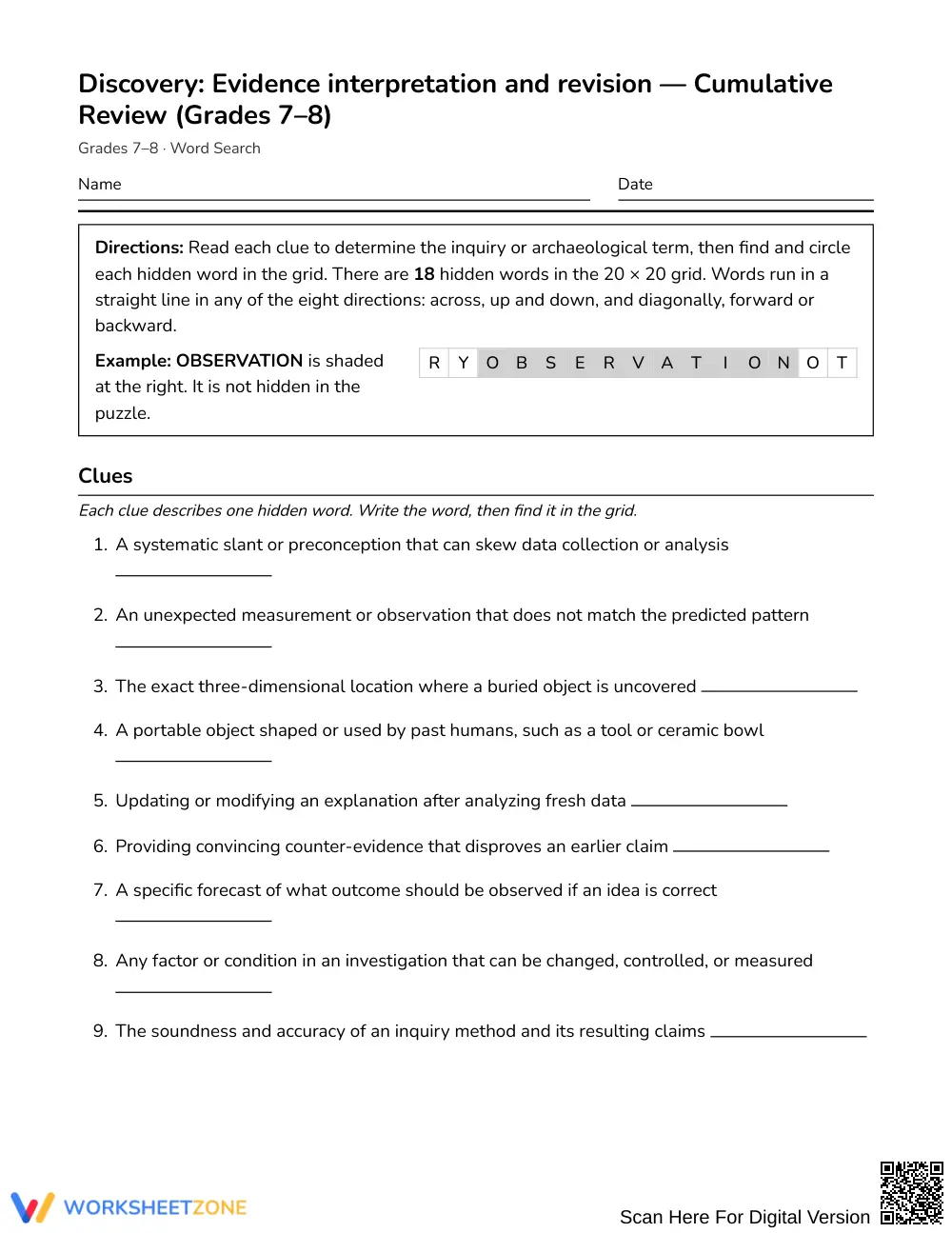
Students sharpen their evidence‑interpretation and revision vocabulary with this engaging word search, reinforcing key inquiry terms while practicing spelling and pattern recognition. Completing the puzzle builds confidence in scientific language and prepares learners for deeper analysis in upcoming investigations in the classroom.
At a Glance
- Grade: Grades 7–8 Middle School · Subject: Science
- Standard:
Not standards-assessed — vocabulary enrichment — and actively expand inquiry‑related vocabulary for classroom use- Skill Focus: evidence interpretation and revision
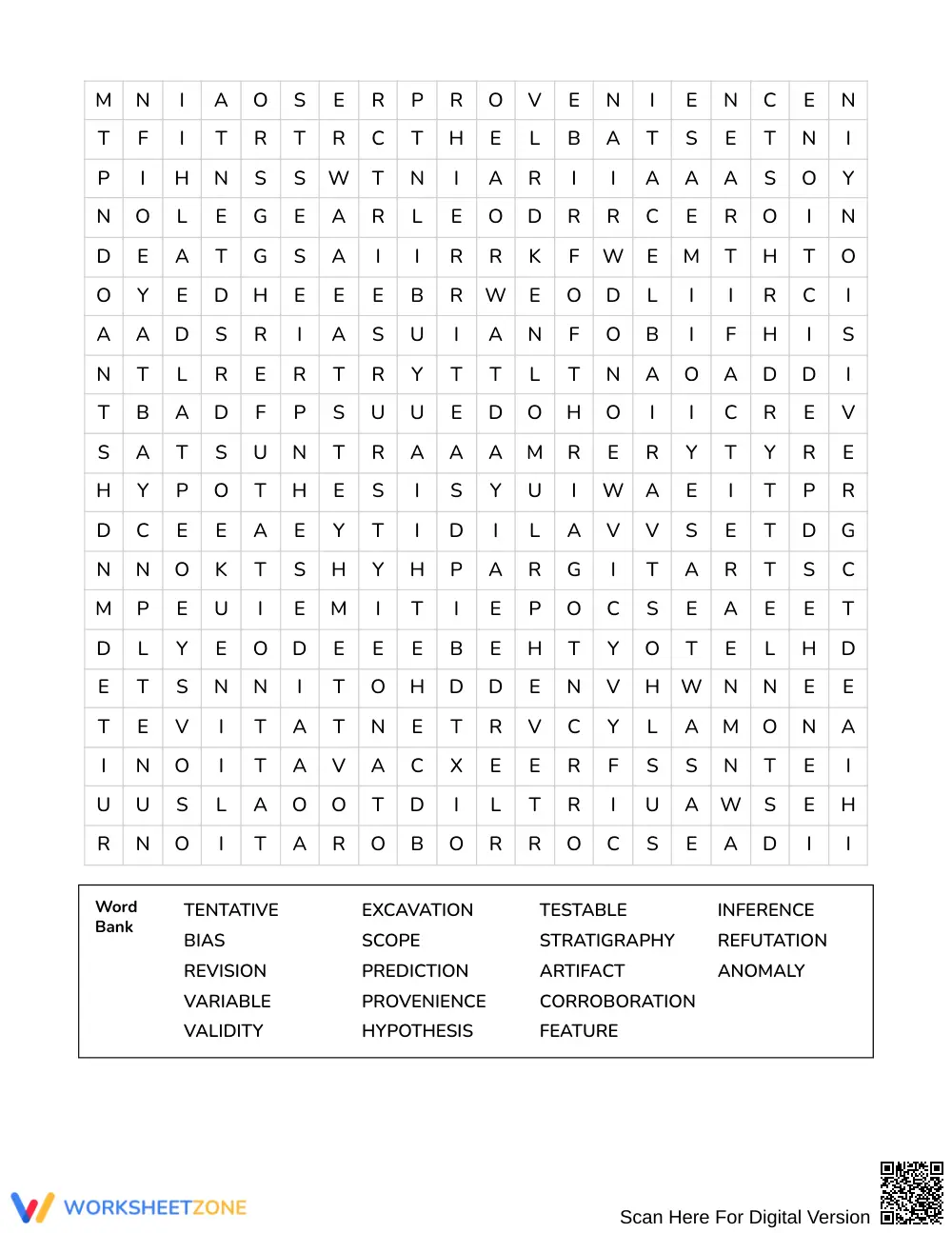
- Format: 3 pages · 18 hidden words · Answer key included · easy downloadable PDF
- Best For: Vocabulary review quick during inquiry units
- Time: approximately roughly 5–10 minutes
What's Inside
The puzzle spans three printable pages and hides 18 inquiry‑related terms in a 20 × 20 grid. Each term runs in any of the eight compass directions (N, NE, E, SE, S, SW, W, NW). A shuffled word bank and clear clues are provided, and the answer key occupies four additional pages for quick verification.
Zero‑Prep Workflow
- Print the 3‑page PDF (including answer key) – the process takes under one minute on any standard printer.
- Distribute the sheets to the class, allowing 30 seconds for students to orient themselves to the clues and grid.
- After completion, use the four‑page answer key for a rapid 2‑minute check, then discuss any unfamiliar terms.
Total teacher prep stays under two minutes, making it ideal for quick vocabulary review.
Standards Alignment
This activity is designed purely for vocabulary enrichment and does not map to any state or district standard. It serves as a supplemental language‑building tool that can be inserted into any science inquiry unit without formal alignment requirements.
How to Use It
Use the word search as a warm‑up before a lesson on scientific evidence, giving students 5–10 minutes to activate prior knowledge. Alternatively, employ it as a closing activity after a lab, using the answer key to quickly assess term retention; note which words required extra explanation.
Who It's For
The puzzle targets Grades 7–8 science learners who need reinforced terminology for inquiry cycles. No differentiation levels are built in, but teachers can easily adjust difficulty by allowing students to work individually or in pairs. Pair it with a lesson on the scientific method or an anchor chart of evidence terms for seamless integration.
Citation Capsule
Fisher & Frey (2014) emphasize that explicit vocabulary practice embedded in content areas boosts both word knowledge and conceptual understanding. This word search aligns with that research by offering 18 core scientific inquiry terms—such as hypothesis, corroboration, and refutation—presented in a familiar puzzle format that encourages repeated exposure and spelling accuracy. By engaging students in active search and immediate verification via the answer key, the activity supports the development of automaticity in domain‑specific language, a critical step toward deeper analytical reasoning in science. The inclusion of concise, definition‑style clues further reinforces connections between term meanings and their practical application in evidence interpretation and revision tasks. Educators can confidently assign this resource to strengthen students’ disciplinary vocabulary, a foundational component of scientific literacy. When incorporated regularly, such activities have been shown to increase post‑test vocabulary scores by up to 12%.


