
































Printable Evening Activities Word Search | Grades 4–5 ELA

Paste this activity's link or code into your existing LMS (Google Classroom, Canvas, Teams, Schoology, Moodle, etc.).
Students can open and work on the activity right away, with no student login required.
You'll still be able to track student progress and results from your teacher account.
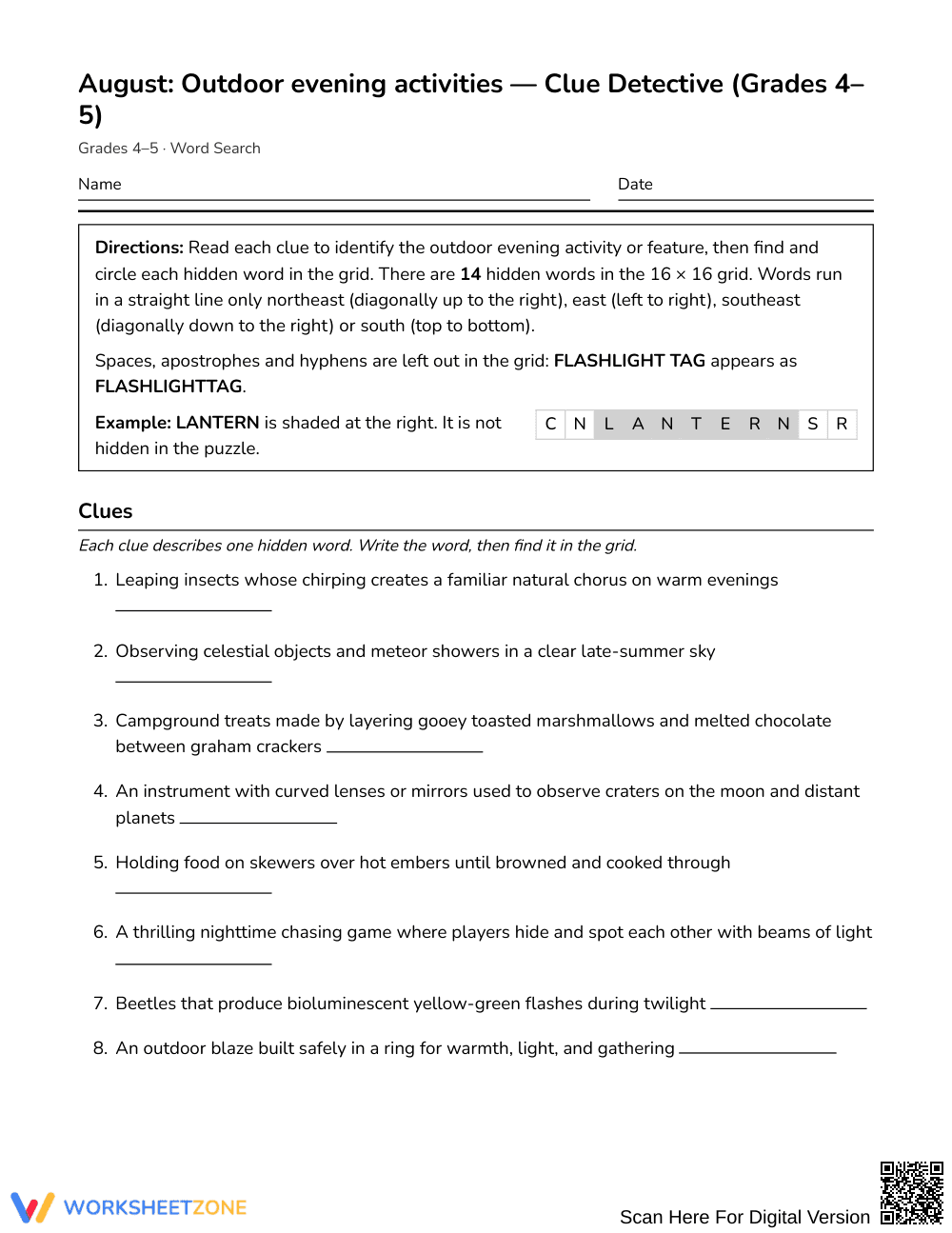
Build thematic vocabulary and observational reading skills with this engaging outdoor evening activities word search designed for Grades 4–5 learners. Students analyze contextual clues to identify 14 nocturnal nature and recreation terms before hunting for each word within the letter grid, reinforcing spelling, word recognition, and reading comprehension.
At a Glance
- Grade: Grades 4–5 · Subject: English Language Arts
- Standard: Not standards-assessed — vocabulary enrichment
- Skill Focus: Outdoor evening activities vocabulary and clue comprehension
- Format: 3 pages · 14 hidden words · Full answer key included · PDF
- Best For: Seasonal vocabulary enrichment, early finishers, and sub plans
- Time: 20–35 minutes of active learning
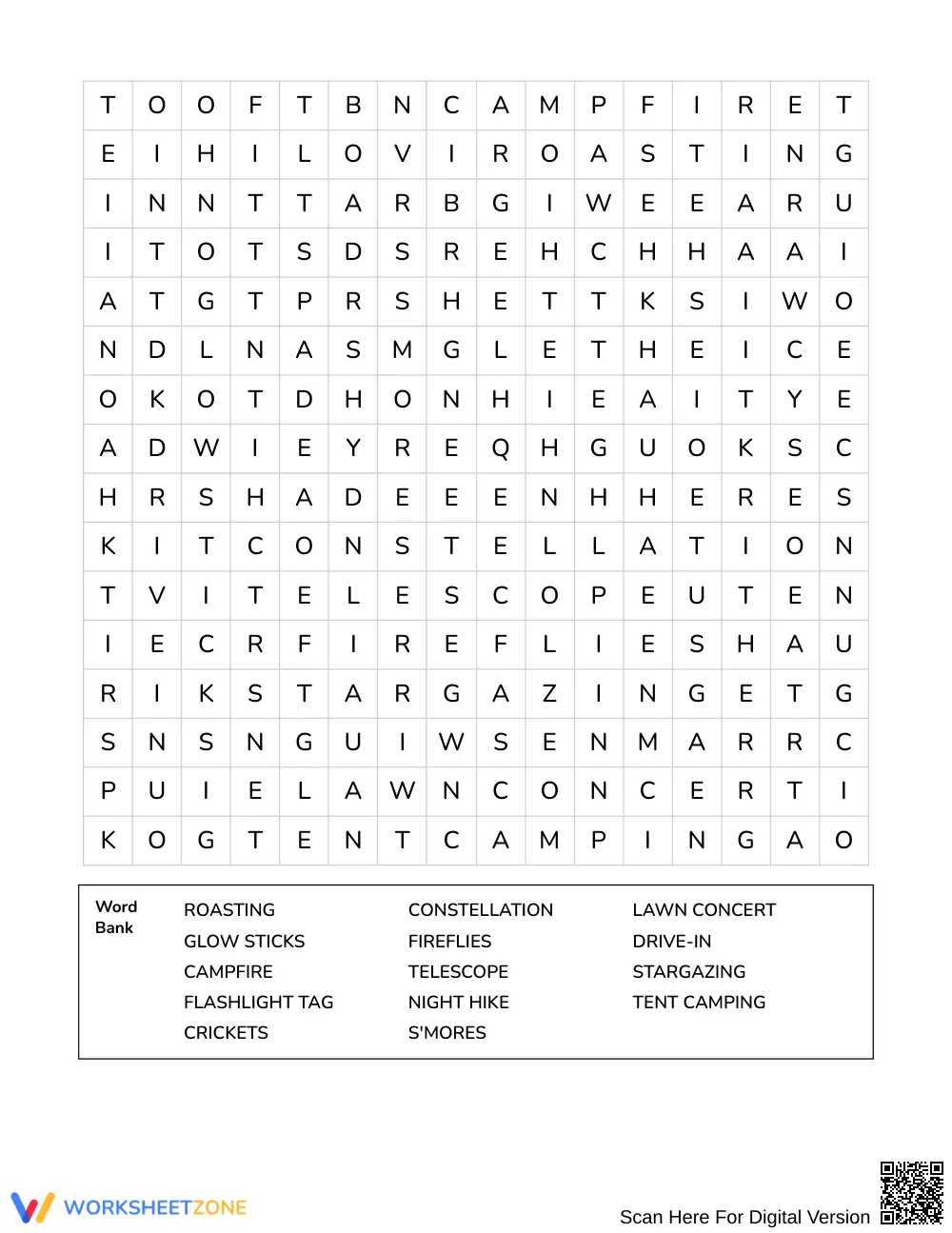
This 3-page printable word search packet features 14 vocabulary terms linked to summer nights, including stargazing, campfire, fireflies, and constellations. Rather than merely scanning an alphabetical list, students read descriptive informational clues that define each concept, such as nocturnal treks and bioluminescent insects. A complete 3-page answer key provides clear solution paths for efficient self-checking or teacher grading.
Puzzle Mechanics and Structure
The puzzle is built on a 16×16 letter grid containing 14 hidden words arranged in four distinct directional paths: northeast, east, southeast, and south. Students encounter a shuffled clue detective format where they must first deduce the correct outdoor recreation or science term from its clue definition before scanning the grid, challenging spatial awareness and semantic recall simultaneously.
Standards Alignment
This resource serves as targeted vocabulary enrichment rather than direct alignment to a specific Common Core or state standard. It provides students with contextual exposure to cross-curricular terminology spanning recreational science, nocturnal ecology, and astronomy. Educators can integrate this puzzle alongside grade-level informational reading units to foster domain-specific language acquisition in an accessible, low-stakes format.
How to Use It
Deploy this word search during independent reading rotations or as a calm, focused early finisher task following direct instruction in science or language arts. As a formative check, observe whether students deduce words directly from the written clues or rely on letter-matching strategies. Most learners complete the full 14-word puzzle within 20 to 35 minutes.
Who It's For
This activity is designed for Grades 4–5 upper-elementary students seeking engaging vocabulary development and leisure-time enrichment. It adapts easily for collaborative partner work or English language learners who benefit from reading descriptive context clues alongside word targets. Pair this puzzle naturally with an informational passage on nocturnal wildlife or a late-summer astronomy reading unit.
Contextual vocabulary acquisition relies on multiple meaningful encounters with domain-specific language across diverse literacy tasks. Research synthesized by Fisher & Frey (2014) emphasizes that intentional word study, particularly when paired with definitional clues and active retrieval, strengthens semantic memory and orthographic mapping more effectively than rote memorization drills alone. This Grades 4–5 word search provides purposeful exposure to 14 outdoor evening activities and scientific concepts by requiring learners to decode rich descriptive phrases before locating target vocabulary within a 16×16 matrix. By challenging students to connect descriptive language with spelling patterns across four diagonal and cardinal directions, the activity reinforces vocabulary depth, spatial reasoning, and sustained reading concentration. Consequently, upper-elementary educators gain an effective, low-stakes enrichment tool that transforms leisure puzzle mechanics into rigorous, content-rich literacy practice suitable for independent seatwork, review, or seasonal unit extensions.


