





























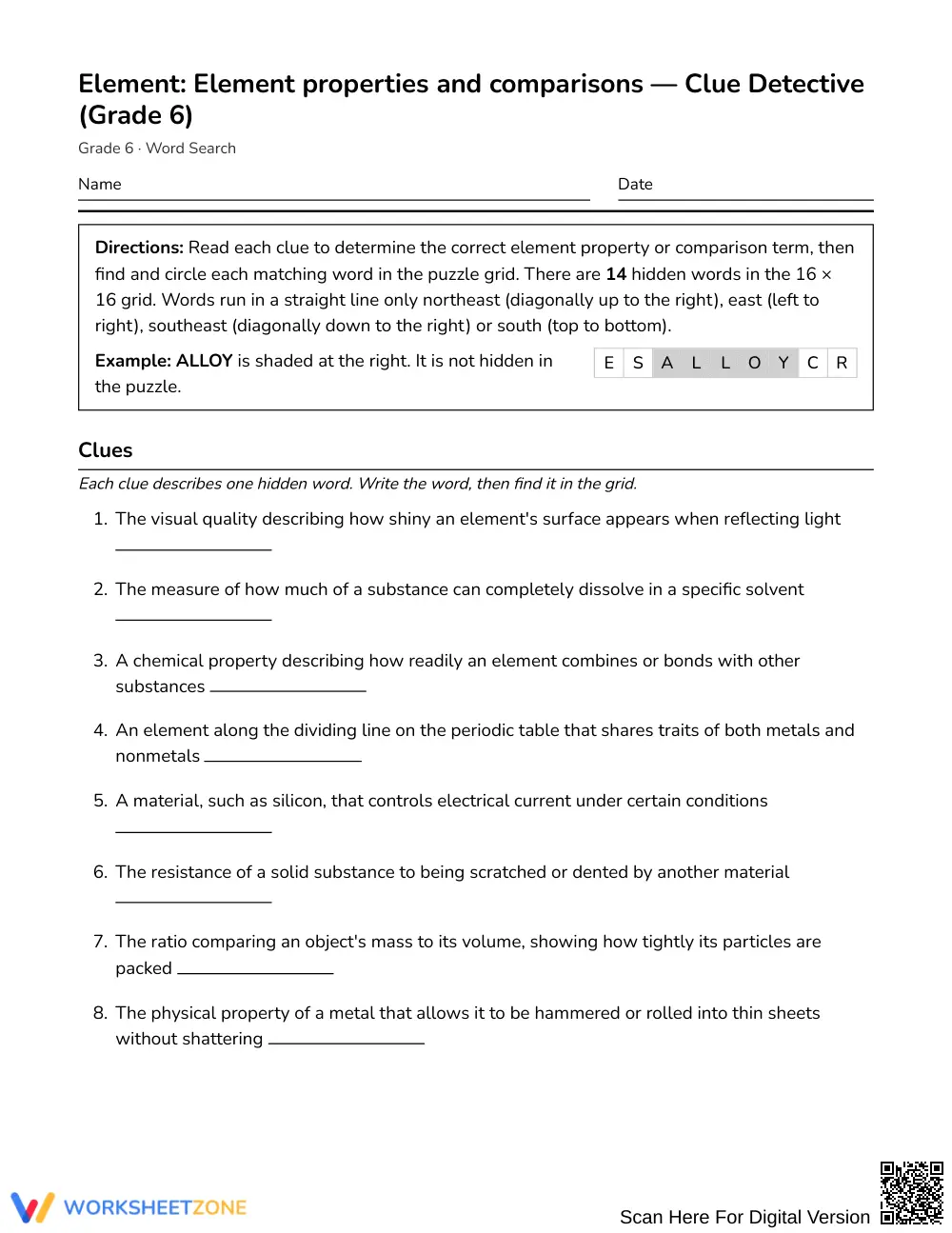


Printable Element Properties Word Search | Grade 6 Science

Paste this activity's link or code into your existing LMS (Google Classroom, Canvas, Teams, Schoology, Moodle, etc.).
Students can open and work on the activity right away, with no student login required.
You'll still be able to track student progress and results from your teacher account.
This Grade 6 Science word search sharpens students’ understanding of element properties and comparisons while building chemistry vocabulary. Learners read clues, locate fourteen hidden terms, and reinforce key concepts through active searching in class with minimal guidance.
At a Glance
- Grade: Grade 6 · Subject: Science
- Standard:
Not standards-assessed — vocabulary enrichment(focus on chemistry terms)- Skill Focus: element properties and comparisons (key chemistry concepts)
- Format: 3 printable pages · 14 hidden words · Answer key included · PDF file
- Best For: vocabulary review, chemistry unit reinforcement, independent practice activity
- Time: 5–10 minutes for quick completion
What's Inside
The activity spans three PDF pages and presents a 16 × 16 grid filled with fourteen chemistry‑related terms. A shuffled word bank and clear clues guide learners to locate each word. An answer key on the final page shows the completed grid for quick checking.
Zero‑Prep Workflow
- Print: Open the PDF and print the three pages (including answer key) – under 1 minute.
- Distribute: Hand the word‑search sheets to students and give a quick reminder of the clue‑reading task – about 30 seconds.
- Review: After completion, use the answer key to check results together – roughly 5 minutes. Total teacher prep stays under 2 minutes, making it ideal for a sub‑plan.
Standards Alignment
This resource is designed for vocabulary enrichment in a chemistry context and is not aligned to any specific state or Common Core standard. It supports the broader goal of building scientific terminology fluency.
How to Use It
1. Pre‑lesson warm‑up: Before introducing a new element property, give students the word search to activate prior knowledge. Observe which clues students struggle with as informal formative data.
2. Post‑lesson reinforcement: After a direct‑instruction session on metallic vs non‑metallic traits, assign the puzzle for independent practice. Collect completed sheets to gauge retention; most groups finish in 5–10 minutes.
Who It's For
Designed for Grade 6 science learners, especially those needing extra practice with chemistry vocabulary. The shuffled word bank adds a mild challenge, while the clear clues support struggling readers. Pair it with a periodic‑table anchor chart or a short video on element properties for a full lesson.
Research shows that targeted word‑search activities boost terminology retention in middle‑school science. Fisher & Frey (2014) highlight that explicit vocabulary practice, combined with contextual clues, improves students’ ability to recall and apply scientific terms in later assessments. This Grade 6 word search leverages that evidence by presenting fourteen key element‑property terms alongside concise definitions, encouraging active decoding and visual memory. The activity’s quick, zero‑prep format aligns with findings that brief, focused practice sessions can increase engagement without sacrificing instructional time. When used alongside a periodic‑table anchor chart, the activity further reinforces connections between terminology and visual representations, helping diverse learners bridge abstract concepts with concrete examples.


