


























Views
Downloads

Printable Line Tracing Worksheet | Pre-K & K Ready
Paste this activity's link or code into your existing LMS (Google Classroom, Canvas, Teams, Schoology, Moodle, etc.).
Students can open and work on the activity right away, with no student login required.
You'll still be able to track student progress and results from your teacher account.
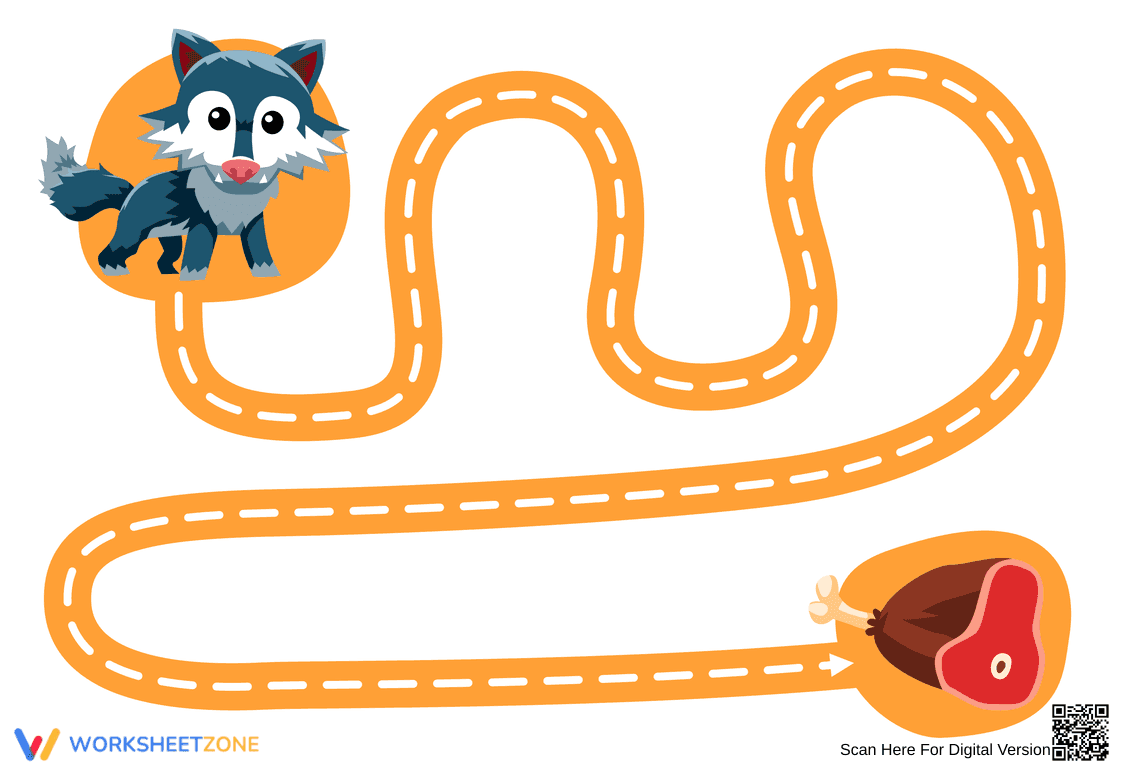
This engaging pre-writing worksheet helps early learners develop essential fine motor control before they begin forming letters. By guiding a wolf along a dotted path to its food, students practice pencil grip, hand-eye coordination, and continuous line tracing in a fun, low-pressure format.
At a Glance
- Grade: Pre-K & K · Subject: Handwriting
- Standard:
CCSS.ELA-LITERACY.L.K.1.A— Practice foundational fine motor skills for printing- Skill Focus: Line tracing and pencil control
- Format: 1 page · 1 continuous path · No answer key needed · PDF
- Best For: Morning work or centers
- Time: 5–10 minutes
This single-page resource features a large, continuous dotted path that loops and curves across the page. The playful design connects a cartoon wolf at the start to a piece of meat at the end, giving young children a clear visual goal. The wide, dashed lines are specifically sized for early learners using thick crayons or beginner pencils, ensuring they can successfully stay on track while building muscle memory.
This activity requires zero teacher preparation.
- Print (30 seconds): Download the PDF and print.
- Distribute (1 minute): Hand out with crayons. The visual instructions are self-explanatory.
- Review (1 minute): Check that students hold writing tools correctly.
Total prep time is under two minutes, perfect for sub plans.
This tracing activity aligns with CCSS.ELA-LITERACY.L.K.1.A, which requires students to print many upper- and lowercase letters. While this specific task focuses on pre-writing strokes rather than explicit letter formation, mastering these curved and straight continuous lines is the direct prerequisite for standard kindergarten handwriting expectations. Both standard codes can be copied directly into lesson plans, IEP goals, or district curriculum mapping tools.
Use this tracing path as morning work as students settle into the classroom. It provides a quiet, focused task requiring minimal instruction. Alternatively, place it in a fine motor center inside a plastic sheet protector for repeated dry-erase use. While students work, observe their pencil grip. If a child struggles, offer hand-over-hand guidance. Expect completion in five to ten minutes.
This resource is designed for preschool, pre-kindergarten, and early kindergarten students who are just beginning their handwriting journey. It is also highly effective for occupational therapy sessions or special education students needing targeted fine motor intervention. For students who finish quickly, challenge them to trace the path again using a different color to create a "rainbow road." Pair this activity with a read-aloud about wolves or forest animals to connect fine motor practice with literacy.
Developing strong fine motor skills through targeted tracing activities is a critical step in early childhood education. This worksheet supports CCSS.ELA-LITERACY.L.K.1.A by helping students practice foundational fine motor skills for printing. According to a comprehensive Fisher & Frey (2014) analysis on early literacy development, explicit instruction and repeated practice in pre-writing strokes significantly improve later letter formation and overall writing fluency. When young learners engage in continuous line tracing, they build the necessary muscle memory and hand-eye coordination required for academic success. By integrating playful elements like guiding a character to a goal, educators can maintain high levels of student engagement during these essential repetitive tasks. This evidence-based approach ensures that children develop the physical stamina and control needed before transitioning to formal handwriting instruction in kindergarten and beyond.


