


























Views
Downloads



Printable Conic Features Worksheet | Grade 11 Algebra II
Paste this activity's link or code into your existing LMS (Google Classroom, Canvas, Teams, Schoology, Moodle, etc.).
Students can open and work on the activity right away, with no student login required.
You'll still be able to track student progress and results from your teacher account.
This Algebra II worksheet develops student mastery in identifying and calculating key geometric features of conic sections. Students analyze circles, parabolas, ellipses, and hyperbolas across 18 problems, finding centers, vertices, and axes from standard and general equations.
At a Glance
- Grade: 11 · Subject: Algebra II
- Standard: Conic Sections — Identify key features and convert quadratic equations into standard form
- Skill Focus: Find Centers, Vertices, and Axes
- Format: 5 pages · 18 problems · Answer key included · PDF
- Best For: High school conic sections practice
- Time: 45–60 minutes
What's Inside
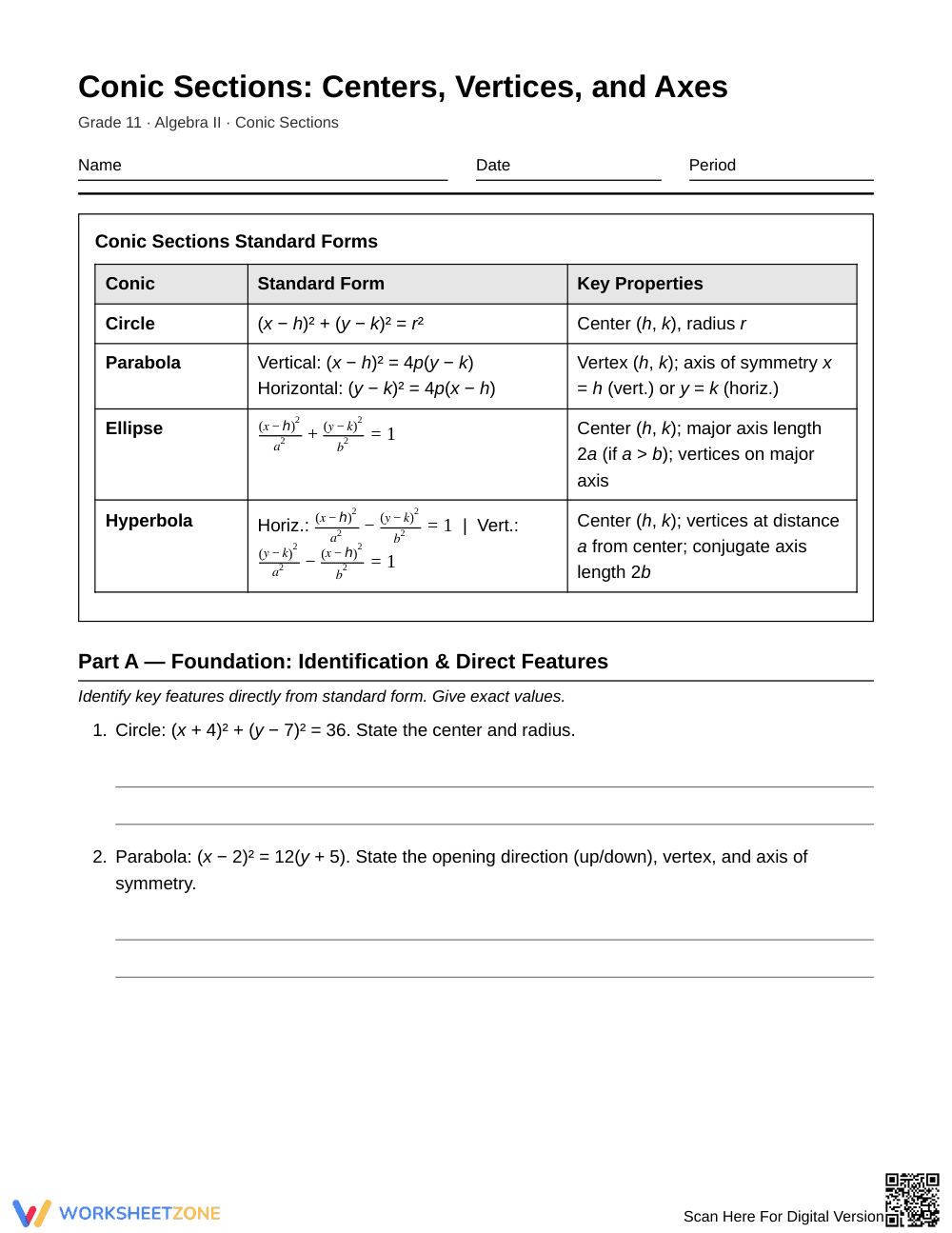
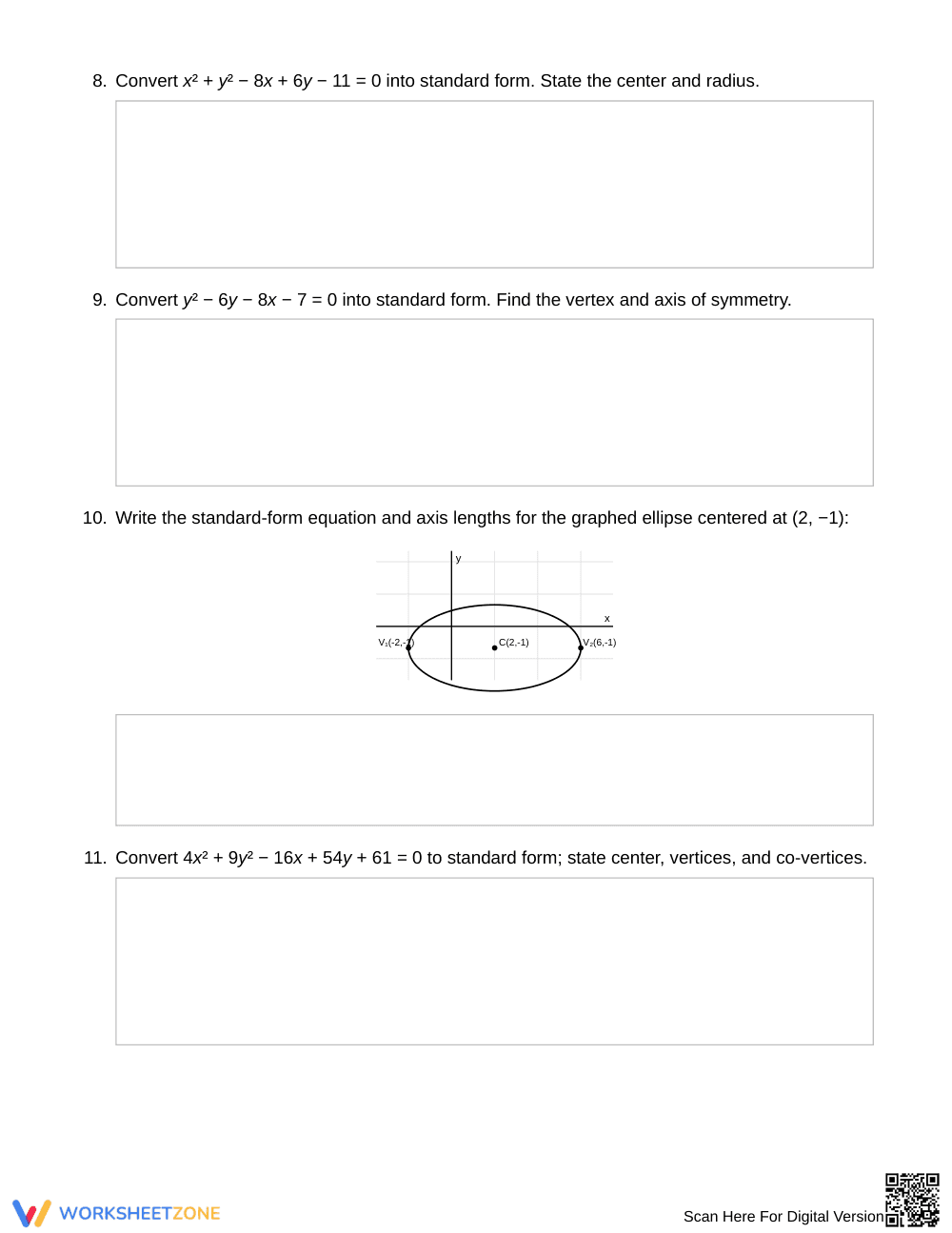
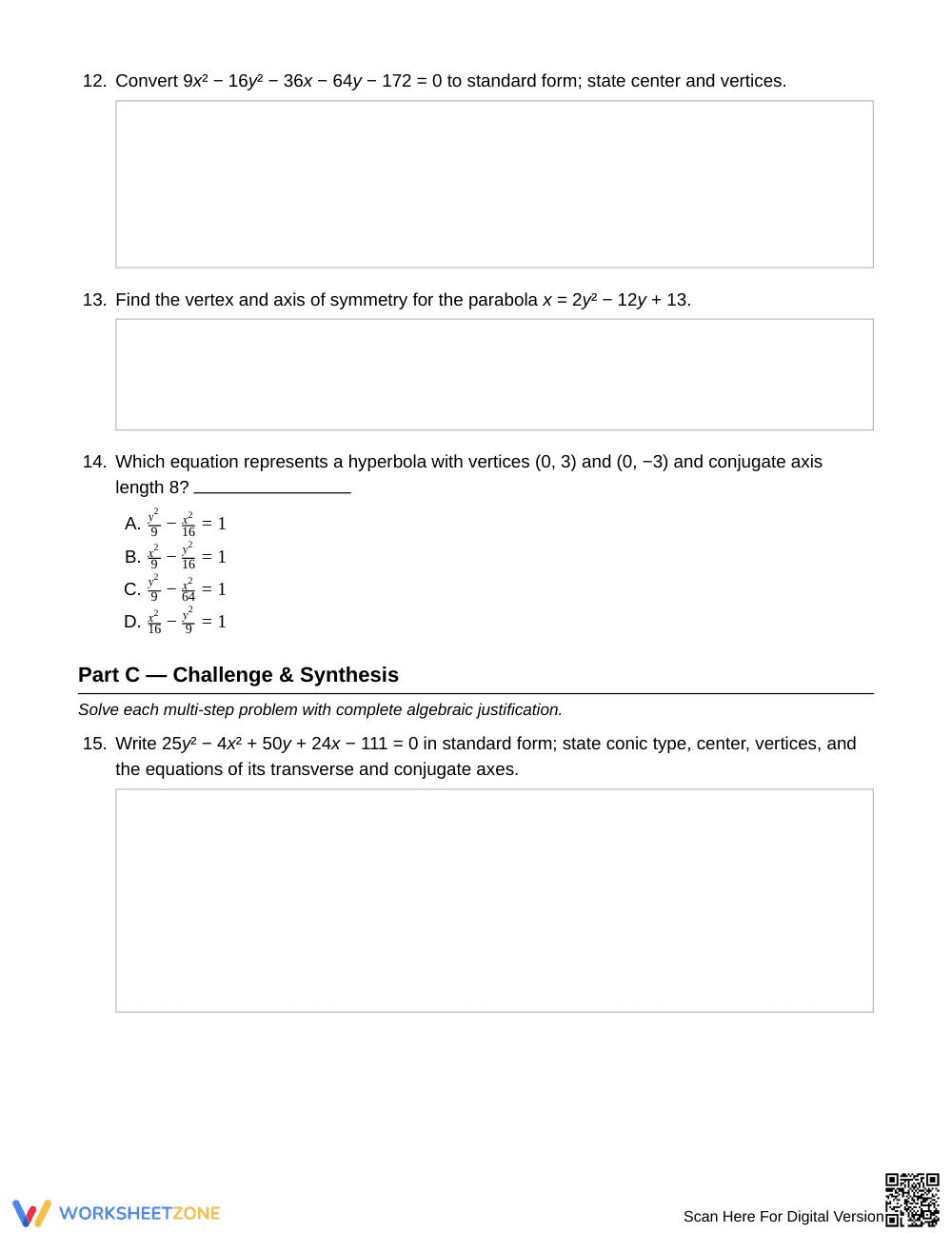
The 5-page student packet opens with a reference chart summarizing standard forms and properties for circles, parabolas, ellipses, and hyperbolas. Students encounter direct identification tasks, general-to-standard form conversions using completing the square, graphical analysis of an ellipse, and challenge problems. A full 2-page answer key provides complete algebraic solutions and exact coordinates for streamlined grading.
Skill Progression
This resource utilizes a structured gradual-release architecture to build conceptual fluency:
- Guided Practice (Part A — 4 problems): Direct identification tasks allow students to extract centers, radii, and vertices using the reference table.
- Supported Practice (Part B — 10 problems): Multi-step problems require completing the square to convert general quadratic equations into standard form and analyze graphs.
- Independent Practice (Part C — 4 problems): Complex synthesis challenges require students to construct equations from geometric properties and derive dual conic systems.
This sequence supports the I Do, We Do, You Do model from initial recognition to mastery.
Standards Alignment
This worksheet aligns with high school Algebra II standards for quadratic relations and analytic geometry. Students analyze second-degree equations in two variables, completing the square to determine vertices, centers, and axes of symmetry. Both standard codes can be copied directly into lesson plans, IEP goals, or district curriculum mapping tools.
How to Use It
Use this worksheet after direct instruction on conic equations. Assign Parts A and B during a 50-minute block, using Part A as a quick check for understanding. As a formative assessment tip, watch for sign errors when students factor leading coefficients before completing the square on hyperbolas. Assign Part C as an extension or homework.
Who It's For
This resource is designed for Grade 11 Algebra II and Pre-Calculus students learning analytic geometry. It supports both on-level practice and honors enrichment. Pair this worksheet with an anchor chart of conic standard forms or graphing software to connect algebraic equations to their geometric curves.
Research by Fisher & Frey (2014) on the gradual release of responsibility demonstrates that scaffolded instructional sequences significantly enhance student retention and procedural accuracy in advanced mathematics. This 5-page Algebra II worksheet targets conic section analysis, guiding Grade 11 students through 18 structured problems to find centers, vertices, and axes across circles, parabolas, ellipses, and hyperbolas. By beginning with an accessible reference chart and progressing through multi-step algebraic conversions using completing the square, the material helps students build solid conceptual schemas for quadratic systems. Teachers can integrate this resource into unit instruction, targeted interventions, or test review to support standard-aligned mastery. The included 2-page answer key provides step-by-step verification, making this an essential tool for high school mathematics classrooms aiming to reinforce analytical problem-solving skills.


