




























Views
Downloads




Printable Complex Numbers Worksheet | Grade 11 Algebra II

Paste this activity's link or code into your existing LMS (Google Classroom, Canvas, Teams, Schoology, Moodle, etc.).
Students can open and work on the activity right away, with no student login required.
You'll still be able to track student progress and results from your teacher account.
This Grade 11 Algebra II worksheet helps students add, subtract, and multiply complex numbers using i² = −1, then apply those skills to quadratic equations with nonreal solutions. Sixteen tiered problems move from recall to justification, so teachers can see exactly where each student's understanding holds and where it breaks down.
At a Glance
- Grade: 11 · Subject: Algebra II
- Standard:
HSN-CN.A.2— Add, subtract, and multiply complex numbers using i² = −1 and the distributive property- Skill Focus: Complex number operations and nonreal quadratic solutions
- Format: 5 pages · 16 problems · Answer key included · PDF
- Best For: Unit review, quiz prep, or homework
- Time: 30–40 minutes
What's Inside
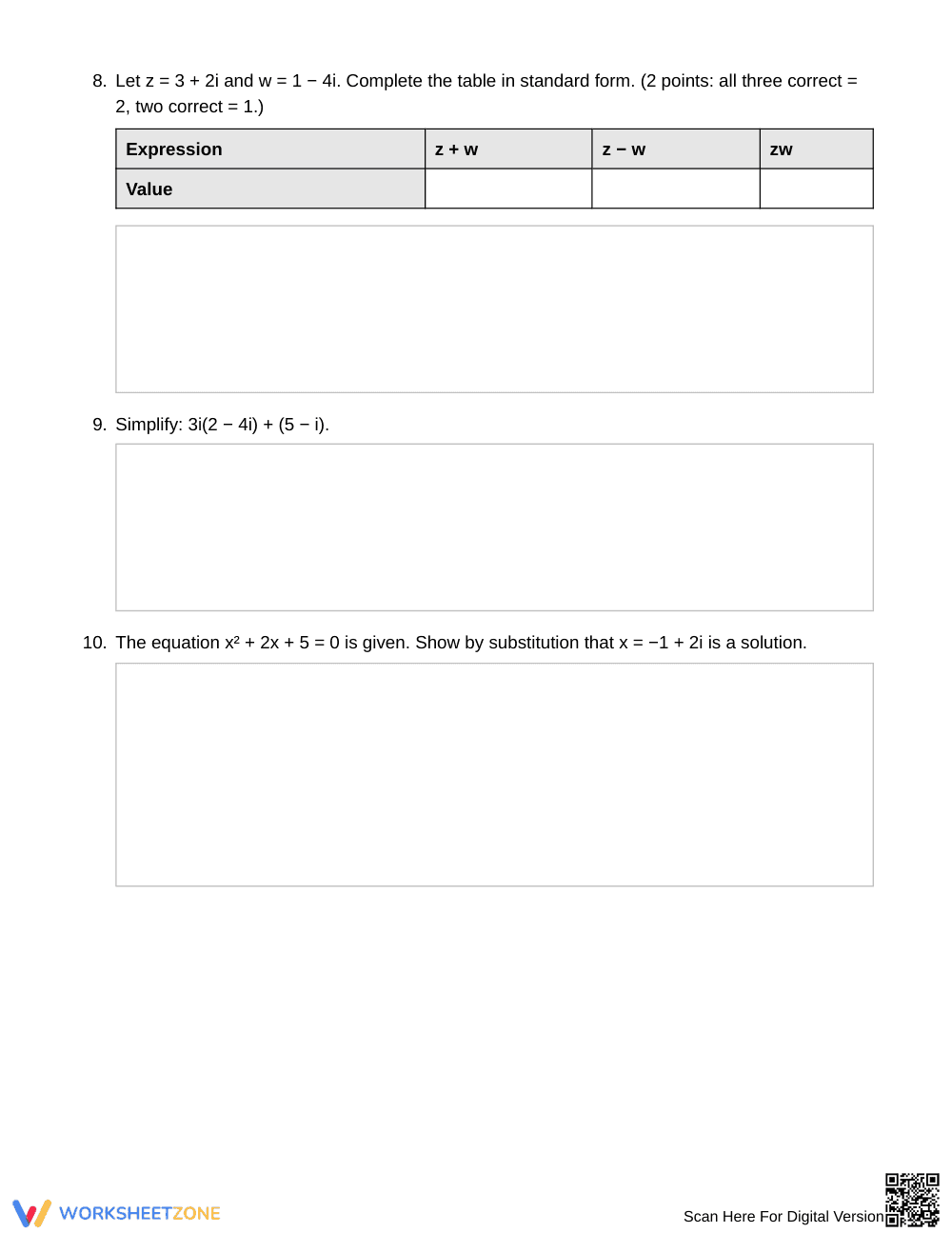
Part A has 4 foundation items (powers of i, adding, subtracting, real and imaginary parts), Part B has 8 core items (products, a z and w table, a substitution check, the quadratic formula, a discriminant question), and Part C has 4 challenge items. A conventions box explains the 32-point scoring. A 2-page answer key completes the 5-page PDF.
Skill Progression
- Guided practice: Part A, 4 problems at 1 point each. Brief work is optional, so students build fluency with powers of i, sums, and differences.
- Supported practice: Part B, 8 problems at 2 points each. Students show every step, and partial credit rewards correct use of i² = −1.
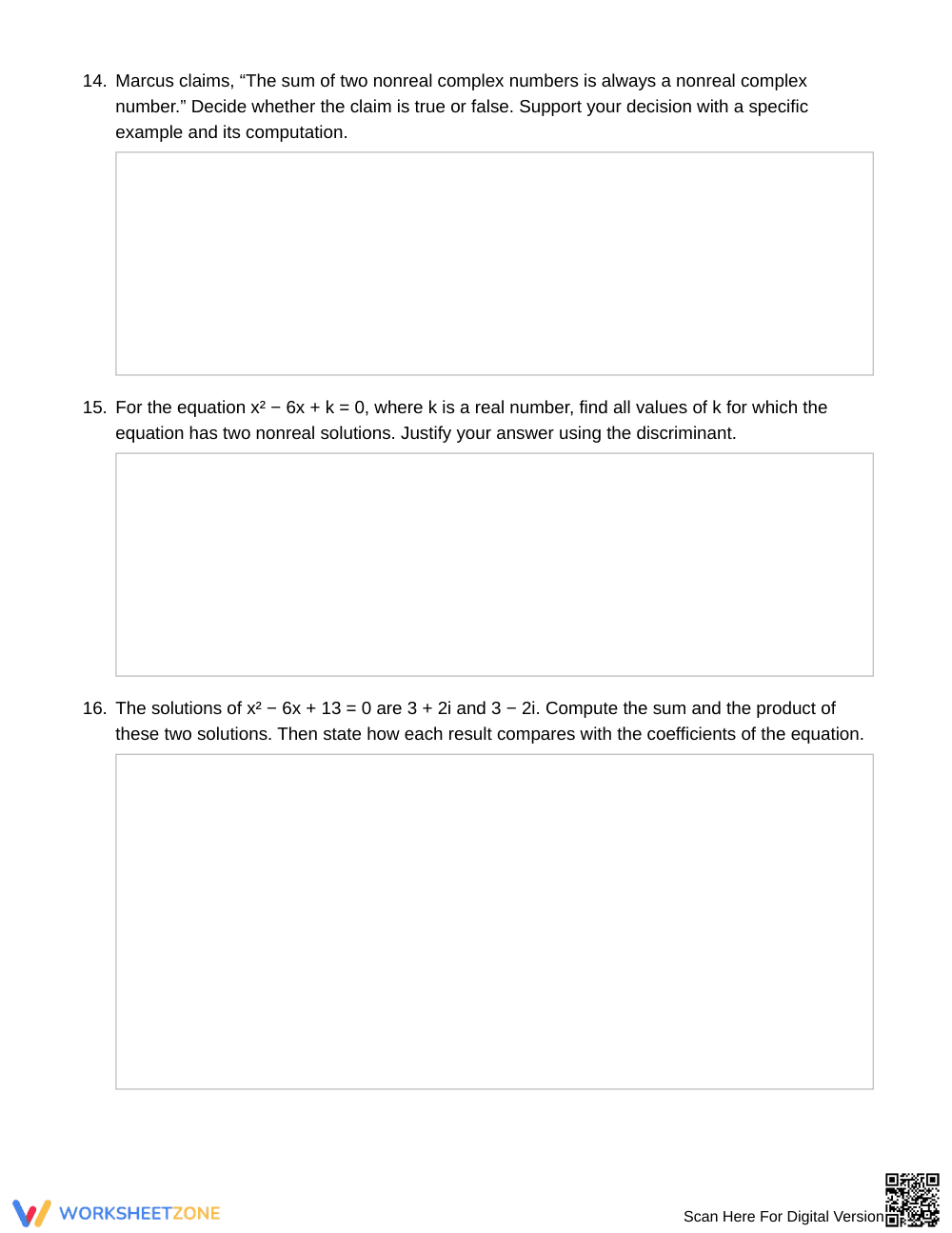
- Independent practice: Part C, 4 problems at 3 points each. Students justify answers, test a claim, and connect roots to coefficients.
The sequence supports gradual release: model Part A (I Do), work Part B in pairs (We Do), then release Part C (You Do).
Standards Alignment
HSN-CN.A.2: Use the relation i² = −1 and the commutative, associative, and distributive properties to add, subtract, and multiply complex numbers. Items on quadratic equations with nonreal solutions also connect to HSN-CN.C.7. Both standard codes can be copied directly into lesson plans, IEP goals, or district curriculum mapping tools.
How to Use It
- After direct instruction: Assign the full set as an in-class check. Circulate and watch whether students replace i² with −1 before combining like terms.
- Before a unit test: Send Parts A and B home as review, then discuss Part C in pairs.
Expect 30–40 minutes for the full set.
Who It's For
Grade 11 Algebra II students finishing a complex numbers unit. Students who need support can start with Parts A and B (20 points), while students ready for more can focus on Part C. Pair it with an anchor chart of powers of i or a lesson on the quadratic formula.
This Grade 11 Algebra II worksheet targets HSN-CN.A.2, which asks students to use i² = −1 and the commutative, associative, and distributive properties to add, subtract, and multiply complex numbers. It contains 16 problems across three scored tiers: 4 foundation items, 8 core items, and 4 challenge items worth 32 points in total. Students move from powers of i and basic arithmetic to binomial products, conjugate pairs, quadratic solutions with negative discriminants, and written justification. The structure reflects the gradual release of responsibility model described by Fisher & Frey (2014), in which learners shift from guided work toward independent application. Because each tier carries its own point value and expectations for shown work, teachers can use the results to separate computation errors from conceptual gaps. A two-page answer key is included in the five-page PDF, making the resource suitable for quizzes, unit reviews, and targeted intervention in Algebra II.


