




























Views
Downloads

Printable Coastal Weather Word Search | Grades 4–5 Science

Paste this activity's link or code into your existing LMS (Google Classroom, Canvas, Teams, Schoology, Moodle, etc.).
Students can open and work on the activity right away, with no student login required.
You'll still be able to track student progress and results from your teacher account.
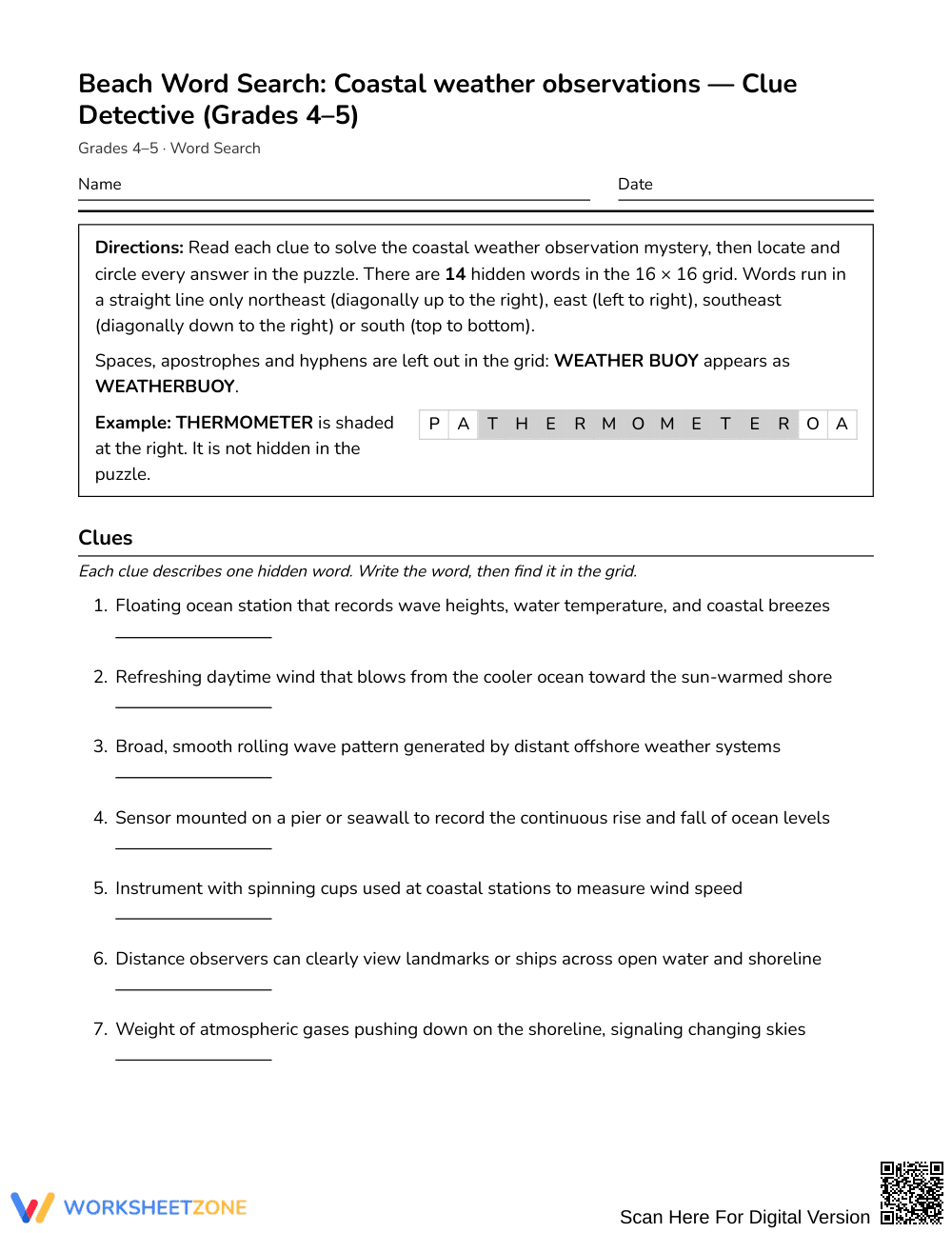
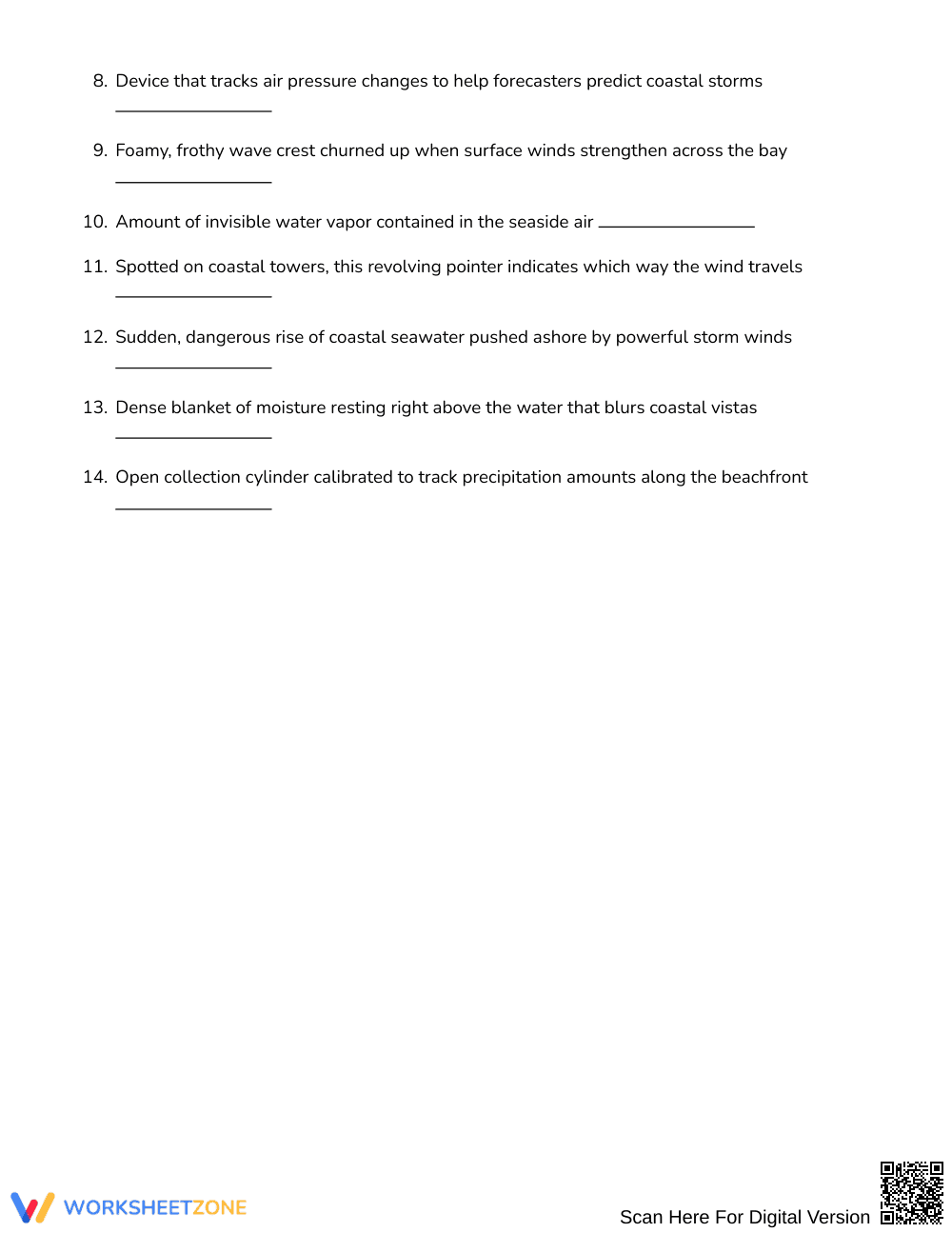
This coastal weather science word search builds Grade 4 and Grade 5 atmospheric science vocabulary through an engaging clue detective format. Students read descriptive definitions of shoreline meteorological phenomena and ocean observation tools, deduce the matching target words, and locate each term within the letter grid to reinforce science comprehension.
At a Glance
- Grade: Grades 4–5 · Subject: Science
- Standard: Not standards-assessed — vocabulary enrichment
- Skill Focus: Coastal weather observations
- Format: 3 pages · 14 words · Answer key included · PDF
- Best For: Science vocabulary reinforcement and review
- Time: 20–30 minutes
What's Inside
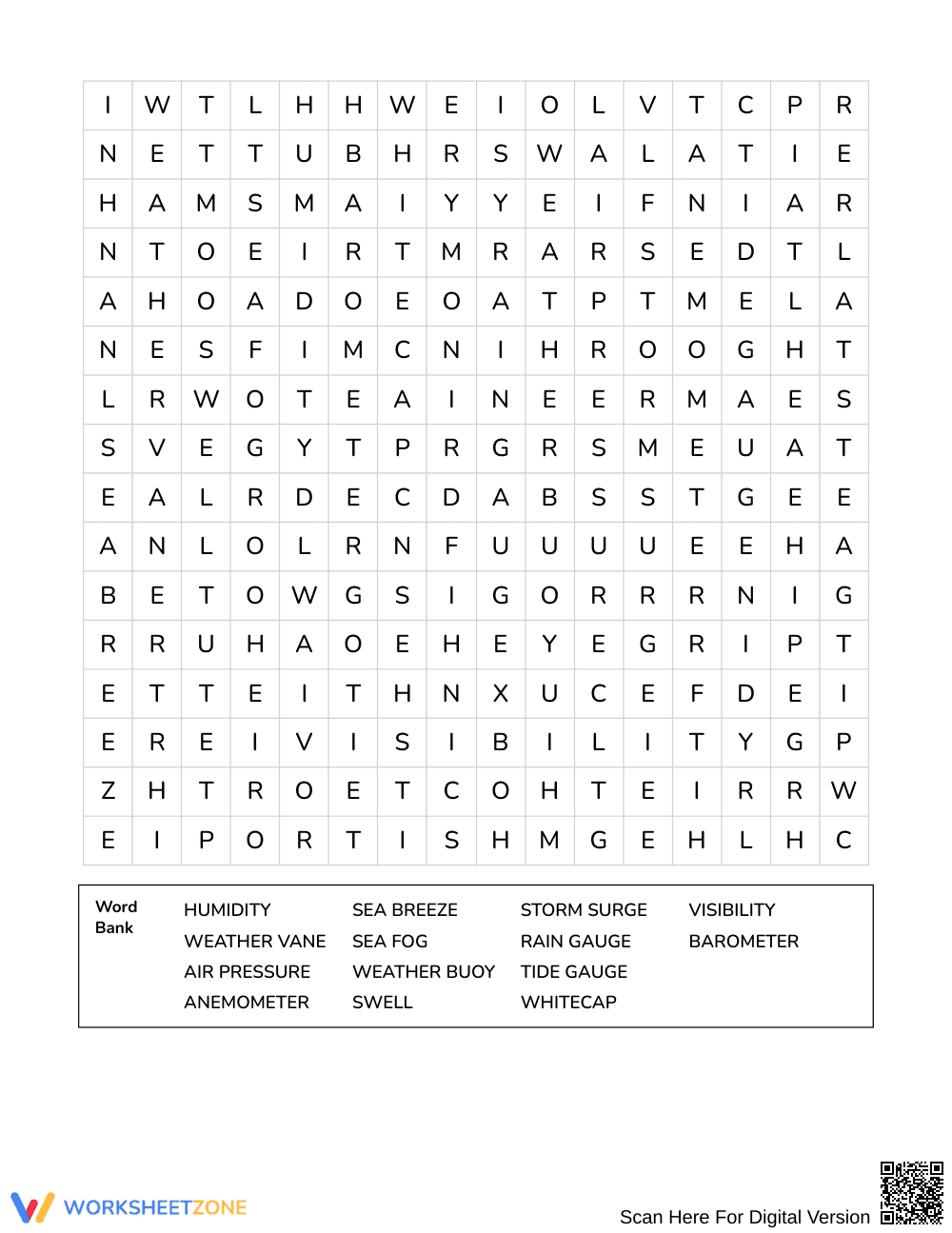
This 3-page printable science resource contains a 14-word clue detective puzzle alongside a complete 3-page reference answer key. Rather than scanning for a basic list of terms, students must first process descriptive definitions for coastal measurement tools and shoreline events. The layout presents a clean student puzzle sheet accompanied by full-solution sheets that highlight exact term placements for rapid checking.
Puzzle Structure and Mechanics
The activity is arranged as a focused, single-level vocabulary challenge featuring specific spatial constraints:
- Grid Dimensions: A structured 16 x 16 letter grid providing an accessible search field.
- Search Vectors: Words run along four distinct directional paths: northeast, east, southeast, and south.
- Clue Detective Bank: Fourteen shuffled definitions prompt learners to identify terms like anemometer, sea breeze, and storm surge before searching.
Standards Alignment
This word search serves strictly as science vocabulary enrichment and is not aligned to a formal state standard. It reinforces essential domain-specific terminology associated with coastal weather tracking, marine observation stations, and shoreline atmospheric conditions without requiring assessment tracking.
How to Use It
Deploy this learning activity directly after explicit instruction on weather instruments to solidify concept retention, or assign it as an independent station task during earth science rotations. While learners work, observe whether they read clues first to determine answers independently or jump directly to letter hunting; prompting them to explain terms like barometer or whitecap offers fast formative feedback. Completion typically requires 20 to 30 minutes.
Who It's For
This activity is designed for Grades 4–5 elementary science classrooms, environmental clubs, and coastal habitat units. For learners requiring extra support, provide an introductory word bank alongside the clues, while advanced learners can write original sentences describing how meteorologists use each instrument. Pair this puzzle with an informational text on ocean storms or an interactive station model lesson.
Integrating structured vocabulary acquisition within science instruction strengthens foundational literacy and reading comprehension across elementary classrooms. As highlighted by Fisher & Frey (2014), intentional exposure to disciplinary terminology through guided retrieval helps intermediate students anchor complex conceptual knowledge into long-term memory. Rather than relying on rote memorization, pairing contextual definitions with active visual search tasks prompts students to repeatedly analyze domain-specific terms, including tide gauge, humidity, and atmospheric pressure. This dual processing model ensures that Grade 4 and Grade 5 learners build familiarity with technical words before encountering them in complex expository reading. Providing dedicated review tools like structured vocabulary searches equips educators with low-stress, highly effective materials that bridge direct teacher instruction and independent scientific inquiry.


