




























Printable Cloud Photography Word Search | Grades 6–7 Science
Paste this activity's link or code into your existing LMS (Google Classroom, Canvas, Teams, Schoology, Moodle, etc.).
Students can open and work on the activity right away, with no student login required.
You'll still be able to track student progress and results from your teacher account.
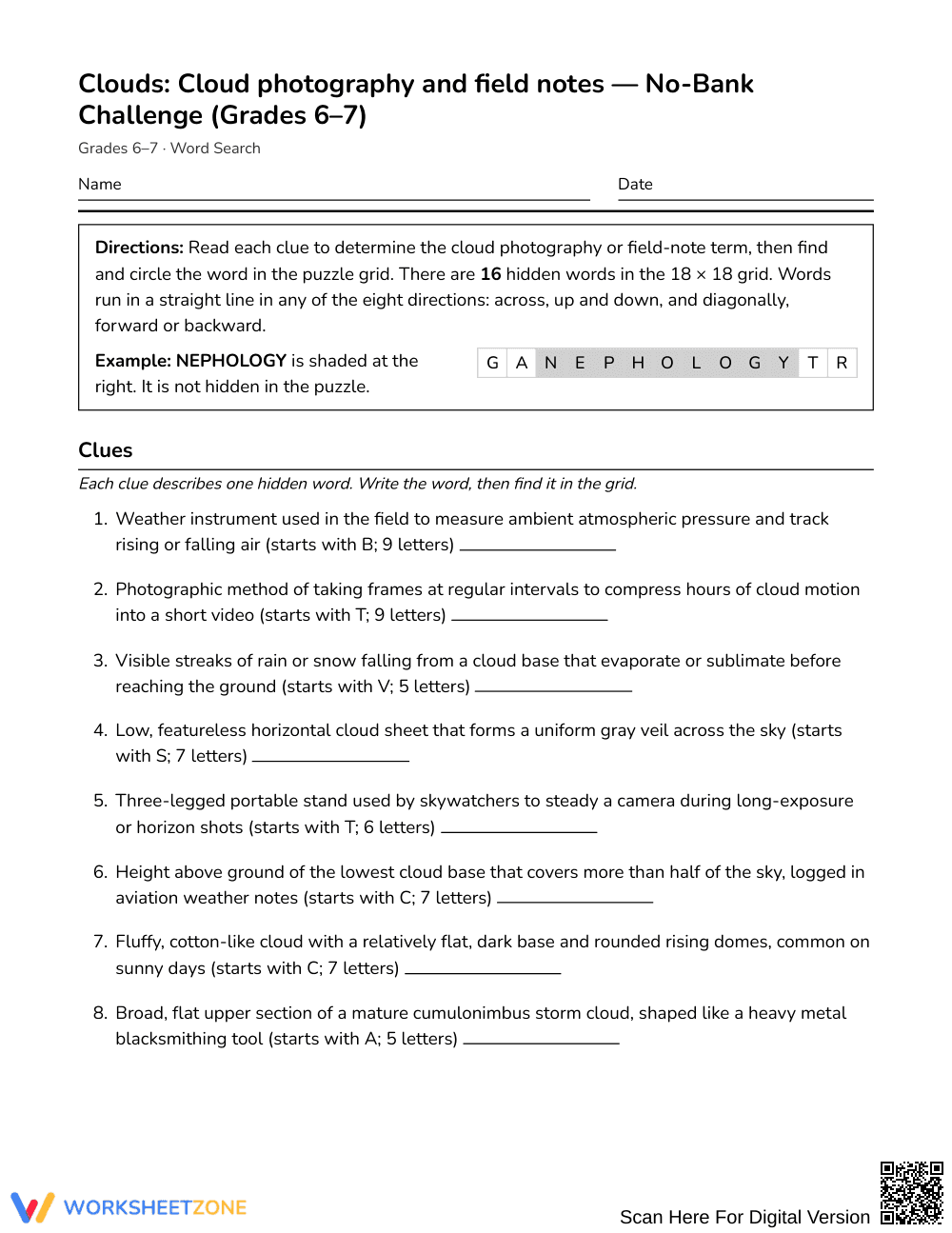
Boost learners’ cloud‑photography vocabulary with this engaging word search. Students locate sixteen key terms, reinforcing field‑note language while sharpening observation skills for sky‑watching projects. The activity can be completed individually or in small groups, fostering discussion about how each term relates to real‑world cloud documentation.
At a Glance
- Grade: Grades 6–7 · Subject: Science
- Standard:
Not standards-assessed — vocabulary enrichment— students locate, circle, and record cloud‑related terminology- Skill Focus: cloud photography and field‑note terminology for sky‑observation journals
- Format: 3 printable pages · 16 hidden words · answer key included · ready‑to‑print PDF
- Best For: a fast, engaging vocab review or enrichment activity during science labs
- Time: quick, approximately 10–15 minutes per class
The three‑page packet contains an 18 × 18 letter grid, a list of sixteen cloud‑related terms, and clear clues that tie each word to photography or field‑note concepts. An answer key on the back confirms each hidden word’s location, making self‑check effortless.
- The puzzle uses an 18 × 18 grid where words may run horizontally, vertically, or diagonally in any of the eight compass directions (N, NE, E, SE, S, SW, W, NW).
- Sixteen target words are hidden; each clue describes a cloud‑photography or field‑note term, guiding students to the correct entry.
- There is no separate word bank; students rely on the clues to locate each term, and the answer key provides the exact coordinates for verification.
This activity is designed solely for vocabulary enrichment and does not map to any specific state or national standard. It supports broader science communication goals by expanding students’ cloud‑related terminology.
Before a unit on atmospheric observation, teachers can introduce the word search as a warm‑up to activate prior knowledge of cloud terminology. Observe which clues spark discussion to gauge baseline understanding.
During a lab where students photograph clouds, the search can serve as a quick exit ticket; students write one sentence using a newly found term, allowing the teacher to assess correct usage in five to ten minutes.
Designed for Grades 6–7 science learners, this word search offers a focused vocabulary boost without additional scaffolding. It pairs well with a cloud‑photography lesson or an anchor chart of cloud types for seamless integration.
Citation: Fisher & Frey (2014) demonstrate that targeted vocabulary exercises embedded within authentic content contexts significantly boost student retention and transfer of terminology. By presenting cloud‑photography and field‑note terms in a word‑search format, learners engage in active decoding while reinforcing scientific language. The activity’s concise 10–15‑minute duration aligns with research indicating that short, focused vocabulary tasks yield measurable gains without overwhelming cognitive load. Moreover, the inclusion of clear, concept‑linked clues mirrors the explicit instruction strategies highlighted by Fisher & Frey, fostering deeper connections between words and their real‑world applications in sky observation. This evidence‑based approach supports educators seeking efficient, standards‑free enrichment for middle‑school science classrooms.


