































Printable Clothing Words Word Search | Grades 2–3 ELA

Paste this activity's link or code into your existing LMS (Google Classroom, Canvas, Teams, Schoology, Moodle, etc.).
Students can open and work on the activity right away, with no student login required.
You'll still be able to track student progress and results from your teacher account.
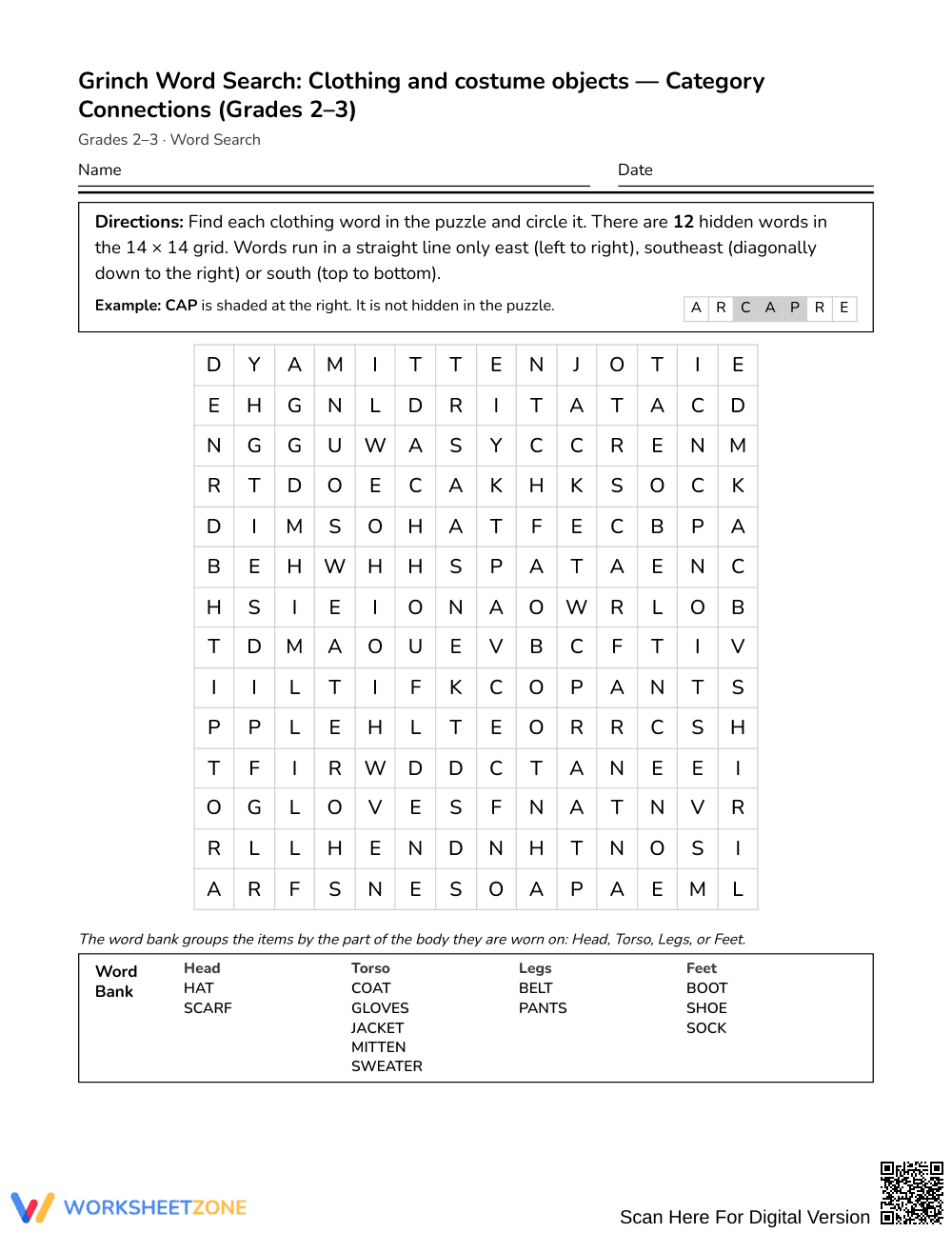
This Grades 2–3 vocabulary word search reinforces clothing and costume terms through targeted visual scanning. Students locate 12 thematic apparel words categorized by body placement, building orthographic recognition and semantic associations. The activity develops spelling awareness and conceptual grouping skills in an engaging, self-directed format.
At a Glance
- Grade: Grades 2–3 · Subject: English Language Arts
- Standard: Not standards-assessed — vocabulary enrichment
- Skill Focus: Clothing and costume objects
- Format: 1 page · 12 words · Answer key included · PDF
- Best For: Morning work and early finishers
- Time: 15–20 minutes
The single-page printable features a clear 14 by 14 letter grid with 12 hidden vocabulary targets. Words are organized into an intuitive category-based word bank dividing garments across four body zones: Head, Torso, Legs, and Feet. A comprehensive 3-page answer key provides visual letter highlighting for rapid verification.
The puzzle utilizes a 14 by 14 letter grid designed specifically for developing readers. Target words are hidden in three natural reading orientations: horizontally east, diagonally southeast, and vertically south. This directional constraint prevents backwards decoding confusion while preserving an appropriate search challenge. Students reference four distinct anatomical categories in the word bank to connect vocabulary items directly to their physical placement on the human body.
This activity provides supplemental vocabulary enrichment and is not aligned to a specific academic standard. It supports fundamental language acquisition by connecting concrete nouns with functional semantic categories during independent English Language Arts practice.
Deploy this word search during independent literacy centers or as a calming morning entry task after direct vocabulary instruction. Teachers can also assign the puzzle to early finishers needing meaningful quiet practice. During the activity, circulate to observe letter-tracking strategies and encourage students to pronounce each completed term aloud. Students typically complete the 12-word search within 15 to 20 minutes.
This activity is designed for second and third graders expanding foundational descriptive vocabulary, including multilingual learners building everyday English nouns. For extra scaffolding, partner emerging readers or invite students to highlight words in specific category colors. The printable pairs naturally with thematic picture books or a shared anchor chart categorizing seasonal attire.
Visual word-search activities support foundational literacy by strengthening orthographic mapping and letter-cluster recognition. According to Fisher & Frey (2014), intentional exposure to domain-specific nouns within structured semantic categories reinforces vocabulary retention and conceptual understanding during independent student practice. When developing readers scan text arrays to identify terms such as coat, scarf, and boots, they practice phonemic recall and left-to-right visual tracking essential for fluent decoding. Categorizing clothing vocabulary by body placement grounds abstract spelling sequences in familiar real-world schema, aiding multilingual learners and developing readers across Grades 2–3. While this supplementary worksheet serves as an ungraded enrichment resource rather than a standards-assessed measure, systematic word study routines foster print confidence and sustain task persistence. Educators can reliably integrate this single-page puzzle into balanced literacy rotations to consolidate spelling patterns and thematic language connections.


