



























Printable Climate Records Word Search | Grades 6–7 Science
Paste this activity's link or code into your existing LMS (Google Classroom, Canvas, Teams, Schoology, Moodle, etc.).
Students can open and work on the activity right away, with no student login required.
You'll still be able to track student progress and results from your teacher account.
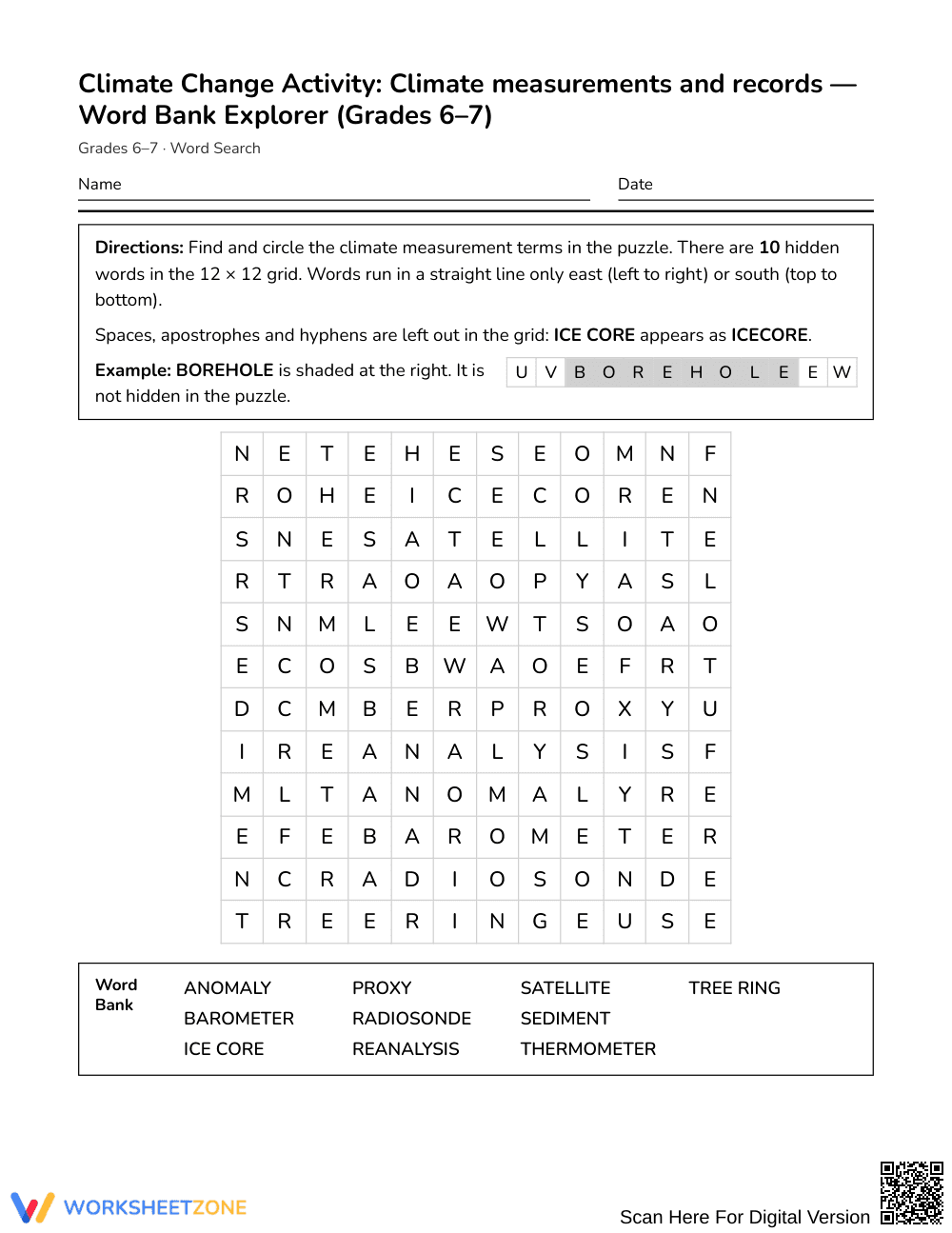
This Grades 6–7 science word search reinforces knowledge of climate measurements and records by familiarizing students with essential scientific vocabulary. Learners identify 10 key atmospheric and paleoclimatic terms, building recognition of tools and evidence used to track global climate patterns across historical and geological timescales.
At a Glance
- Grade: Grades 6–7 · Subject: Science
- Standard: Not standards-assessed — vocabulary enrichment
- Skill Focus: Core terms for climate measurements and historical records
- Format: 1 student page · 10 hidden vocabulary words · 3-page answer key included · Printable PDF download
- Best For: Middle school climate science unit vocabulary review
- Time: 15–25 instructional minutes
What's Inside
This single-page science activity features a 10-word puzzle alongside a complete three-page answer key. Students locate target climate terms in a letter grid using an alphabetical word bank. The answer key provides visual grid solutions with full definitions for every term, ensuring quick verification.
How the Puzzle Works
The activity features a 12 by 12 letter grid with 10 hidden terms running in only two directions: horizontally from left to right (east) and vertically from top to bottom (south). Because words do not appear backwards or diagonally, students can systematically search the grid using the alphabetical word bank containing terms such as barometer, radiosonde, and ice core.
Standards Alignment
This activity provides vocabulary enrichment and is not aligned to a formal performance standard. Rather than assessing analytical mastery, it strengthens recognition of specialized terminology regarding Earth's climate record and weather tools. Teachers can integrate it flexibly across Earth science units without recording standard-specific assessment data.
How to Use It
Use this word search as an introductory warm-up before direct instruction on climate monitoring to spark curiosity about proxy records and instrumentation. Alternatively, assign it after instruction as a review station. Observe which terms prompt student hesitation—confusion with words like anomaly or reanalysis reveals concepts needing reinforcement. Students typically finish in 15 to 25 minutes.
Who It's For
This resource is built for Grades 6–7 science students studying climate systems, weather instruments, and geological records. For learners needing support, have peer partners highlight initial word letters together. Pair this activity with an introductory reading passage on paleoclimatology proxies or an anchor chart displaying atmospheric instruments.
Serving as non-assessed vocabulary enrichment for middle school science, this word search reinforces 10 essential terms related to climate measurements and records. Students in Grades 6–7 develop orthographic familiarity with key vocabulary spanning paleoclimatology proxies, atmospheric sensors, and temperature indicators, including ice core, radiosonde, sediment, and barometer. Research by Fisher & Frey (2014) highlights that intentional, low-stakes exposure to domain-specific academic vocabulary supports conceptual retention and eases cognitive load during subsequent scientific reading and inquiry. By encountering specialized terms within an accessible 12 by 12 puzzle grid with unidirectional horizontal and vertical placements, learners build the lexical foundations necessary for analyzing historical climate records. The single-page format and complete three-page answer key enable efficient classroom integration for introductory lessons, review rotations, or independent study, ensuring students encounter scientific language in a structured, engaging, and supportive instructional context.


