


























Views
Downloads

Printable Classroom Job Application | Grade 3
Paste this activity's link or code into your existing LMS (Google Classroom, Canvas, Teams, Schoology, Moodle, etc.).
Students can open and work on the activity right away, with no student login required.
You'll still be able to track student progress and results from your teacher account.
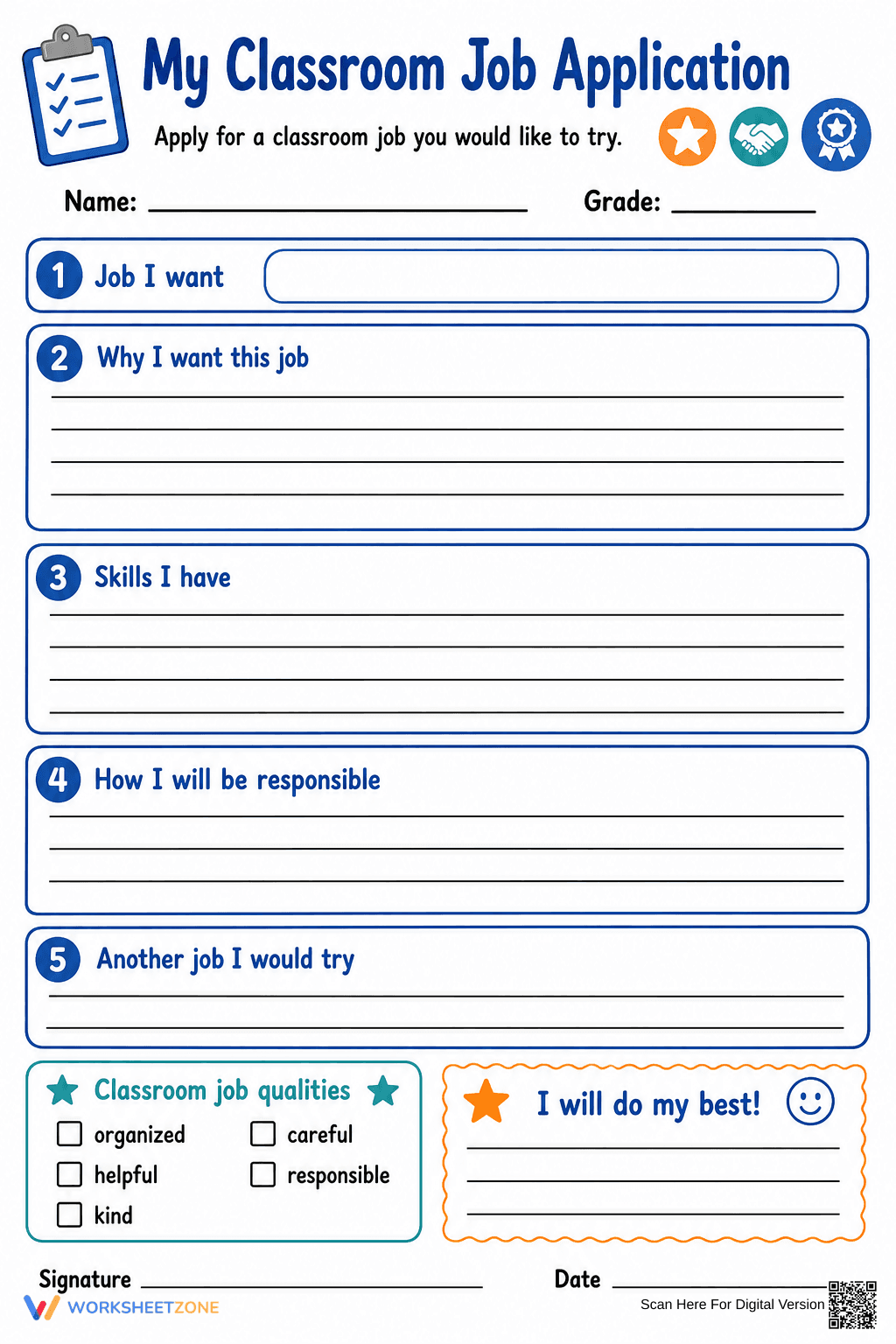
This Grade 3 classroom job application worksheet helps students practice persuasive writing while building a sense of classroom community and responsibility. By filling out specific fields about their skills and reasons for wanting a role, learners actively apply opinion writing techniques to a real-world scenario.
At a Glance
- Grade: 3 · Subject: ELA
- Standard:
CCSS.ELA-LITERACY.W.3.1— Write opinion pieces supporting a point of view.- Skill Focus: Persuasive Writing
- Format: 1 page · 6 tasks · No answer key · PDF
- Best For: Back-to-school routines
- Time: 15–20 minutes
This single-page resource features five structured writing prompts and a qualities checklist designed to guide students through the application process. The layout includes dedicated spaces for students to state their desired job, explain their reasoning, list relevant skills, and describe how they will demonstrate responsibility. A self-assessment checklist of positive traits and a formal signature line complete the professional feel of the document.
Zero-Prep Workflow
This worksheet is designed for immediate classroom implementation with minimal teacher setup:
- Print (1 minute): Simply print the PDF. The clean design ensures clear copies for the entire class.
- Distribute (1 minute): Hand out the applications during your morning meeting or back-to-school orientation block.
- Review (3 minutes): Briefly explain the available classroom jobs and let students complete the form independently.
Total teacher prep time is under two minutes, making this an excellent activity for the first week of school or a reliable substitute teacher plan.
Standards Alignment
This resource aligns directly with CCSS.ELA-LITERACY.W.3.1: Write opinion pieces on topics or texts, supporting a point of view with reasons. By requiring students to justify why they want a specific job and how their skills make them a good fit, the activity provides practical application of standard opinion writing structures. Both standard codes can be copied directly into lesson plans, IEP goals, or district curriculum mapping tools.
How to Use It
Use this application during the first week of school to establish routines. It works perfectly as independent morning work before direct instruction. Alternatively, use it mid-year when rotating jobs to refresh responsibilities. As students work, use this as a formative assessment to observe how well learners articulate reasons and organize thoughts. Expected completion time is 15 to 20 minutes.
Who It's For
This worksheet is primarily designed for third-grade students, though it functions well for upper elementary learners up to sixth grade. For students needing extra support, teachers can provide a word bank of character traits or sentence frames to help them structure their reasoning. It pairs naturally with an anchor chart detailing the responsibilities of each classroom job, giving students concrete details to reference while writing.
Integrating real-world writing tasks like this classroom job application significantly boosts student engagement and skill retention. Aligned with CCSS.ELA-LITERACY.W.3.1, this activity requires students to write opinion pieces supporting a point of view, directly connecting academic standards to classroom community building. According to Fisher & Frey (2014), providing students with authentic, purpose-driven writing opportunities increases their motivation and helps them understand the practical value of clear communication. When learners articulate their skills and justify their job preferences, they practice essential persuasive techniques in a low-stakes, highly relevant context. This structured approach not only reinforces foundational writing mechanics but also fosters a sense of ownership and responsibility within the classroom environment. By blending social-emotional learning with rigorous academic standards, educators can create a more dynamic and responsive learning space.


