

































Printable Classifying Changes Worksheet | Grade 7 Science

Paste this activity's link or code into your existing LMS (Google Classroom, Canvas, Teams, Schoology, Moodle, etc.).
Students can open and work on the activity right away, with no student login required.
You'll still be able to track student progress and results from your teacher account.
This Grade 7 physical science worksheet trains middle school learners to classify physical and chemical changes using molecular composition and substance identity. Rather than relying on misleading surface rules like reversibility, students evaluate atomic rearrangements, analyze temperature shifts, and articulate precise scientific justifications across 12 rigorous problems.
At a Glance
- Grade: 7 · Subject: Science
- Standard: Analyze evidence to classify physical and chemical changes in matter
- Skill Focus: Classify Changes with Qualified Reasons
- Format: 5 pages · 12 problems · Answer key included · PDF
- Best For: Middle school physical science practice
- Time: 40–50 minutes
What's Inside: The 5-page printable resource opens with a foundational reference box detailing core principles, molecular benchmarks, and common misconceptions surrounding reversibility. Across three distinct sections, students analyze laboratory scenarios, interpret synthetic test data for iron-sulfur combinations, and solve multi-step chemical prompts. A thorough 3-page answer key provides complete qualitative explanations for every item.
Skill Progression
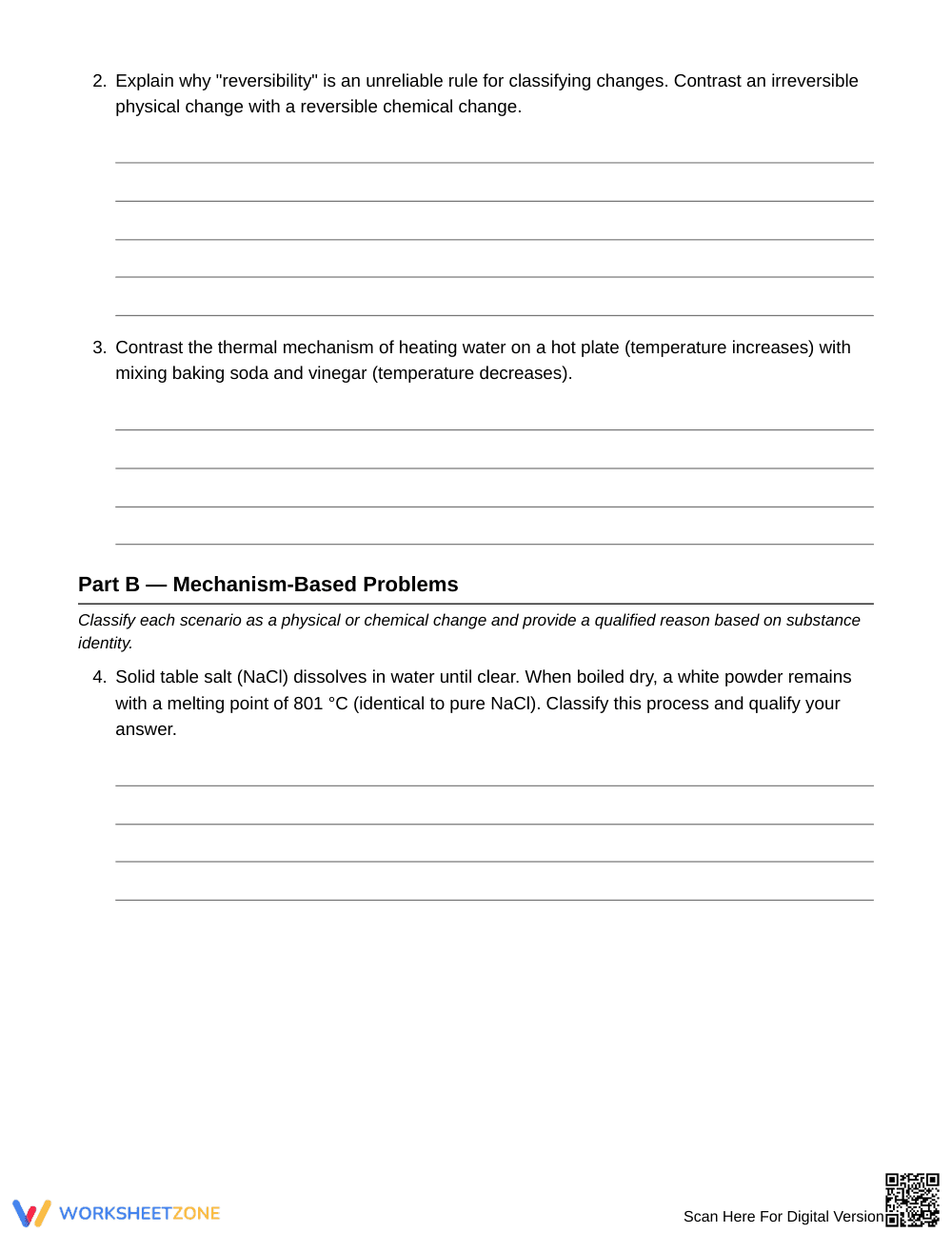
- Guided Practice (Part A, Problems 1–3): Students examine essential principles with high conceptual framing, refuting common misconceptions about boiling water, evaluating reversibility limits, and contrasting thermal mechanisms.
- Supported Practice (Part B, Problems 4–9): Learners classify real-world mechanisms using concrete data sets, evaluating dissolving salt, precipitation reactions, candle combustion, and oxidation.
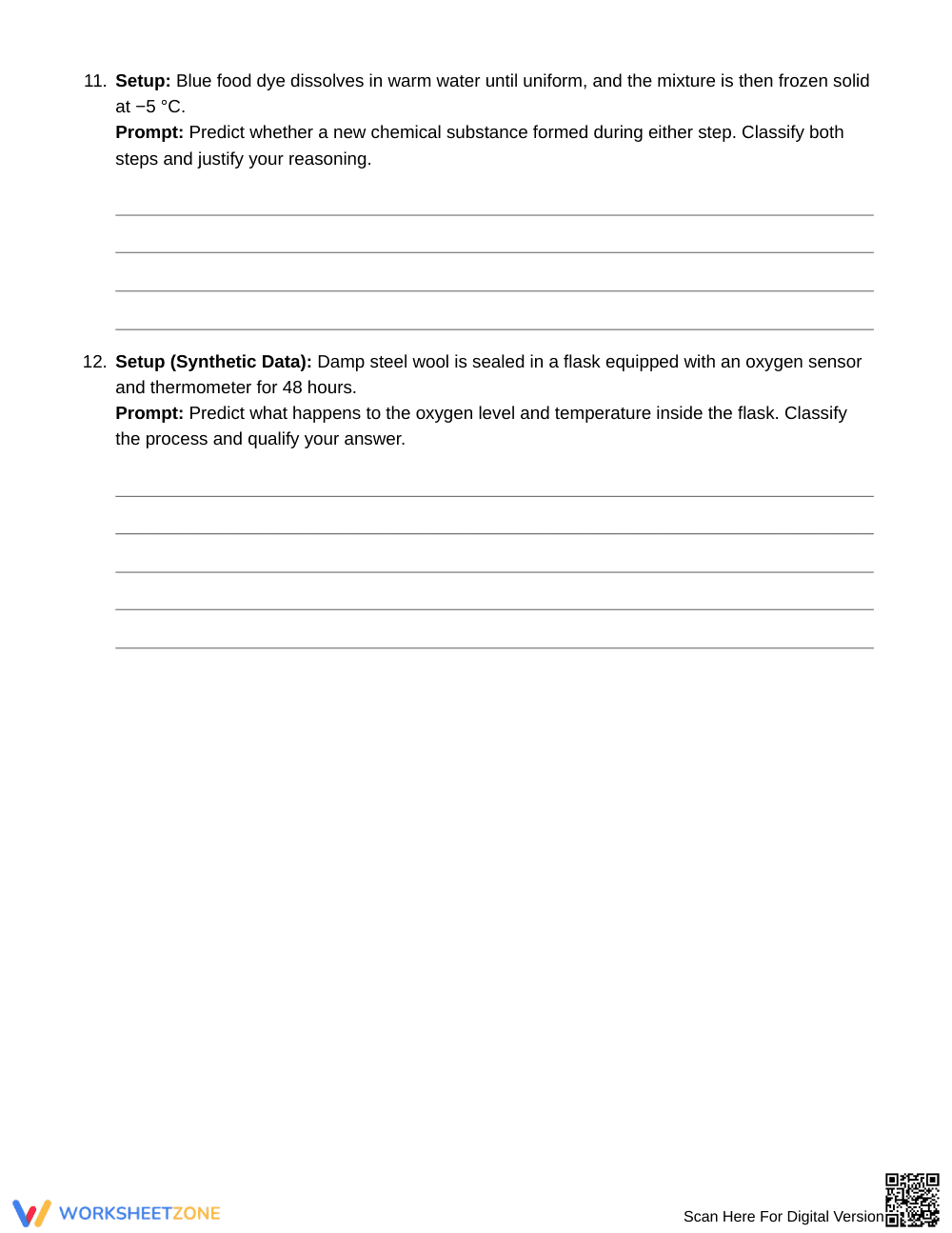
- Independent Practice (Part C, Problems 10–12): Students make predictions on unobserved chemical and physical setups, synthesizing property evidence to justify irreversible dissolution and enclosed oxidation reactions.
This structured progression follows the gradual-release framework, shifting cognitive responsibility from foundational concept checks to independent, evidence-backed evaluation.
Standards Alignment
This resource aligns directly with middle school physical science standards focused on matter and its interactions. Students develop models describing how atomic arrangements change or remain constant during observable interactions, distinguishing substances through characteristic properties such as density, melting point, and magnetic attraction. Both standard codes can be copied directly into lesson plans, IEP goals, or district curriculum mapping tools.
How to Use It
Deploy this worksheet after direct instruction on atomic theory and reaction indicators. In a collaborative partner activity, have students complete Part B together, pausing to discuss why gas production from boiling differs fundamentally from gas production in acid-base reactions. For formative assessment, inspect student responses to the iron-sulfur trial data to verify whether they recognize chemical synthesis versus mechanical mixture. The entire 12-item problem set takes approximately 40 to 50 minutes to complete.
Who It's For
This activity is designed for Grade 7 general science, physical science, and introductory chemistry classrooms. It provides critical scaffolded writing practice for emerging bilingual students and learners needing explicit sentence frames for scientific justifications. Pair this assignment with a hands-on physical and chemical changes lab station or an interactive molecular modeling kit.
According to Fisher & Frey (2014), structured guided practice that requires students to justify classifications using disciplinary evidence significantly deepens conceptual retention compared to binary identification tasks. When middle school students evaluate whether an interaction represents a physical or chemical change, distinguishing between atomic rearrangement and state changes demands rigorous justification. This 5-page science resource delivers 12 multi-tiered tasks that transition learners from addressing widespread misconceptions—such as confusing boiling with chemical gas generation—to interpreting synthetic data tables and predicting reaction outcomes. By emphasizing substance identity, melting points, and magnetic responsiveness, the practice tasks ensure students build enduring scientific reasoning habits that align with secondary inquiry expectations.


