
































Printable Civics Word Search | Grades 10–12 Social Studies

Paste this activity's link or code into your existing LMS (Google Classroom, Canvas, Teams, Schoology, Moodle, etc.).
Students can open and work on the activity right away, with no student login required.
You'll still be able to track student progress and results from your teacher account.
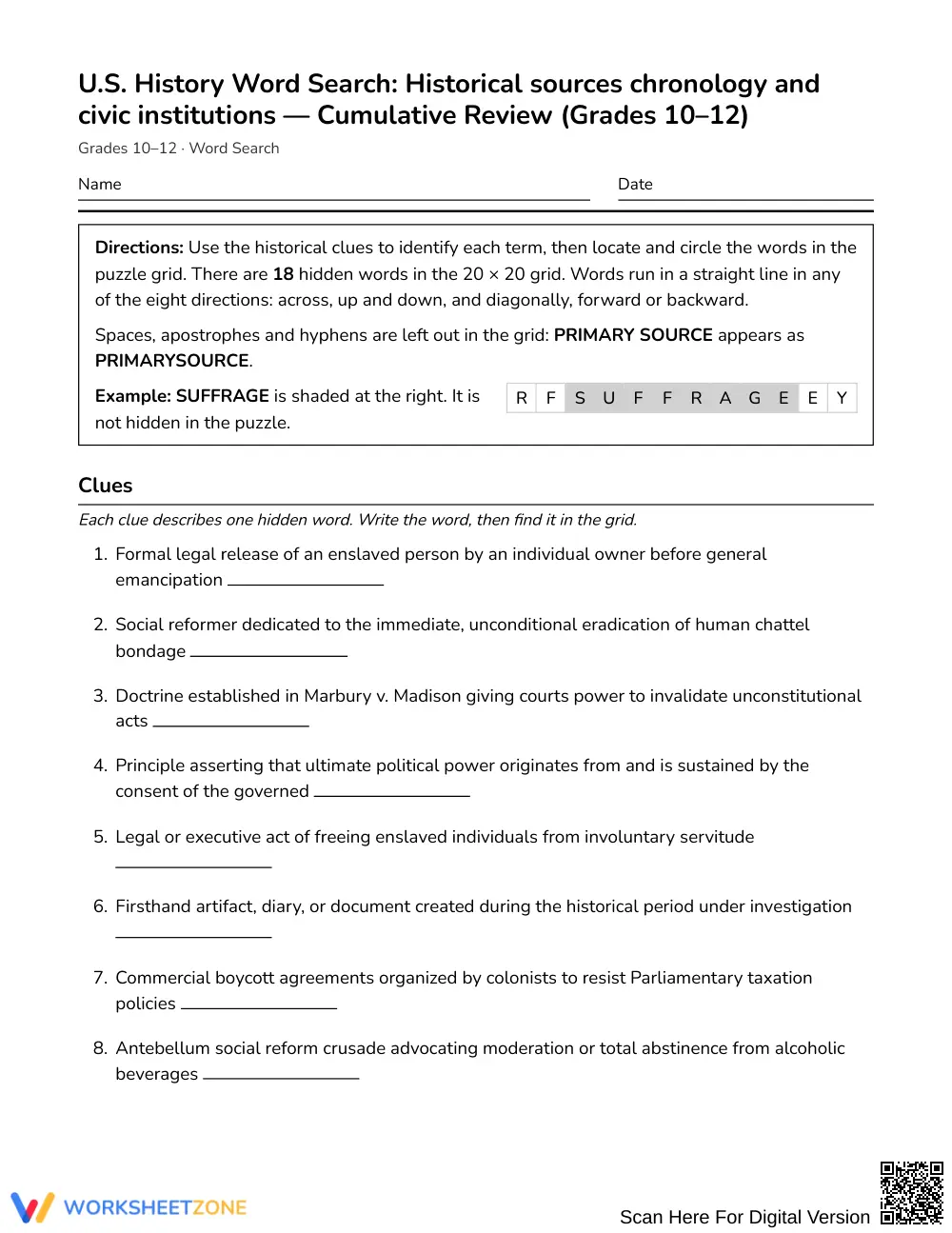
This U.S. history and civics word search reinforces foundational historical terminology through analytical retrieval. Designed for secondary social studies students, the activity challenges high schoolers to define 18 essential terms using historical clues before searching the puzzle grid. Students deepen their mastery of founding principles, constitutional structures, and historical methodology while engaging in focused vocabulary review.
At a Glance
- Grade: Grades 10–12 · Subject: Social Studies
- Standard: Not standards-assessed — targeted vocabulary enrichment and conceptual reinforcement
- Skill Focus: Historical sources chronology, constitutional structures, and civic institutions
- Format: 3 pages · 18 hidden terms · Full answer key included · PDF
- Best For: Cumulative unit review, emergency sub plans, or vocabulary warm-ups
- Time: 25–35 minutes of engaged learning
What's Inside
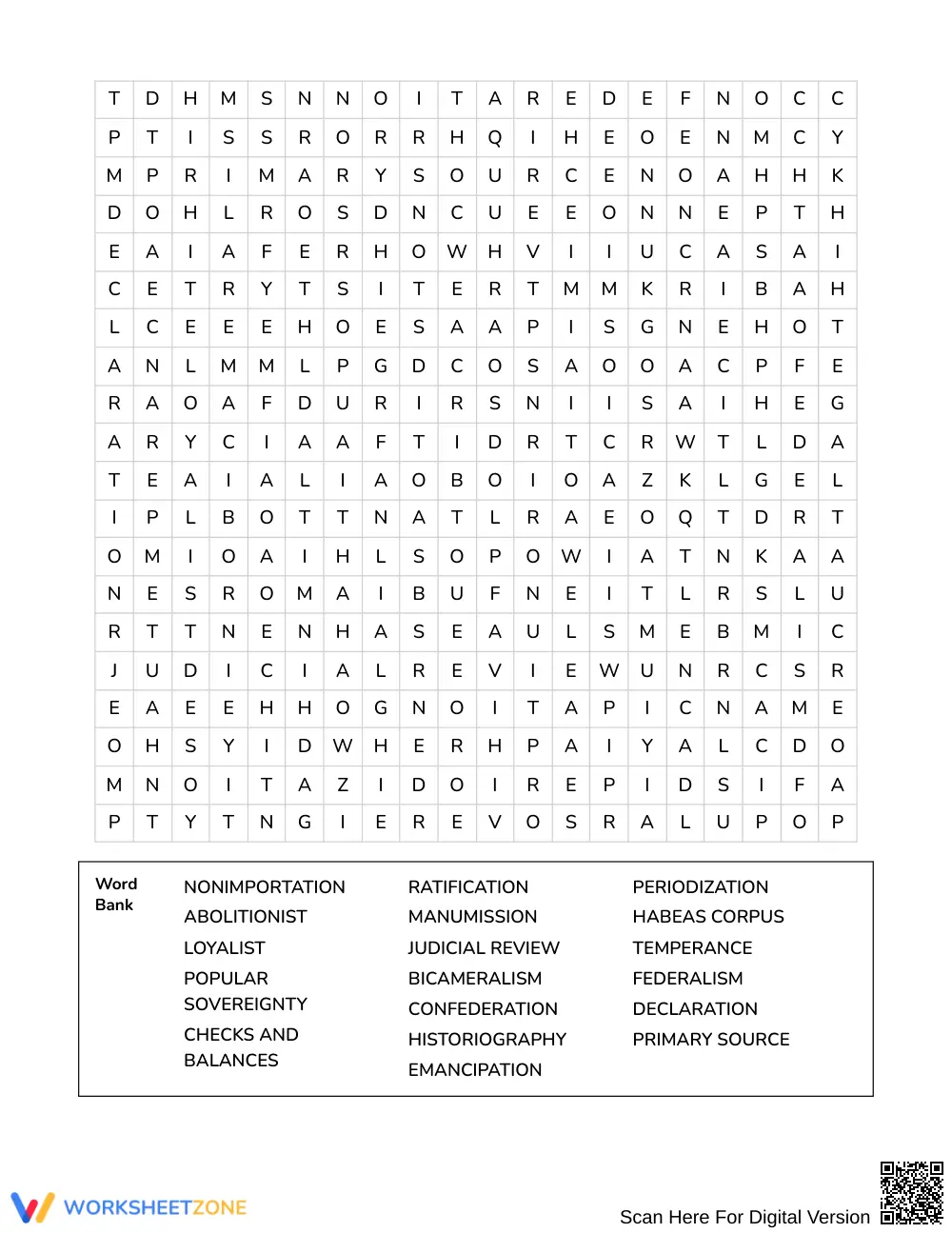
This 3-page printable activity packet centers on a clue-driven vocabulary challenge. Rather than relying on a passive word list, the puzzle provides 18 rigorous, text-based clues covering historiography, constitutional checks, civil liberties, and early American political structures. Students read each definition, deduce the correct historical term, and verify their findings against the included term bank. A complete 4-page answer key provides clear grid solutions for quick verification.
Puzzle Mechanics and Structure
This word search uses an expansive 20-by-20 letter grid designed to engage upper high school learners. The 18 terms are concealed in all 8 compass directions: North, Northeast, East, Southeast, South, Southwest, West, and Northwest, including forward, backward, and diagonal orientations. Because the word bank presents terms in shuffled order alongside scholarly historical clues, learners must synthesize conceptual definitions before locating each term within the dense letter array.
Standards Alignment
This resource serves as targeted vocabulary enrichment and is not aligned to an individual state or national content standard. It reinforces essential academic vocabulary spanning social studies literacy, historical analysis, and civics education across Grades 10–12 curricula.
How to Use It
Deploy this puzzle as an introductory anticipatory set before launching a cumulative civics review, or assign it as an independent post-lecture consolidation task following lessons on constitutional foundations. During the activity, circulate to monitor whether students can identify vocabulary from clues alone before looking at the shuffled bank. The puzzle typically requires 25 to 35 minutes to complete.
Who It's For
This resource is crafted specifically for high school students in Grades 10–12 enrolled in U.S. History, Civics, or Advanced Placement Government courses. For students requiring additional scaffolding, pair the activity with a unit glossary or reference textbook. It integrates naturally alongside primary source document packets or constitutional analysis units.
Academic vocabulary acquisition is an essential driver of historical literacy and conceptual comprehension in upper secondary social studies. While this word search is not standards-assessed and focuses on vocabulary enrichment, it directly reinforces 18 core concepts related to historical sources chronology and civic institutions. Educational research by Fisher & Frey (2014) emphasizes that intentional vocabulary instruction combined with retrieval practice significantly strengthens domain-specific reading comprehension and content retention in secondary learners. By requiring students to read complex historical clues, infer corresponding terminology, and visually locate terms across an eight-directional 20-by-20 grid, this activity moves beyond rote recognition into active cognitive retrieval. High school students in Grades 10–12 solidify their working knowledge of constitutional checks, federalism, and historiographical methods, providing a reliable foundation for text-based historical inquiry, essay composition, and advanced civic discourse across diverse classroom settings.


