































Printable By 11s: Multi-Step Math Problems

Paste this activity's link or code into your existing LMS (Google Classroom, Canvas, Teams, Schoology, Moodle, etc.).
Students can open and work on the activity right away, with no student login required.
You'll still be able to track student progress and results from your teacher account.
This Grade 3 math worksheet equips learners to solve multi-step word problems involving multiplication facts of 11. Students build computational confidence by connecting number-line skip counting, visual arrays, and two-step scenarios, transitioning smoothly from basic fact recall to interpreting complex word problems.
At a Glance
- Grade: 3 · Subject: Math
- Standard:
3.OA.D.8— Solve two-step word problems using the four operations and assess answer reasonableness- Skill Focus: Multi-step problems combining ×11 facts with prerequisite knowledge
- Format: 3 pages · 21 problems · Answer key included · PDF
- Best For: Independent practice and small-group targeted intervention
- Time: 30–45 minutes
What's Inside
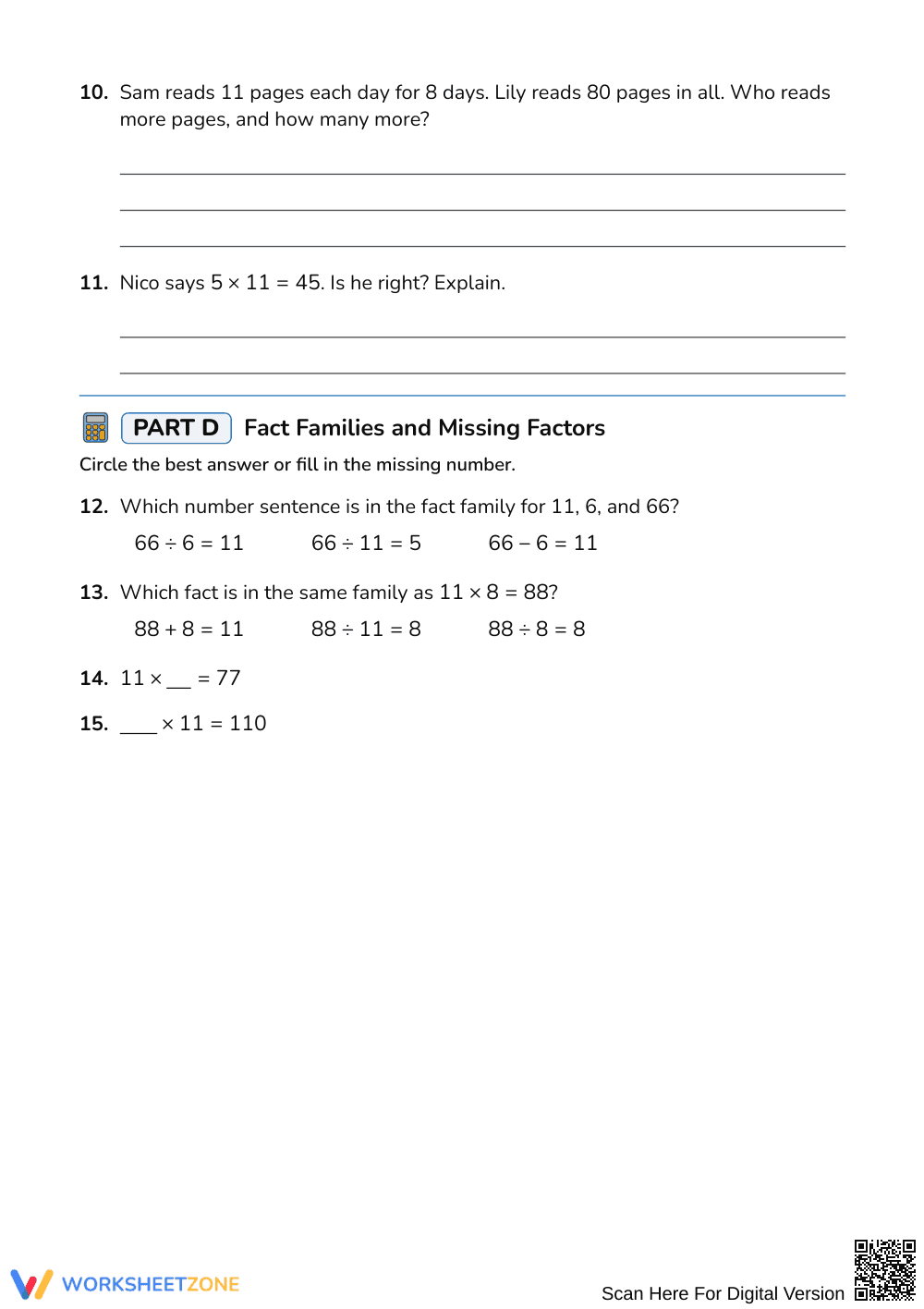
Across 3 pages, students tackle 21 math exercises supported by visual arrays and number lines. The resource includes skip-counting warm-ups, an array model showing distributive reasoning, seven multi-step word problems, and fact-family tasks. A 3-page answer key provides complete worked solutions for immediate checking.
Skill Progression
- Guided practice (Parts A & B, 7 tasks): High scaffolding using a skip-counting number line and visual dot array connects repeated addition to multiplication.
- Supported practice (Part C, 7 tasks): Moderate scaffolding prompts students to multiply first before applying addition or subtraction to solve multi-step word problems.
- Independent practice (Part D, 7 tasks): Minimal scaffolding challenges learners to identify related fact families and find missing factors without visual models.
This sequence follows the gradual-release I Do, We Do, You Do model to secure student mastery.
Standards Alignment
Primary alignment is `3.OA.D.8`: Solve two-step word problems using the four operations and assess answer reasonableness. Supporting standard `3.OA.B.5` applies properties of operations as strategies to multiply. Both standard codes can be copied directly into lesson plans, IEP goals, or district curriculum mapping tools.
How to Use It
Use this worksheet during guided practice or as an independent activity following direct instruction on two-step word problems. For formative assessment, observe whether students identify the initial multiplication step in Part C before calculating the remaining operation. Expect completion within 30 to 45 minutes.
Who It's For
Designed for Grade 3 general education students developing multi-step problem proficiency and Grade 4 learners needing targeted review. Visual dot arrays support English learners and students with IEP accommodations. Pair this resource with a two-step problem anchor chart.
Mastering multi-step word problems under standard 3.OA.D.8 requires Grade 3 students to coordinate multiplication facts of 11 with prerequisite addition and subtraction skills. According to findings from Fisher & Frey (2014) on effective instructional scaffolding, guiding learners through structured visual models before expecting independent problem solving significantly improves operational transfer and procedural fluency. This 21-task curriculum resource operationalizes that evidence by pairing concrete dot arrays with contextual word problems, enabling students to deconstruct complex multi-step narratives into distinct mathematical stages. By linking number-line skip counting directly to two-step equations, the worksheet reinforces conceptual grounding while reducing cognitive load during intermediate calculation steps. Elementary educators can cite this aligned 3-page instructional document to substantiate curriculum pacing and demonstrate standards-based intervention fidelity during district audits, progress monitoring meetings, and collaborative grade-level professional learning community data reviews.


