































Printable Bridge Forces Word Search | Grade 6 Science

Paste this activity's link or code into your existing LMS (Google Classroom, Canvas, Teams, Schoology, Moodle, etc.).
Students can open and work on the activity right away, with no student login required.
You'll still be able to track student progress and results from your teacher account.
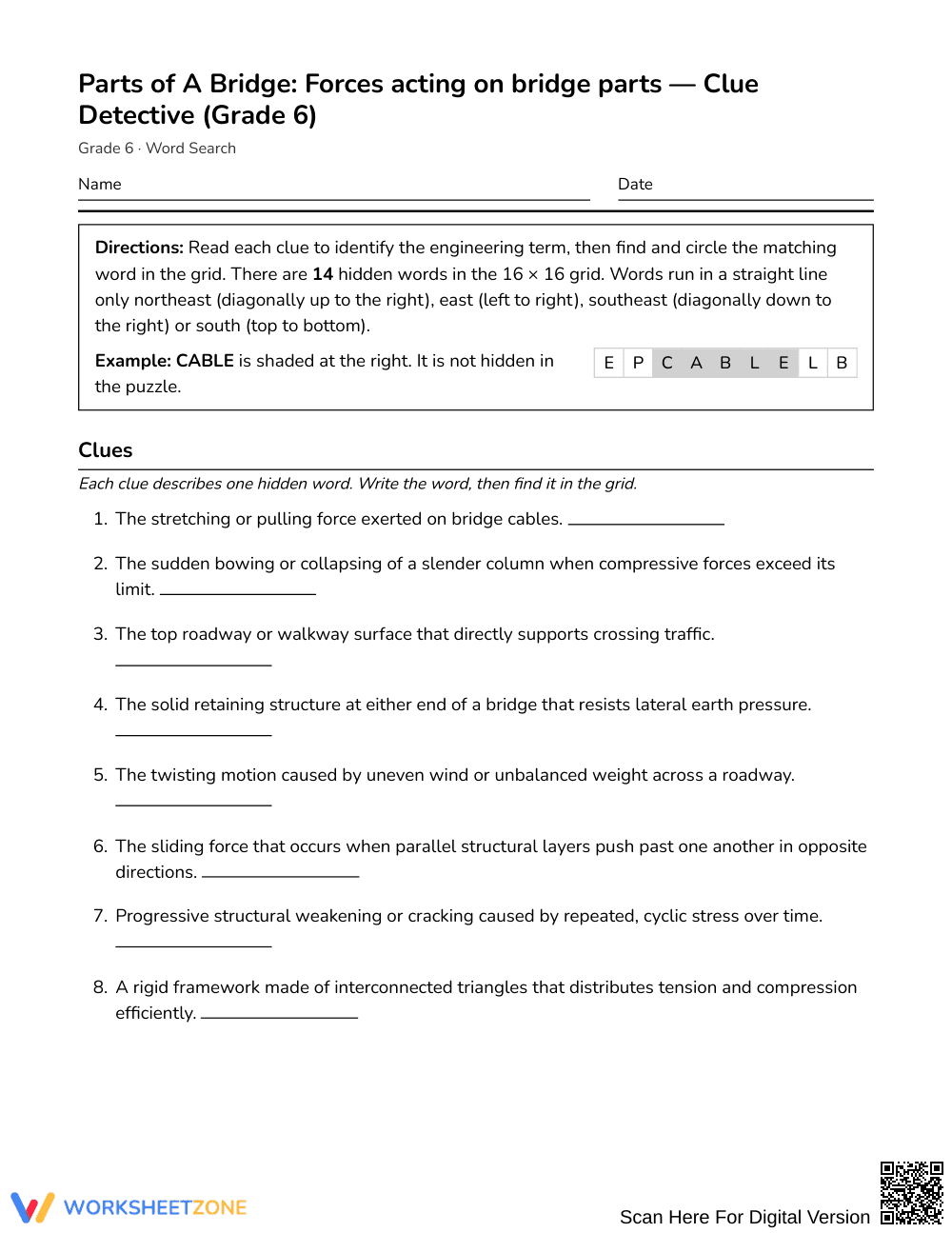
Build foundational physical science and engineering literacy with this clue-driven vocabulary activity. Designed for middle school learners, this resource challenges students to match engineering definitions with key terms before locating all 14 target words within the grid. Students solidify their comprehension of structural forces such as tension, compression, and shear while actively engaging in purposeful vocabulary review.
At a Glance
- Grade: Grade 6 · Subject: Science
- Standard: Not standards-assessed — vocabulary enrichment
- Skill Focus: Forces acting on bridge parts
- Format: 3 pages · 14 words · Answer key included · PDF
- Best For: Science vocabulary review and sub plans
- Time: 20–30 minutes
What's Inside
This 3-page printable science activity provides a complete vocabulary detective experience. Page 1 presents the puzzle layout featuring a full set of 14 clue definitions alongside a shuffled word bank. Students read each clue to determine the corresponding engineering term before searching the puzzle. The remaining pages contain a clear, full-size answer key overlay displaying exact word placements and coordinates for rapid grading or student self-checking.
Puzzle Mechanics
This activity is structured to reinforce scientific terminology through systematic visual search:
- Grid Layout: The puzzle is arranged on a dense 16 x 16 letter grid containing 14 hidden structural engineering terms.
- Word Placements: Target vocabulary words run in four distinct directional paths: northeast, east, southeast, and south.
- Clue Detective Format: Students cannot rely solely on simple letter matching; they read structural engineering definitions to identify each term from the shuffled word bank before searching the grid.
Standards Alignment
This activity provides targeted vocabulary enrichment and is not aligned to a specific state or national standard. It supports physical science and STEM coursework by reinforcing technical vocabulary related to structural loads, material stress, and civil engineering concepts.
How to Use It
Introduce this word search as an engaging introductory warm-up at the launch of a structural engineering unit, or assign it immediately following direct instruction on bridge designs to consolidate new terms. During work time, circulate to observe whether students use the clue definitions to verify terms or simply search letter strings from the word bank. The expected completion window is 20 to 30 minutes, making it suitable for independent practice or quick partner collaboration.
Who It's For
This puzzle is tailored for Grade 6 science classes studying forces, structures, or physical science principles. For English learners or developing readers, teachers can highlight initial root words or provide illustrated bridge diagrams. Pair this activity with a hands-on toothpick bridge lab or a video demonstration of bridge resonance and aerodynamic flutter.
Domain-specific vocabulary knowledge directly influences reading comprehension in middle school science curricula. According to Fisher & Frey (2014), intentional exposure to disciplinary terminology through structured, text-dependent tasks strengthens long-term concept retention and academic discourse. This Grade 6 vocabulary activity reinforces forces acting on bridge parts by requiring learners to connect descriptive definitions to 14 technical terms, including tension, compression, resonance, and torsion. Rather than presenting passive rote memorization, the clue-driven puzzle design encourages active retrieval before visual scanning on a 16 x 16 grid. Clear word-tracking across northeast, east, southeast, and south orientations builds visual persistence and orthographic memory. Supported by an explicit answer key, this resource gives educators a reliable tool for reinforcing physical science concepts during introductory engineering units, post-assessment extensions, or independent learning periods.


