




























Views
Downloads
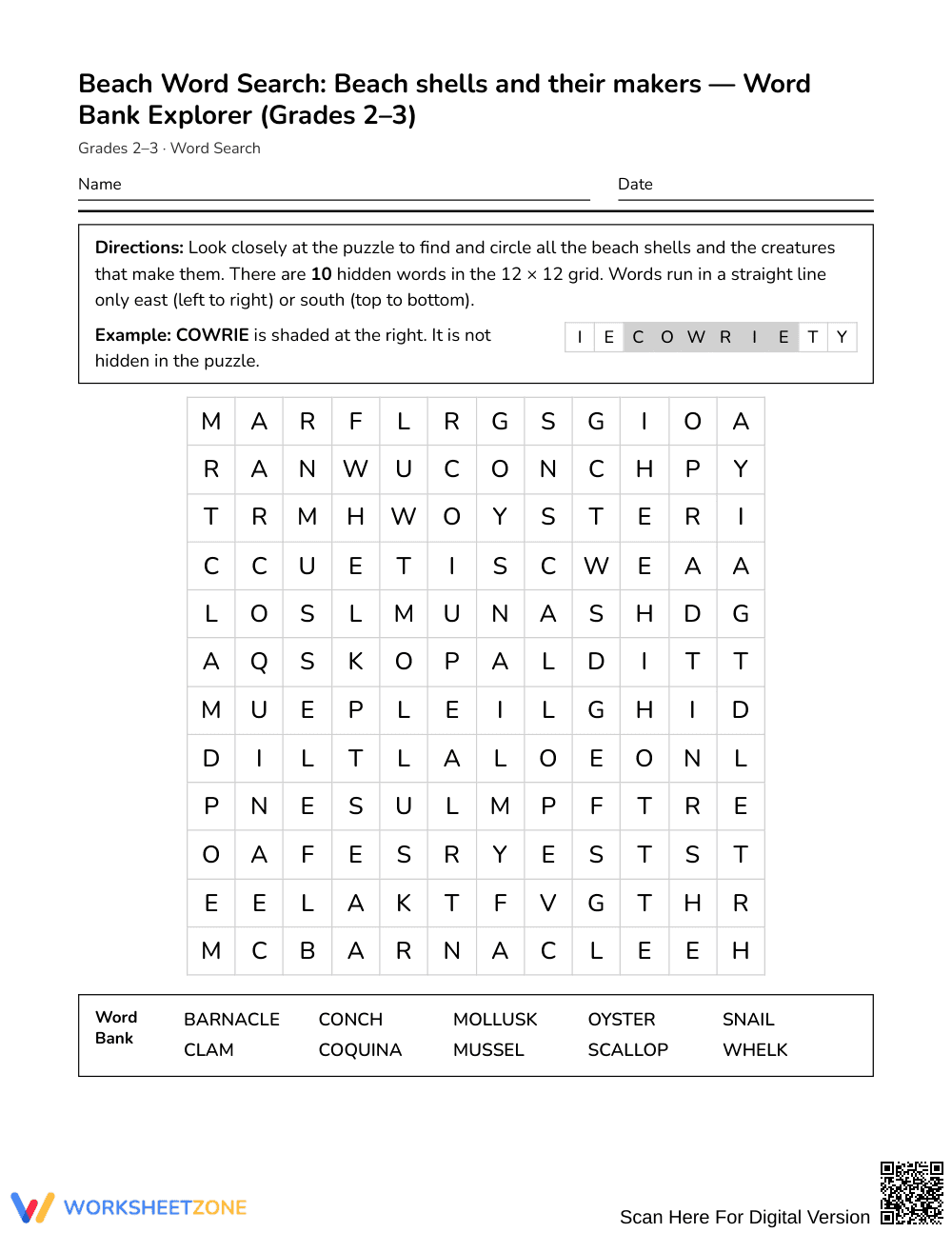

Printable Beach Shells Word Search | Grades 2–3 Science

Paste this activity's link or code into your existing LMS (Google Classroom, Canvas, Teams, Schoology, Moodle, etc.).
Students can open and work on the activity right away, with no student login required.
You'll still be able to track student progress and results from your teacher account.
This Grades 2–3 science word search introduces young learners to marine mollusks and ocean organisms. Students search for ten key marine science terms while building recognition of coastal creatures and their protective shells. It offers an engaging, low-stress format that reinforces foundational animal classification terminology in elementary science classrooms.
At a Glance
- Grade: Grades 2–3 · Subject: Science
- Standard: Not standards-assessed — vocabulary enrichment
- Skill Focus: Beach shells and their makers
- Format: 1 page · 10 words · Answer key included · PDF
- Best For: Science centers, morning work, or sub plans
- Time: 15–20 minutes
What's Inside
The activity sheet features a 12-by-12 letter grid containing ten target science vocabulary terms arranged alongside an alphabetical word bank. Hidden vocabulary words represent coastal invertebrates and shell types, including conch, scallop, oyster, and mollusk. A complete 3-page answer key provides clear visual overlays displaying exact word coordinates for rapid checking.
Zero-Prep Classroom Workflow
Designed for immediate classroom implementation, this puzzle requires under two minutes of teacher preparation:
- Print (1 minute): Send the single student page to your printer or copy machine with no collation or cutting required.
- Distribute (30 seconds): Hand out the puzzle alongside highlighters or pencils during science rotations or morning arrivals.
- Review (30 seconds): Use the clear solution sheet to check student completions instantly or display it for self-correction.
The self-contained layout makes it an ideal option for emergency substitute teacher folders and rainy-day science blocks.
Standards Alignment
This activity serves strictly as supplementary vocabulary enrichment and is not aligned to a specific state or national standard. It supports cross-curricular literacy in elementary life science by exposing students to domain-specific terminology connected to ocean habitats and animal structures.
How to Use It
Deploy this word search during an ocean unit immediately following direct instruction on marine habitats. As a formative check, observe whether students recognize that terms like clam, oyster, and mussel belong to the mollusk group. Alternatively, use it as a calm independent task during morning transitions. Most students finish within 15 to 20 minutes.
Who It's For
This resource serves general education students in Grades 2–3 exploring animal classification and coastal ecosystems. Visual searchers benefit from tracking letters that run only east (left to right) and south (top to bottom). Pair this puzzle with an illustrated non-fiction read-aloud about tide pools or an anchor chart displaying mollusk shells.
Integrating structured science vocabulary into elementary classrooms reinforces essential domain knowledge and word consciousness. According to Fisher & Frey (2014), intentional exposure to disciplinary vocabulary through multiple low-stakes modalities strengthens reading comprehension across informational texts. This single-page word search highlights ten marine biology terms—including mollusk, barnacle, whelk, and coquina—within a 12-by-12 grid where words run strictly horizontally and vertically. By isolating word identification within an accessible, age-appropriate puzzle format, second- and third-grade learners connect orthographic patterns with coastal organisms. The activity functions as a targeted enrichment tool that supports animal classification units, aids spelling retention, and provides teachers with a zero-prep visual resource suited for independent learning stations or introductory science centers.


