


























Views
Downloads



Printable Atom Tracing Worksheet | Grade 9 Biology
Paste this activity's link or code into your existing LMS (Google Classroom, Canvas, Teams, Schoology, Moodle, etc.).
Students can open and work on the activity right away, with no student login required.
You'll still be able to track student progress and results from your teacher account.
This Grade 9 Biology worksheet teaches students to trace atoms through the simplified equations for photosynthesis and cellular respiration. Students count atoms, scale equations, and explain why matter cycles while energy flows. By the end, they can justify conservation of matter using evidence from equations and data.
At a Glance
- Grade: 9 · Subject: Biology
- Standard: Conservation of matter and energy flow in photosynthesis and respiration — students count atoms and explain cycling.
- Skill Focus: Trace atoms through simplified process equations
- Format: 5 pages · 10 problems · Answer key included · PDF
- Best For: Practice after teaching the two equations
- Time: 40–50 minutes
What's Inside
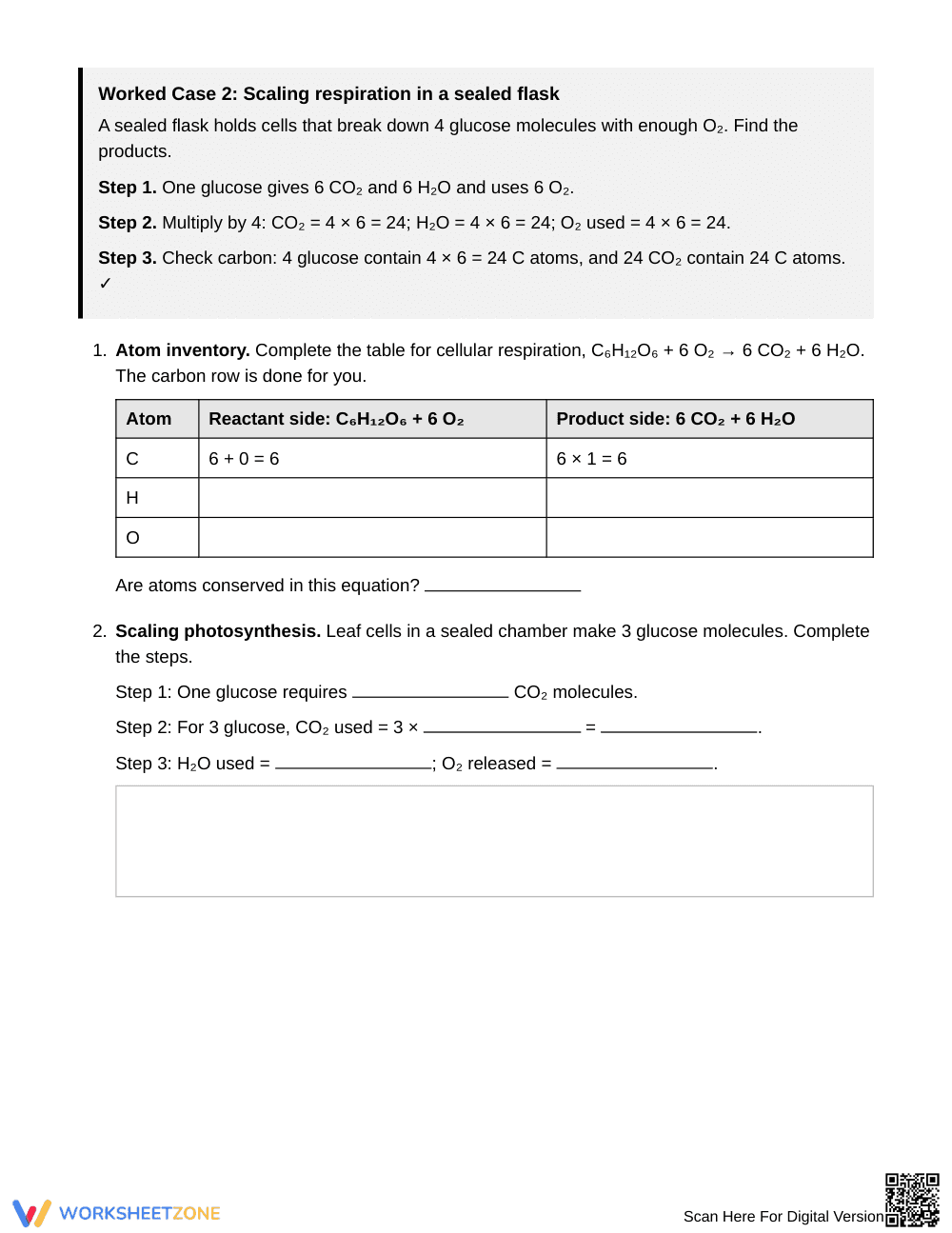
The 5-page packet opens with a reference box listing both simplified equations, the counting rules, and rounded molar masses. Part A offers two worked cases and three partly completed items. Part B has five independent problems: scaling, multiple choice, balancing, and a mass check. Part C has two written explanations, one using a data table. A 3-page answer key is included.
Skill Progression
- Guided practice (3 problems): two worked cases, then an atom-inventory table with the carbon row filled in, a fill-in scaling problem, and a stepwise carbon trace.
- Supported practice (5 problems): students apply the reference box to scaling, equation selection, balancing, and mass conservation.
- Independent practice (2 tasks): students write explanations, including a claim-evidence-reasoning response to sealed-jar data.
The sequence follows gradual release: I Do, We Do, You Do.
Standards Alignment
No standard code is attached to this worksheet. It targets the idea that atoms are rearranged, never created or destroyed, in photosynthesis and cellular respiration, and that matter cycles while energy flows. Add your state or district code when you paste this into lesson plans, IEP goals, or curriculum mapping tools.
How to Use It
- After direct instruction: assign Parts A and B as classwork once students have seen both equations.
- Unit review: use Part C as a written check before a quiz.
While students work, watch whether they multiply coefficients by subscripts before adding. Expect 40–50 minutes in total.
Who It's For
Built for Grade 9 Biology students in a first-year course. Students who need support can lean on the worked cases and reference box; confident students can start at Part B. Pair it with an anchor chart showing the two equations side by side.
Tracing Atoms Through Photosynthesis and Cellular Respiration is a Grade 9 Biology worksheet that asks students to count atoms in simplified equations, scale reactions for sealed systems, and explain why matter cycles while energy flows. It contains 10 tasks across 5 pages with a 3-page answer key. The sequence follows the gradual release of responsibility model described by Fisher & Frey (2014): worked cases and partly completed items come first, then independent calculations, then written claim-evidence-reasoning responses. Students use the equations 6 CO₂ + 6 H₂O → C₆H₁₂O₆ + 6 O₂ and its reverse, plus rounded molar masses, to show that atoms are conserved and that energy is transferred rather than recycled. Every experiment is synthetic, so students practice reasoning without needing lab equipment or outside data. The worksheet suits unit practice, review, or formative checks in a high school biology course on photosynthesis and cellular respiration.


