


























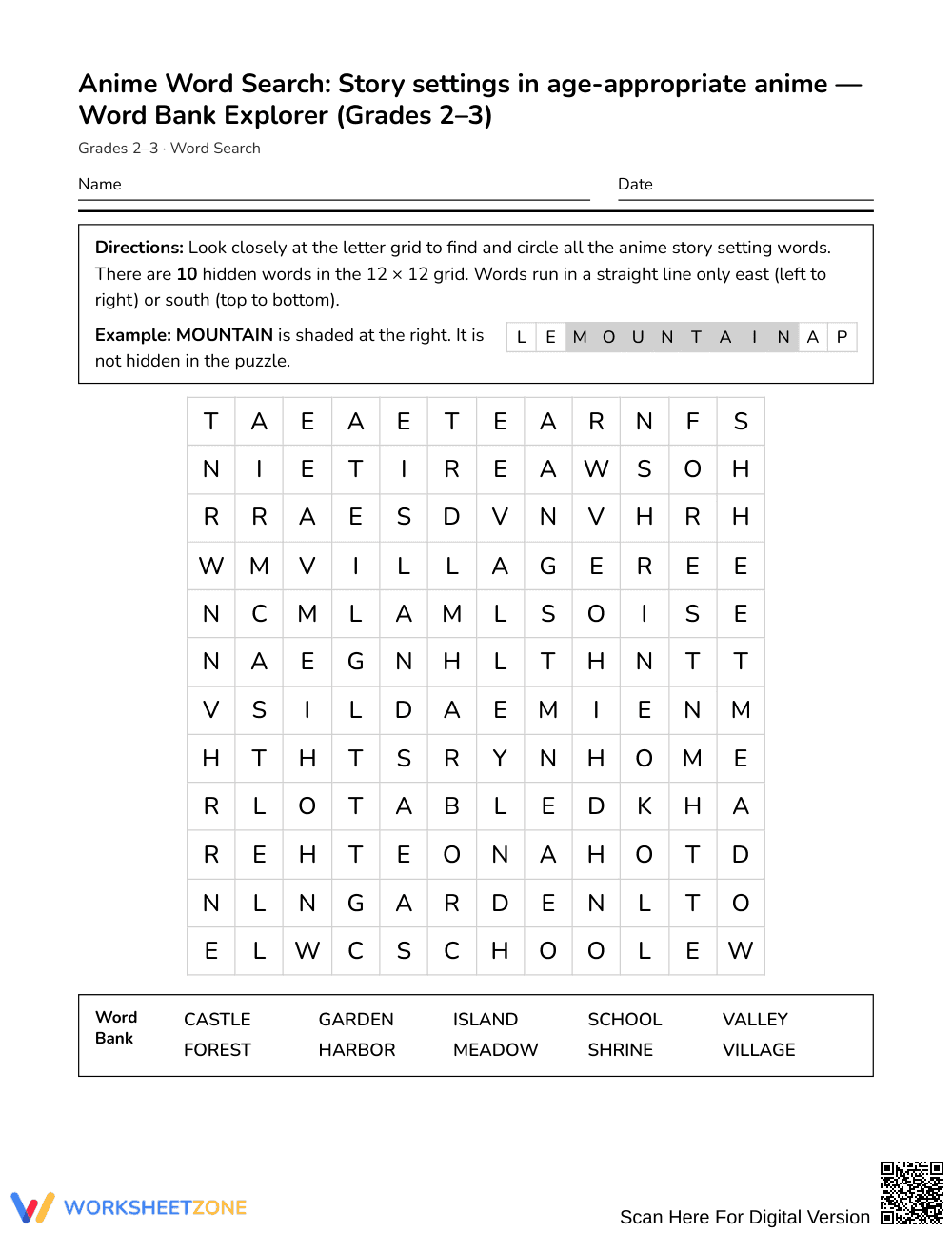

Printable Anime Story Settings Word Search | Grades 2–3 ELA
Paste this activity's link or code into your existing LMS (Google Classroom, Canvas, Teams, Schoology, Moodle, etc.).
Students can open and work on the activity right away, with no student login required.
You'll still be able to track student progress and results from your teacher account.
This Grades 2–3 English Language Arts word search builds narrative vocabulary by challenging learners to locate 10 words related to story settings in age-appropriate anime. Students strengthen letter-pattern recognition and setting comprehension as they identify key environments like castles, harbors, and shrines, reinforcing literary concepts in an engaging, self-directed visual puzzle format.
At a Glance
- Grade: Grades 2–3 · Subject: English Language Arts (ELA)
- Standard: Not standards-assessed — targeted vocabulary enrichment and narrative recognition
- Skill Focus: Identifying story settings in age-appropriate anime narratives
- Format: 1 student page · 10 words · 2-page answer key included · PDF
- Best For: Independent vocabulary practice, literacy centers, and morning work
- Time: 15–20 minutes
The activity features a clean 1-page puzzle containing 10 hidden words to find, accompanied by a comprehensive 2-page answer key that highlights letter positions clearly. The layout includes an alphabetical word bank displaying key setting nouns alongside child-friendly narrative clues that define each location. Clear, spacious lettering ensures accessibility for young readers working through the puzzle independently or in small literacy groups.
The puzzle features a 12 by 12 letter grid designed for early elementary learners. All 10 setting terms appear in only two orientations: horizontally from left to right (East) and vertically from top to bottom (South). This clean layout avoids backwards or diagonal text, helping students focus on visual discrimination as they locate words from the alphabetical bank and review corresponding setting clues.
This supplementary activity is designed for vocabulary enrichment and is not aligned to a specific academic standard. Instead of formal standards-based testing, the puzzle offers focused exposure to spatial and environmental vocabulary that supports descriptive writing and reading comprehension across elementary fiction units.
Use this activity following direct instruction on story elements to reinforce how authors build fictional settings. Alternatively, place it in an independent literacy center during reading workshop. During work time, observe whether students scan row by row or search for specific consonant clusters to assess visual tracking habits. Students typically complete all 10 words in 15 to 20 minutes.
This word search is designed for students in Grades 2 and 3 practicing descriptive vocabulary and narrative comprehension. For students needing support, suggest highlighting the initial letter of each word in the bank before searching the grid. Pair this sheet with an anchor chart on story elements or a fiction read-aloud featuring diverse settings.
Vocabulary enrichment activities that combine orthographic search with contextual definitions strengthen early elementary reading development. According to research on gradual release of responsibility by Fisher & Frey (2014), purposeful word-level practice provides students with low-stakes opportunities to consolidate language acquisition after direct instruction. By locating 10 narrative setting terms across a 12 by 12 letter grid running horizontally and vertically, learners in Grades 2 and 3 reinforce spelling patterns, left-to-right visual tracking, and story setting concepts without cognitive overload. The integration of descriptive definitions alongside an organized alphabetical bank supports semantic mapping between abstract setting words and concrete imagery. While not tied to an individual assessed standard, targeted enrichment activities of this nature foster orthographic fluency and expand the expressive vocabulary necessary for fictional text comprehension, making them valuable resources for foundational literacy routines.


